
Current real estate market data, news and analysis for the Fort Wayne, IN metropolitan area — 466,258 residents across Allen, Wells and Whitley counties.
Data as of May 2026. Sources: Redfin Data Center, U.S. Census Bureau.
Latest Fort Wayne Real Estate News
Fort Wayne Real Estate Market Overview
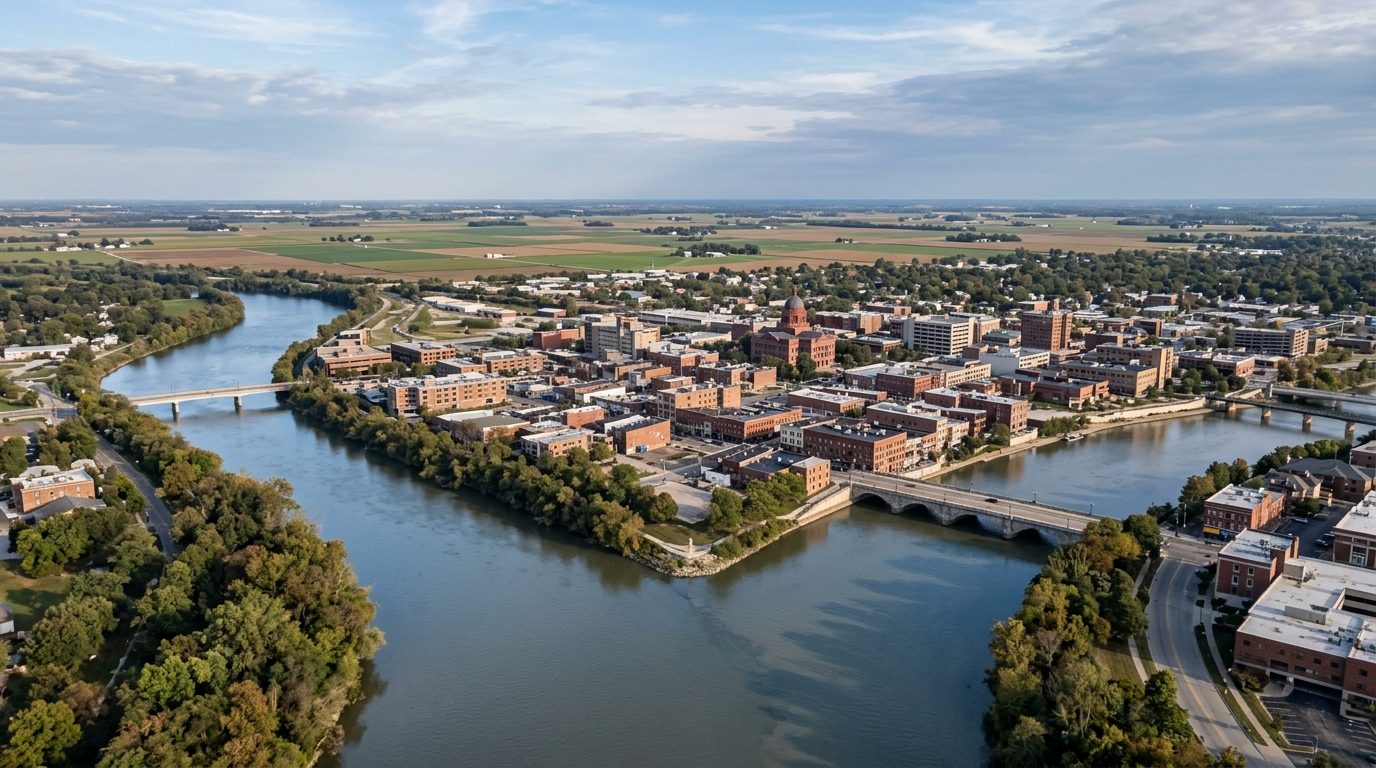
Fort Wayne sits in northeastern Indiana at the point where the St. Joseph and St. Marys rivers join to form the Maumee River, a confluence that shaped the city’s original street grid and still defines its downtown core. Beyond the city, Allen, Wells, and Whitley counties spread into flat to gently rolling farmland typical of the till plains left behind by glaciation, with small towns such as Grabill, Huntertown, Columbia City, and Bluffton anchoring the surrounding agricultural land. Housing stock reflects more than a century of continuous building: brick and frame homes from the late 1800s and early 1900s cluster near downtown and along the rivers, mid-century ranch and Cape Cod homes fill inner-ring neighborhoods built after World War II, and single-family subdivisions with larger lots extend into the newer suburban edges of the metro.
Within the metro, price tiers track distance from downtown, school district lines, and the age of construction. Southwest Fort Wayne’s Aboite Township, served by Southwest Allen County Schools and home to newer subdivisions such as Sycamore Hills and Copper Creek, and the growing northeast side near Parkview Health’s north campus tend to carry higher price points, reflecting newer construction and, in Aboite’s case, planned amenities like clubhouses and golf courses. The far northwest, around Huntertown and Carroll, served by Northwest Allen County Schools, has also drawn substantial new construction as the metro expands outward. Older urban neighborhoods closer to downtown, along with southeast Fort Wayne and small outlying towns such as Larwill, Poneto, and Zanesville, generally offer more modest and older housing stock at lower price points.
The regional economy rests on a mix of manufacturing, healthcare, defense, and financial services. General Motors operates a large truck assembly plant in the city, and automotive suppliers including Dana Incorporated and Michelin North America maintain a presence in the area. Defense and aerospace work is anchored by BAE Systems, which designs and builds electronic combat systems locally. Healthcare is one of the largest employment sectors, led by Parkview Health and Lutheran Health Network, both of which operate hospital systems across the metro. Fort Wayne is also headquarters to several nationally known companies, including Vera Bradley, Sweetwater Sound, Do It Best, Steel Dynamics, and Franklin Electric, along with financial and insurance firms such as Lincoln Financial Group, Brotherhood Mutual, and STAR Financial Bank.
Buyers should factor in a few regional realities. Fort Wayne lies within a part of the Midwest that experiences severe thunderstorms and occasional tornadoes, particularly in spring and early summer, along with cold winters that bring regular snow and ice, so homeowners insurance should be reviewed for wind, hail, and storm coverage. Indiana caps property tax bills as a share of assessed value, but rates and levies still vary by taxing district, so buyers should confirm actual bills with the county assessor rather than relying on a prior owner’s tax history. The metro is largely car-dependent, with a limited local bus system and commuting patterns built around an interstate loop and radiating state highways rather than rail transit. Growth is concentrated on the northeast, southwest, and northwest fringes of Fort Wayne, so buyers should independently verify school district boundaries, flood zone status near the rivers, and any homeowners association rules attached to newer subdivisions.
Cities and Towns in the Fort Wayne Metro Area
Notable Communities and Neighborhoods
Fort Wayne Real Estate Market FAQ
How is the Fort Wayne, IN metro area organized?
The metro spans Allen, Wells, and Whitley counties in northeastern Indiana, anchored by the city of Fort Wayne where the St. Joseph and St. Marys rivers meet to form the Maumee. Around the core city, smaller towns such as Huntertown, Grabill, Leo-Cedarville, and New Haven form growing suburban and exurban communities, while Columbia City and South Whitley serve Whitley County and Bluffton and Ossian anchor Wells County to the south. Much of the surrounding land outside these towns remains active farmland.
Which parts of the Fort Wayne area tend to be pricier, and why?
Southwest Fort Wayne’s Aboite Township and the far northeast and northwest suburban fringes, including newer growth areas near Huntertown, tend to command higher prices, largely because of newer construction, larger lots, and school district reputation. Older neighborhoods closer to downtown and smaller, more rural towns further from the city generally have older, more modest housing stock and lower price points.
What should buyers verify locally before purchasing a home in the Fort Wayne metro?
Buyers should confirm which school corporation a property falls in, since district lines do not always match town or neighborhood boundaries, and check flood zone status for properties near the St. Joseph, St. Marys, or Maumee rivers. In outlying towns, it is worth confirming whether a home relies on a private well or septic system versus municipal utilities, and any homeowners association rules should be reviewed for newer subdivisions. Actual property tax bills should be confirmed directly with the county assessor rather than assumed from a prior owner’s history.
What regional weather or environmental risks are relevant to homebuyers in Fort Wayne?
Fort Wayne is part of a Midwest region that experiences severe thunderstorms and occasional tornadoes, particularly in spring and early summer, along with cold winters that bring regular snow and ice accumulation. Homeowners should review insurance coverage for wind and hail damage and understand local building codes and any storm shelter or basement features of a property, since not all homes in the area include below-grade shelter space.
Nearby Markets