
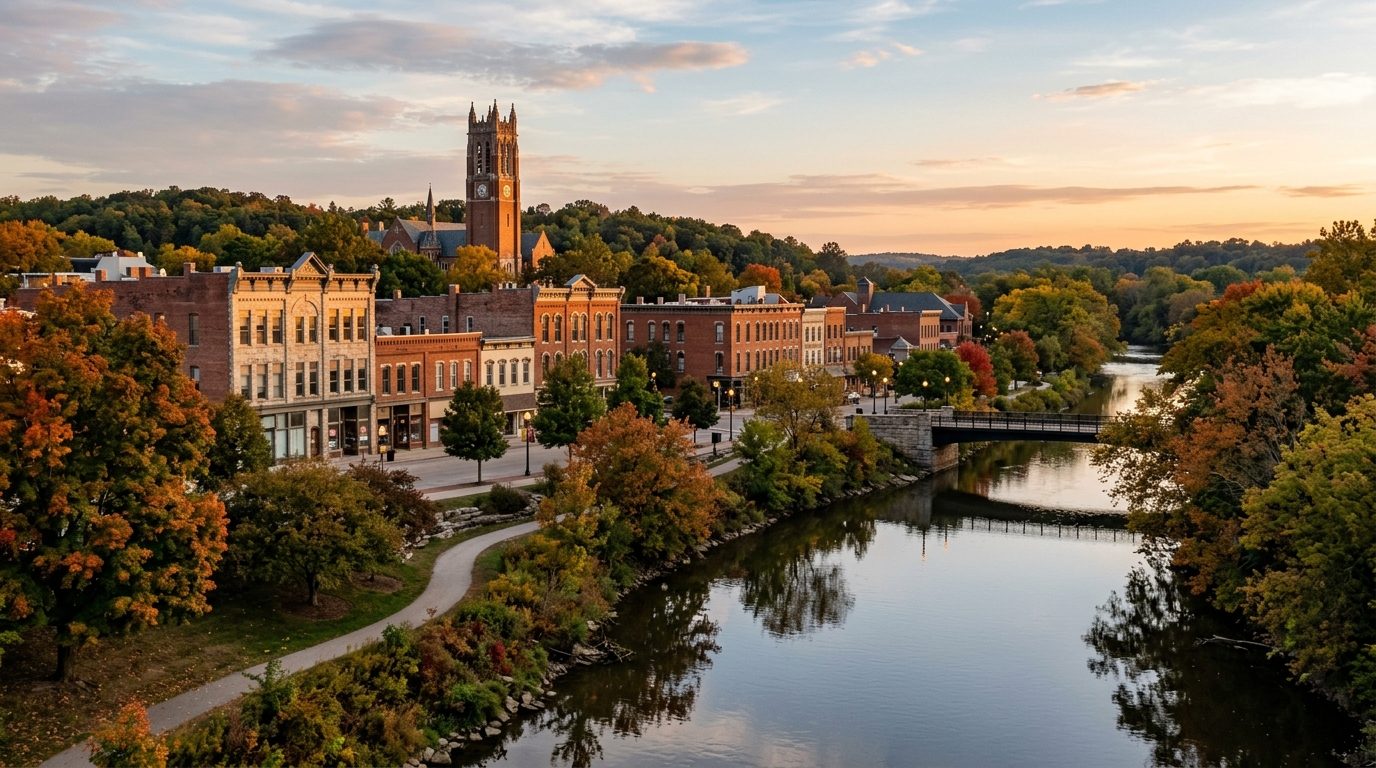
Current real estate market data, news and analysis for the Muncie, IN metropolitan area — 113,106 residents across Delaware county.
Data as of May 2026. Sources: Redfin Data Center, U.S. Census Bureau.
Latest Muncie Real Estate News
Coverage of this market is coming soon. Browse all housing market news.
Muncie Real Estate Market Overview
Muncie sits in east-central Indiana on the White River, roughly an hour northeast of Indianapolis, in a landscape of gently rolling glacial till plains and farmland typical of the region. Prairie Creek Reservoir, a few miles southeast of the city, is the area’s main recreational lake, while the White River itself winds through downtown before continuing west. Muncie’s housing stock reflects its late-1800s natural-gas boom, when the city grew quickly around glassmaking and other manufacturing: the core neighborhoods near downtown and Ball State University are dense with Victorian, Foursquare, and early-20th-century bungalow homes on traditional street grids, while the towns and townships ringing the city — Yorktown, Daleville, Albany, Gaston, Selma, Eaton — show a more spread-out pattern of postwar ranch homes and newer subdivisions built on former farmland.
Within the city, the historic districts closest to downtown and the university — areas built up during the gas-boom decades with restored Victorian and Foursquare homes — tend to draw the most buyer interest for their architecture and walkability, even though many properties there are also rented to students and Ball State staff. Yorktown, west of Muncie along the White River, has emerged as the metro’s most active growth area, benefiting from highway access and a redeveloped downtown that has drawn newer construction. Neighborhoods built up during Muncie’s industrial peak, along with the smaller rural towns scattered across Delaware County, tend to offer the most affordable and modest housing stock, reflecting their older, smaller-lot origins and, in some cases, proximity to former factory districts rather than lakefront or highway amenities.
Ball State University and IU Health Ball Memorial Hospital are the metro’s two largest employers and anchor its economy, drawing students, faculty, medical staff, and support industries into the local labor market. Manufacturing remains part of the base as well, tracing back to the Ball Corporation’s glass works and other companies that located here during the natural-gas boom of the late 1800s, though the sector has shifted toward metals and advanced manufacturing in recent decades. Ivy Tech Community College’s Muncie campus adds to the education sector, and the city continues to serve as Delaware County’s retail, healthcare, and government-services hub.
Riverside neighborhoods along the White River and Killbuck Creek carry periodic flood risk from heavy rainfall and spring runoff, and buyers there should check FEMA flood-zone status before closing. Indiana caps property tax bills by law and layers a county-level income tax on top of the state income tax, a structure unlike many neighboring states, so buyers relocating from elsewhere should budget for both. Local public transit, run by the Muncie Indiana Transit System, covers the city with fixed routes to Ball State, the hospital, and the mall but does not run on Sundays, making a car effectively necessary for most households. Muncie also carries a distinctive research history as the subject of the "Middletown" sociological studies of the 1920s and 1930s, though that legacy has more to do with the city’s civic identity than its housing market.
Cities and Towns in the Muncie Metro Area
Notable Communities and Neighborhoods
Muncie Real Estate Market FAQ
How is the Muncie housing market organized?
The market splits between Muncie’s older, denser in-town neighborhoods near downtown and Ball State University, and the more spread-out towns and rural townships surrounding the city, which mostly offer newer, larger-lot suburban and rural housing.
Which parts of the Muncie metro tend to be pricier?
Restored homes in the historic districts near downtown and the university, and newer construction in and around Yorktown, tend to draw the strongest demand, while older neighborhoods near the city’s former industrial districts and the smaller outlying towns are generally more affordable.
What should buyers verify before purchasing in the Muncie area?
Buyers near the White River or Killbuck Creek should confirm FEMA flood-zone status, and anyone renting to or buying alongside student housing near Ball State should check local rental-occupancy and zoning rules, since university-area neighborhoods mix owner-occupied and rental properties.
What is the main regional risk factor to know about?
Periodic flooding along the White River and its tributaries is the metro’s most consistent local risk, affecting low-lying parcels in and near downtown Muncie more than the higher ground in outlying towns.
Nearby Markets