
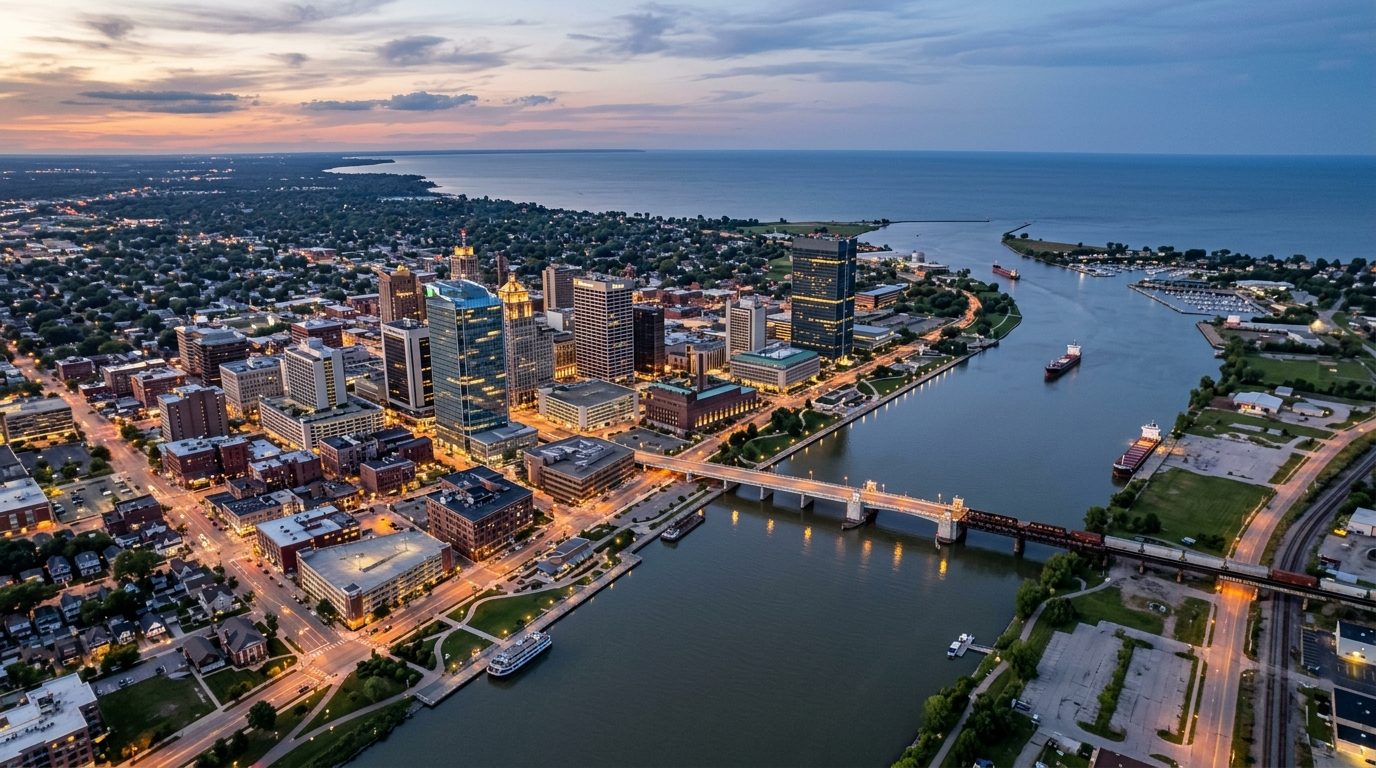
Current real estate market data, news and analysis for the Toledo, OH metropolitan area — 599,376 residents across Fulton, Lucas and Wood counties.
Data as of May 2026. Sources: Redfin Data Center, U.S. Census Bureau.
Latest Toledo Real Estate News
Toledo Real Estate Market Overview
Toledo sits at the western end of Lake Erie, where the Maumee River empties into Maumee Bay on the Michigan border. The land is flat, a legacy of the glacial lakebed and the Great Black Swamp that once covered the region, and that flatness shapes street grids and drainage across the metro. Housing reflects a long industrial history: dense blocks of early-twentieth-century bungalows, foursquares, and Victorian-era homes fill older city neighborhoods near downtown and along the river, while ranch and split-level homes from the postwar decades spread through inner-ring suburbs like Sylvania, Maumee, and Oregon. Farther out in Wood and Fulton counties, the terrain opens into farmland dotted with small towns and newer subdivisions. The lakeshore through Oregon toward Maumee Bay adds a distinct waterfront character, with marinas, wetlands, and cottages alongside year-round residential streets.
Within the metro, price tiers track school district reputation, commute distance, and housing age. Ottawa Hills, an independent village surrounded by the city of Toledo, has long stood at the top tier because of its mature tree canopy, distinct large homes, and its own regarded school system. Perrysburg and Sylvania follow closely, offering newer construction, well-funded schools, and easy highway access via I-75 and I-475 for commuters to hospital campuses and office parks. Maumee and Waterville also carry a premium tied to riverfront setting. By contrast, older core neighborhoods in Toledo proper, along with some smaller industrial towns in Lucas County, tend to sit at lower price tiers, reflecting smaller lots, aging infrastructure, and a higher share of long-vacant housing left over from decades of manufacturing decline.
The regional economy still carries the imprint of Toledo’s nickname, the Glass City. Owens Corning and Owens-Illinois, both companies with roots in the local glass industry pioneered by Edward Libbey in the late 1800s, remain headquartered in the metro. Automotive manufacturing is another anchor, with a Jeep assembly complex operated by Stellantis and a General Motors powertrain plant, supported by parts suppliers including Dana Incorporated. Health care has grown into one of the largest employment sectors, led by ProMedica Health System and Mercy Health, both operating multiple hospital campuses, alongside the University of Toledo and its academic medical center. The region’s location at the crossroads of Interstates 75, 80, and 90 also supports a logistics and freight sector tied to Great Lakes shipping through the Port of Toledo.
Winters bring lake-effect snow squalls off Lake Erie, particularly on the metro’s eastern and northern edges, so buyers should factor in snow removal and heating costs. Flooding is a localized but real concern along the Maumee River and its tributaries and near Maumee Bay, making a check of FEMA flood-zone status and any history of basement or sump-pump issues a standard part of due diligence. Property tax bills vary by school district and by whether a home sits within Toledo city limits or an unincorporated township, since township residents avoid municipal income tax but face differently structured levies; recent assessment volatility in Lucas County makes a review of valuation history worthwhile. Public transit is limited mainly to bus service through TARTA, so most households rely on cars, and land-use outside the city core remains largely low-density and auto-oriented, governed by a patchwork of city, township, and county zoning authorities worth consulting directly for additions or land splits.
Cities and Towns in the Toledo Metro Area
Notable Communities and Neighborhoods
Toledo Real Estate Market FAQ
How is the Toledo, OH metro area organized geographically?
The metro spans Lucas, Wood, and Fulton counties in northwest Ohio, anchored by the city of Toledo where the Maumee River meets Lake Erie. It includes older urban neighborhoods within the city, established inner-ring suburbs such as Sylvania, Maumee, and Perrysburg, the independent village of Ottawa Hills, lakeshore communities near Maumee Bay in Oregon, and a ring of smaller towns and farming communities spreading into Wood and Fulton counties to the south and west.
Which parts of the Toledo metro tend to be pricier, and why?
Ottawa Hills, Perrysburg, and Sylvania consistently sit at the higher end because of established or newer housing stock, strong local schools, mature landscaping, and convenient access to major highways. Riverfront and lakeshore settings in places like Maumee and parts of Oregon also carry a premium. Older core neighborhoods closer to downtown Toledo and some smaller industrial towns tend to be more affordable, reflecting smaller lots, older infrastructure, and longer-term population shifts.
What should buyers verify locally before purchasing in the Toledo area?
Buyers should confirm which taxing jurisdiction and school district a property falls under, since rates and municipal income tax exposure differ between the city of Toledo and surrounding townships. It’s also worth checking FEMA flood-zone status for properties near the Maumee River or Maumee Bay, reviewing recent county property valuation history given recent local scrutiny of assessment practices, and confirming zoning and any historic-district design restrictions with the relevant city, township, or county planning office.
What is the primary region-specific risk to be aware of in the Toledo metro?
Lake-effect snow off Lake Erie brings periodic heavy winter weather, especially in areas closer to the lakeshore, which affects heating costs, snow removal, and roof and gutter maintenance. Localized flooding along the Maumee River and its tributaries, as well as in low-lying areas near Maumee Bay, is the other recurring risk worth investigating property by property rather than assuming uniformly across the metro.
Nearby Markets