
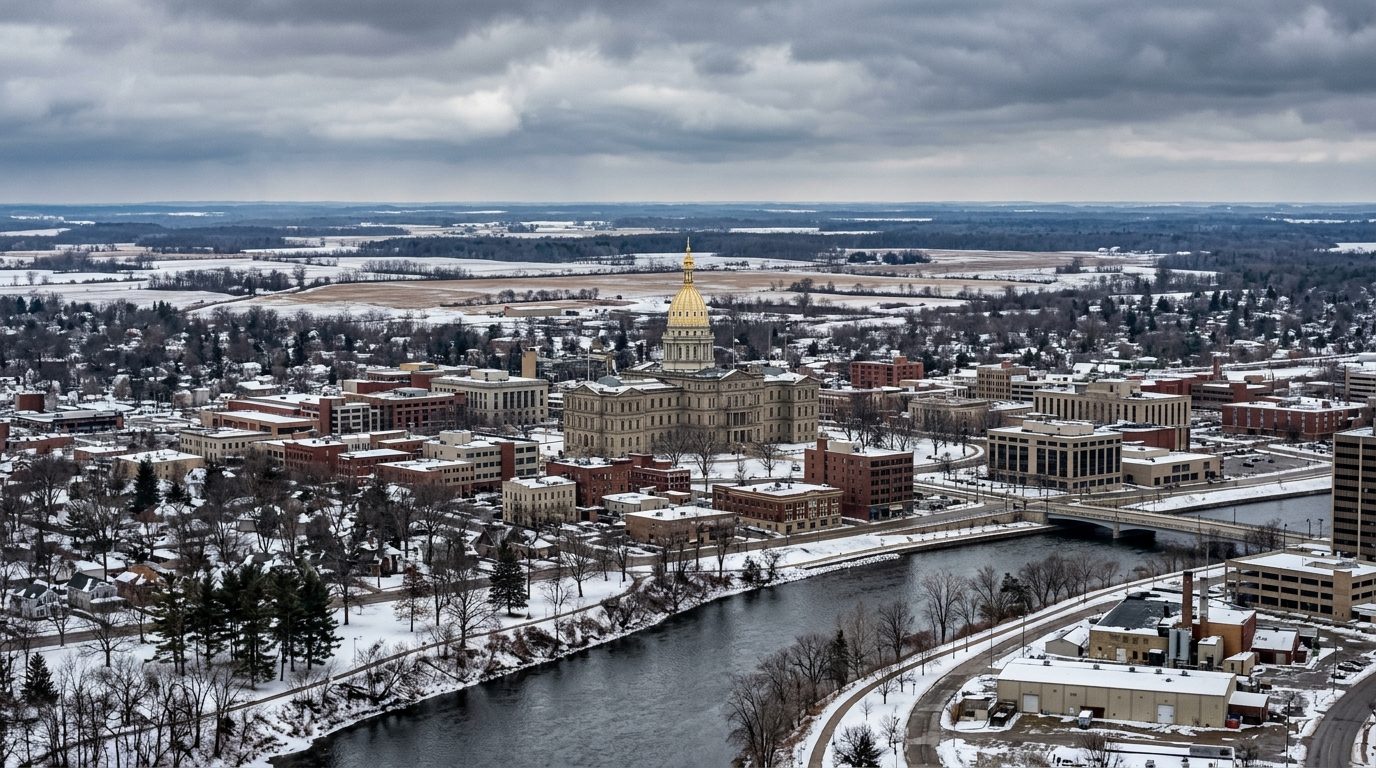
Current real estate market data, news and analysis for the Lansing-East Lansing, MI metropolitan area — 479,722 residents across Clinton, Eaton and Ingham counties.
Data as of May 2026. Sources: Redfin Data Center, U.S. Census Bureau.
Latest Lansing Real Estate News
Lansing Real Estate Market Overview
Lansing-East Lansing sits on flat mid-Michigan terrain along the Grand and Red Cedar rivers, where Clinton, Eaton, and Ingham counties meet. Lansing is the state capital, anchored by the domed Michigan State Capitol downtown, while East Lansing, just across the Red Cedar River, is defined by the campus of Michigan State University. Beyond these two cores, the metro spreads into smaller cities and rural townships, including Grand Ledge, DeWitt, Mason, St. Johns, Charlotte, Williamston, and Eaton Rapids, set among typical mid-Michigan farmland. Housing stock reflects a long build-out: early-1900s foursquares and bungalows near Lansing’s older core, a wave of postwar ranch and colonial construction filling in 1950s-70s suburbs and townships, and newer subdivisions on the metro’s edges. Near MSU, the mix shifts toward dense student rentals, duplexes, and smaller postwar homes.
Proximity to Michigan State University and to the capitol and downtown corridor tends to put East Lansing and the adjoining Meridian Township communities of Okemos and Haslett in the higher price tiers, helped by regarded schools, walkable commercial nodes, and steady rental demand from students, faculty, and state employees. Grand Ledge and DeWitt, each with an established downtown and its own school district, also carry a premium for small-town character paired with a short commute into Lansing. Older neighborhoods within the city of Lansing, including areas near downtown and the historically industrial south side, tend toward the more affordable end, reflecting older housing stock and a longer history of urban wear. Farther-out rural townships and small towns such as Bellevue, Potterville, and Vermontville offer lower-cost, lower-density living but with longer commutes and fewer nearby services.
The regional economy centers on state government, since Lansing hosts the bulk of Michigan’s state agency offices, alongside Michigan State University, one of the state’s largest employers and research institutions. General Motors maintains a manufacturing presence, building vehicles at its Lansing Grand River plant and running a stamping and assembly complex in Delta Township, continuing an auto-manufacturing history tied to the Oldsmobile and REO Motor Car companies once headquartered in Lansing. Health care is a significant employer too, led by hospital systems with major campuses in and around the city. The insurance industry also has deep roots here, with national and regional insurers headquartered in the area. Together, government, higher education, health care, insurance, and manufacturing give the metro an economic base more stable than many single-industry Michigan metros.
Buyers should weigh a few local factors. Michigan winters bring sustained cold and regular snowfall, and the freeze-thaw cycle common to the region can stress roads, driveways, foundations, and roofing over time, making inspections and attention to drainage and grading worthwhile. Michigan’s property tax system caps annual increases in a home’s taxable value while owned by the same person, but taxable value resets to market value at sale, so a buyer’s first-year tax bill can differ from what the seller was paying; confirm this with the local assessor before making an offer. The metro is largely car-dependent outside the MSU campus and the downtown Lansing and East Lansing cores, though the Capital Area Transportation Authority runs bus service connecting the two cities and surrounding townships. Land use is a patchwork of city, township, and county zoning, so development patterns can vary block by block; check zoning and any planned developments directly with the relevant municipality.
Cities and Towns in the Lansing Metro Area
Notable Communities and Neighborhoods
Lansing Real Estate Market FAQ
How is the Lansing-East Lansing housing market organized geographically?
The metro is centered on two adjoining core cities, Lansing (the state capital) and East Lansing (home to Michigan State University), surrounded by a mix of established suburban townships like Meridian and Delta and a ring of smaller cities and rural towns across Clinton, Eaton, and Ingham counties, including Grand Ledge, DeWitt, Mason, St. Johns, Charlotte, Williamston, and Eaton Rapids. Each of these smaller communities functions as its own local market with a distinct downtown, school district, and housing stock rather than as an undifferentiated suburb.
Which parts of the metro tend to be pricier, and why?
Areas closest to Michigan State University and the state capitol, including East Lansing and the nearby Meridian Township communities of Okemos and Haslett, tend to command higher prices due to school district reputation, walkable commercial districts, and consistent rental demand from students, faculty, and state workers. Small cities with their own established downtowns and school districts, such as Grand Ledge and DeWitt, also tend to price at a premium relative to older sections of Lansing, where housing stock skews older and lot sizes smaller.
What should buyers verify locally before purchasing in this metro?
Because taxable value resets to market value at the time of sale under Michigan’s property tax system, buyers should confirm expected tax bills with the local city or township assessor rather than relying on the seller’s current bill. It is also worth checking which school district and municipality a specific address falls under, since township and city boundaries can split neighborhoods, and reviewing local zoning or planned development with the relevant municipal planning office, since land use rules vary from one township to the next.
What regional risk factor is most relevant to buyers in the Lansing area?
Michigan’s winter climate is the main regional consideration: sustained cold, regular snow accumulation, and freeze-thaw cycles can gradually stress roads, driveways, roofs, and foundations, particularly in older homes. Buyers should budget for winter-related maintenance, have heating, roofing, and foundation systems inspected carefully, and ask about a property’s history of ice damming, drainage issues, or basement moisture before closing.
Nearby Markets