
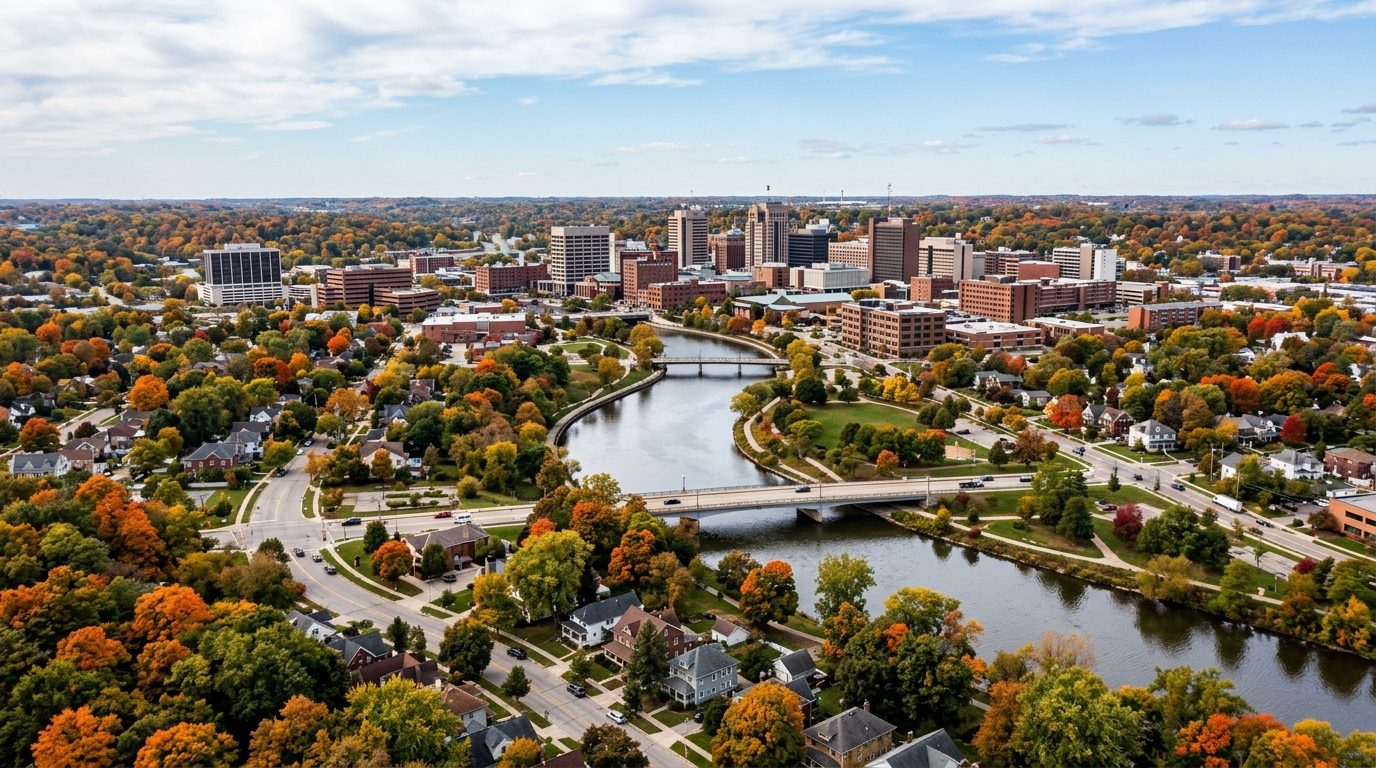
Current real estate market data, news and analysis for the Flint, MI metropolitan area — 401,093 residents across Genesee county.
Data as of May 2026. Sources: Redfin Data Center, U.S. Census Bureau.
Latest Flint Real Estate News
Flint Real Estate Market Overview
Genesee County sits in southeastern Michigan, with the city of Flint built along the Flint River. The county is mostly flat, with rolling terrain and small lakes near its southern edge around Grand Blanc and Fenton. Flint grew up as an auto-manufacturing center, and its housing stock still reflects that era: bungalows, foursquares, and modest frame houses built for factory workers fill many city neighborhoods, alongside larger homes built for company executives in a handful of historic districts. Housing from the postwar boom rings the city with ranch and split-level homes, while newer construction sits farther out, toward the county’s southern and eastern edges.
Price levels vary mainly with housing age, proximity to lakes and golf courses, and school district reputation. Areas toward the south of the county, including Grand Blanc, Fenton, and Linden, near the Oakland and Livingston county lines, tend to sit in the higher price tiers, reflecting newer subdivisions, waterfront and golf-course settings, and strong-performing schools. Suburbs ringing the city, such as Flushing, Davison, and Swartz Creek, occupy a middle tier mixing postwar and newer homes. Flint’s core neighborhoods generally sit at the lower end, reflecting an aging housing stock, population loss tied to the auto industry’s contraction, and, in some pockets, higher vacancy. A handful of historic districts near the cultural center and downtown buck that pattern, drawing buyers interested in distinctive older housing even as nearby blocks vary in condition.
Healthcare and higher education anchor the Flint-area economy. Hurley Medical Center and McLaren Flint operate major hospital campuses in the city, and Ascension Genesys Hospital serves the region from nearby Grand Blanc Township; these systems are among the county’s largest employers. Higher education also plays an outsized role: Kettering University, known for cooperative-education engineering programs, and the University of Michigan-Flint draw students and faculty into the city’s core, while Mott Community College serves as a regional workforce-training hub. The automotive industry remains present but diminished from its peak; General Motors continues truck and engine manufacturing at Flint Assembly and Flint Engine Operations, supporting a supplier base countywide. Local economic-development groups, including the Flint & Genesee chamber of commerce, have promoted diversification into professional services and advanced manufacturing to reduce reliance on a single industry.
Flint’s municipal water system drew national attention during a public-health crisis that began roughly a decade ago, when a change in water source and treatment led to lead contamination in the drinking water. Since then, a court-supervised program has replaced lead and galvanized service lines, and monitoring has shown the system meeting lead-testing standards. Buyers should still verify the service-line material and any documented plumbing work for a property, since older interior plumbing can contain lead regardless of the exterior line’s status, and rarely used properties are more susceptible to elevated readings. Buyers should also verify local property tax millage rates, which vary by city, township, and school district and can include voter-approved millages for the regional transit authority; transit service is otherwise limited, so most residents rely on cars. Winters bring sustained cold and snowfall, worth weighing when evaluating roofing, insulation, and heating in older homes. Local land banks continue redevelopment and demolition efforts targeting vacant and blighted properties in parts of the city, so buyers should check a property’s history with the relevant city or township office before purchasing.
Cities and Towns in the Flint Metro Area
Notable Communities and Neighborhoods
Flint Real Estate Market FAQ
How is the Flint metro housing market organized geographically?
The metro is centered on the city of Flint in Genesee County, surrounded by a ring of townships and smaller cities. Housing character shifts as you move outward: the city core has the oldest housing stock tied to the early auto-manufacturing era, the immediate suburbs have postwar ranch and split-level homes, and the townships toward the county’s southern and eastern edges hold more recently built subdivisions. Each surrounding town, such as Fenton, Grand Blanc, Davison, and Swartz Creek, functions as its own small market with its own school district and local government, so conditions can differ block by block and town by town rather than following one uniform metro-wide pattern.
Which parts of the Flint metro tend to be pricier, and why?
Areas toward the southern part of Genesee County, closer to the Oakland and Livingston county lines, such as Grand Blanc, Fenton, and Linden, tend to command higher prices. These communities offer newer subdivisions, lake and golf-course settings, and school districts with strong reputations, all factors that draw buyers willing to pay a premium. The city of Flint’s core neighborhoods, along with some older inner suburbs, tend to sit at the lower end of the price range, reflecting an older housing stock and decades of population and industrial change. A number of Flint’s historic districts are an exception, holding architecturally distinctive homes that draw buyers even though surrounding blocks can vary widely in condition.
What should buyers verify locally before purchasing in the Flint area?
Given the region’s water-infrastructure history, buyers should confirm the service-line material for a specific property and ask for any documentation of lead or galvanized line replacement, since interior plumbing in older homes can still contain lead components even where the exterior service line has been addressed. Beyond water, buyers should verify the property’s tax jurisdiction and current millage rate with the local city or township assessor, confirm school district boundaries, check whether the home or block has been part of local land-bank or demolition activity, and, for older homes generally, have plumbing, electrical, roofing, and foundation systems inspected given the age of much of the region’s housing stock.
What region-specific factors are worth understanding before buying in Flint’s housing market?
Much of the metro’s housing stock dates to the early-to-mid twentieth century auto-manufacturing boom, so age-related maintenance items such as older wiring, aging plumbing, and older roofs are more common than in newer-built markets and should be factored into inspections and budgeting. The region also experiences a full four-season Midwest climate with cold winters and regular snowfall, which affects heating costs and the condition of exterior systems. Public transit is limited outside the Mass Transportation Authority’s bus network centered on Flint, so most households rely on personal vehicles, which is worth factoring into where within the metro a buyer chooses to live relative to work and services.
Nearby Markets