
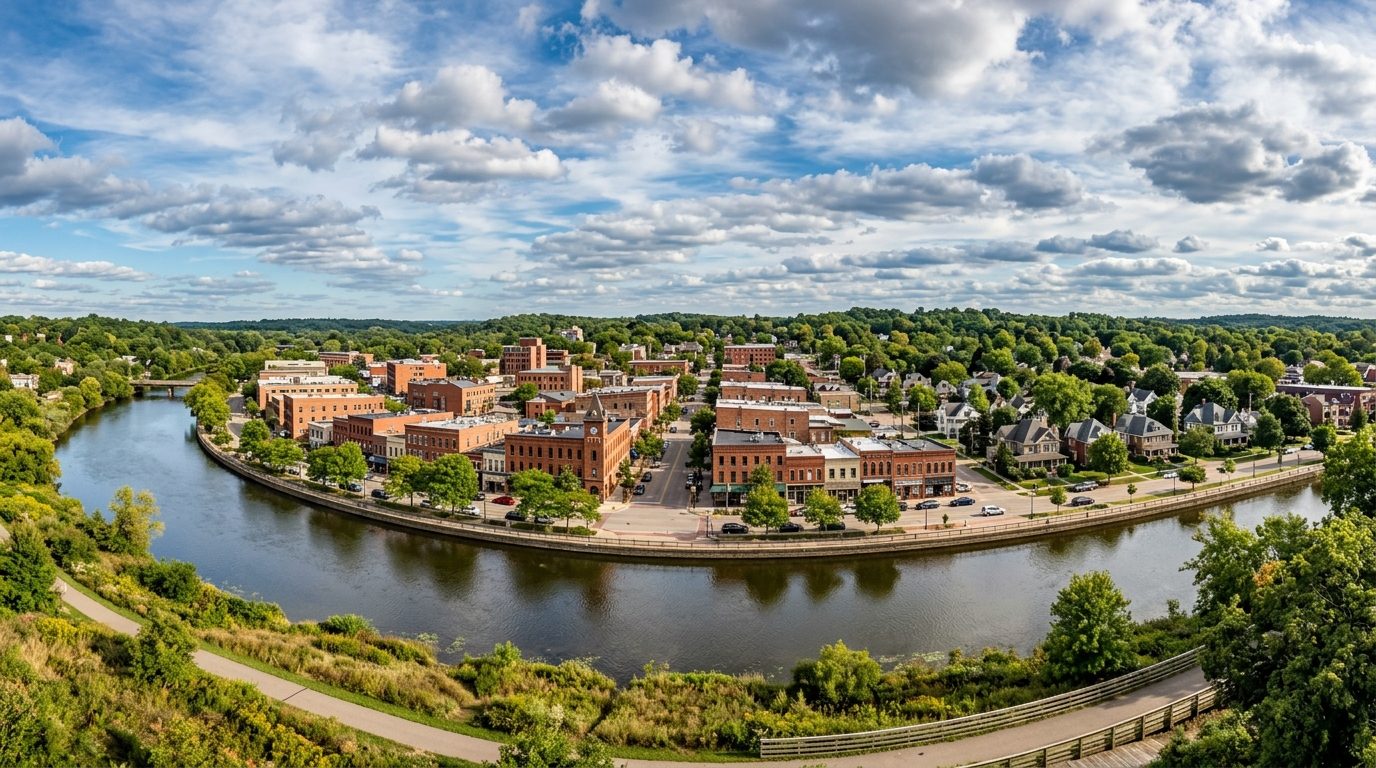
Current real estate market data, news and analysis for the Battle Creek, MI metropolitan area — 133,408 residents across Calhoun county.
Data as of May 2026. Sources: Redfin Data Center, U.S. Census Bureau.
Latest Battle Creek Real Estate News
Coverage of this market is coming soon. Browse all housing market news.
Battle Creek Real Estate Market Overview
Battle Creek sits in southwest Michigan at the confluence of the Kalamazoo River and the Battle Creek River, in Calhoun County along the Interstate 94 corridor linking Detroit and Chicago. The metro extends beyond the city to historic Marshall, the college town of Albion, and rural townships including Athens, Burlington, Homer, Springfield, and Tekonsha. Housing stock reflects that layered history: the core has a dense mix of early twentieth-century foursquares, bungalows, and worker-era cottages built around the city’s cereal and manufacturing boom, while surrounding townships hold postwar ranches, later subdivisions, and farmsteads on larger rural parcels. The landscape is flat to gently rolling, shaped by the river valley, connecting lakes, and surrounding farmland.
Within the metro, price tiers track age, preservation status, and proximity to water more than any single pattern. Historic Marshall, with its well-preserved nineteenth-century Greek Revival and Italianate homes and walkable downtown, commands a premium tied to preservation status and appeal to buyers seeking an intact small-town setting. Homes around Goguac Lake and other lakeside pockets carry a similar premium tied to water access and recreation. By contrast, many of Battle Creek’s older core neighborhoods, shaped by decades of industrial employment and aging infrastructure, sit at a lower tier, as do parts of Albion tied to its manufacturing legacy. Newer subdivisions on Battle Creek’s outer edges and in townships along I-94 offer more recently built homes on larger lots, at a lower cost per square foot than in-town historic properties. The most rural townships offer the most land for the least money.
The area’s economy has long been anchored by food production and manufacturing. WK Kellogg Co, the cereal business spun off from the original Kellogg Company, keeps its headquarters in Battle Creek, and Post Consumer Brands, founded in the city by C. W. Post, still operates a plant there. Denso Manufacturing Michigan, an automotive thermal-systems maker, is one of Calhoun County’s largest private employers, and Duncan Aviation runs a major maintenance operation at Battle Creek Executive Airport. The federal government has a local presence through the Battle Creek VA Medical Center and the Hart-Dole-Inouye Federal Center, home to Defense Logistics Agency operations. Albion College, a liberal arts institution founded in 1835, anchors Albion and adds an academic presence to that part of the county.
Several local factors are worth understanding before buying here. Parts of Battle Creek and Marshall sit near the Kalamazoo and Battle Creek rivers, and a mid-twentieth-century flood-control project channelized sections of the river through downtown Battle Creek; buyers considering river-adjacent property should check current floodplain mapping. Marshall’s downtown and residential core form a nationally recognized historic landmark district, and Battle Creek maintains its own local historic districts, both applying exterior-alteration review to changes affecting appearance. Given the age of much of the core housing stock, inspecting older wiring, plumbing, and paint is standard practice. The Kalamazoo River corridor also carries an industrial history, including a well-documented pipeline spill and cleanup near Marshall in 2010, worth understanding for parcels along that stretch. Outside the core, many homes rely on private well and septic systems, and public transit is limited to the city itself, so most of the metro is car-dependent. Property tax rates and millages vary by township and school district and should be confirmed with the local assessor before purchase.
Cities and Towns in the Battle Creek Metro Area
Notable Communities and Neighborhoods
Battle Creek Real Estate Market FAQ
How is the Battle Creek metro area organized?
The metro corresponds to Calhoun County. Battle Creek, at the confluence of the Kalamazoo and Battle Creek rivers along I-94, is the core city. Historic Marshall sits a short distance to the southeast as a distinct small city, Albion anchors the county’s western side as a college town, and the remainder of the metro is made up of smaller villages and rural townships, including Athens, Burlington, Homer, Springfield, and Tekonsha.
Which areas in the Battle Creek metro tend to be priced higher, and why?
Historic Marshall commands a premium because of its well-preserved nineteenth-century architecture, walkable downtown, and preservation status. Lakeside pockets such as those around Goguac Lake also carry a premium tied to water access. Battle Creek’s older core neighborhoods and parts of Albion tied to earlier manufacturing eras tend to sit at a lower tier, while newer subdivisions on the metro’s edges offer more recently built homes on larger lots at a comparatively lower cost per square foot.
What should buyers verify before purchasing in this market?
In Marshall’s historic landmark district and Battle Creek’s local historic districts, confirm what exterior changes require design review approval before planning renovations. For property near the Kalamazoo or Battle Creek rivers, check current floodplain status. In rural townships, confirm whether the property uses a private well and septic system rather than municipal water and sewer, and given the age of much of the area’s housing stock, have wiring, plumbing, and other major systems inspected. Property tax millage also varies by township and school district and should be confirmed with the local assessor.
What is the main region-specific risk to be aware of here?
River flooding along the Kalamazoo and Battle Creek rivers is the primary physical risk, particularly for property near channelized sections of the river through downtown Battle Creek and along the Marshall-to-Battle Creek corridor. That same river corridor also has an industrial and environmental history, including a well-documented pipeline spill and multi-year cleanup near Marshall, which buyers of river-adjacent parcels should research before purchasing.
Nearby Markets