
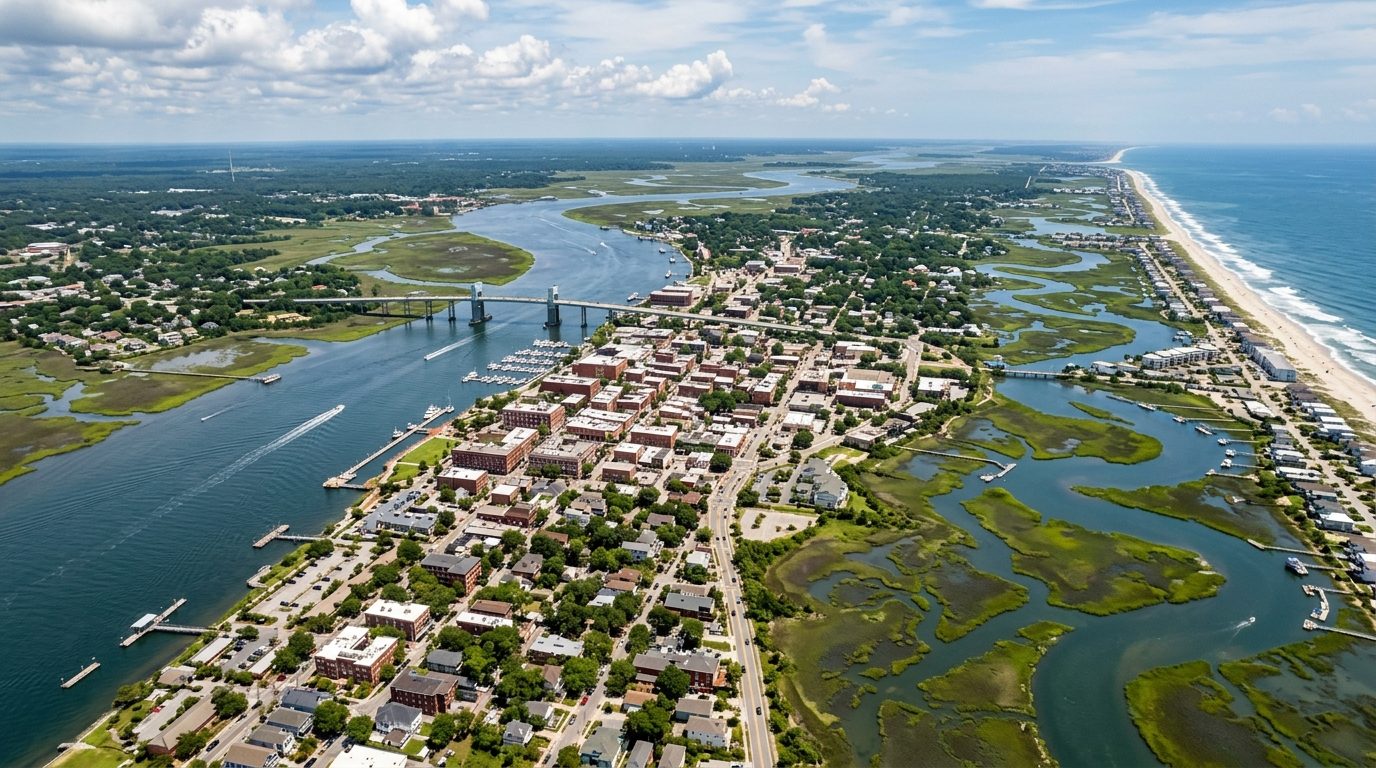
Current real estate market data, news and analysis for the Wilmington, NC metropolitan area — 492,772 residents across Brunswick, New Hanover and Pender counties.
Data as of May 2026. Sources: Redfin Data Center, U.S. Census Bureau.
Latest Wilmington Real Estate News
Wilmington Real Estate Market Overview
The Wilmington metro area occupies North Carolina’s southeastern corner, spanning New Hanover, Brunswick, and Pender counties where the Cape Fear River meets the Atlantic Ocean. The landscape is defined by barrier islands, wide marshes, and the Intracoastal Waterway, with the city of Wilmington sited on a peninsula between the river and the sea. Housing stock varies widely in age and form: the historic downtown core holds restored antebellum and Victorian-era homes on tree-lined streets, mid-20th-century brick ranches and bungalows fill inner neighborhoods, and low-rise cottages, duplexes, and condominium buildings line the barrier-island beach towns. Farther from the coast, in Brunswick and Pender counties, newer single-family subdivisions and golf-course developments dominate, built largely since the 1990s as the region has grown outward from the urban core toward Leland, Southport, and the beach communities south of the Cape Fear River.
Within the metro, price tiers track proximity to open water and to established amenities more than any other factor. Wrightsville Beach, Landfall, Figure Eight Island, and Porters Neck command premiums for direct ocean or Intracoastal access, mature tree canopy, and proximity to Wilmington’s shops, restaurants, and hospitals. Bald Head Island, reachable only by ferry, and the gated golf communities of St. James Plantation and Brunswick Forest similarly draw buyers willing to pay for privacy and recreational amenities. More moderately priced housing tends to sit inland and northward, in and around Leland, Navassa, Burgaw, and unincorporated Pender County, where lots are larger, commutes to Wilmington run longer, and shoreline access is indirect or absent.
The regional economy blends healthcare, higher education, finance, manufacturing, and film production. Novant Health New Hanover Regional Medical Center anchors the healthcare sector as the area’s largest hospital system, while the University of North Carolina Wilmington supplies jobs along with a steady population of students and researchers. Corning Incorporated and GE Hitachi Nuclear Energy operate major manufacturing and engineering facilities locally, and the Port of Wilmington, run by the North Carolina State Ports Authority, handles container, bulk, and breakbulk cargo that supports regional logistics employment. Financial technology and banking firms such as Live Oak Bank and nCino are headquartered in Wilmington, and the Cinespace Wilmington studio complex north of downtown, formerly EUE/Screen Gems, continues a film and television production presence dating to the 1980s.
Buyers should weigh hurricane exposure carefully. Coastal and low-lying areas fall within flood zones that typically require separate flood insurance, and many barrier-island and waterfront properties also carry distinct wind and hail coverage alongside standard homeowners policies; availability and cost vary block by block and should be confirmed before writing an offer. North Carolina counties assess property taxes locally and periodically revalue property, so rates and assessed values differ among New Hanover, Brunswick, and Pender counties. Public transit is limited, and most residents rely on cars, with bridges and causeways to the beach towns creating chokepoints during evacuations and peak summer traffic. Coastal construction also falls under state rules governing setbacks and dune protection, so buyers should independently verify flood zone designation, elevation certificates, septic or sewer service, and any homeowners’ association or coastal-development restrictions tied to a specific property.
Cities and Towns in the Wilmington Metro Area
Notable Communities and Neighborhoods
Wilmington Real Estate Market FAQ
How is the Wilmington, NC market organized?
The metro spans New Hanover, Brunswick, and Pender counties and includes the city of Wilmington along with a wide arc of smaller towns and beach communities such as Wrightsville Beach, Carolina Beach, Kure Beach, Leland, Southport, Oak Island, Shallotte, Calabash, Sunset Beach, and Burgaw. New Hanover County forms the urban core around Wilmington and UNCW, Brunswick County covers fast-growing suburban and beach towns south and west of the Cape Fear River, and Pender County is more rural, stretching north along the coast and inland.
Which parts of the Wilmington area tend to be pricier, and why?
Neighborhoods and towns with direct ocean or Intracoastal Waterway access, established tree canopy, and short drives to downtown Wilmington’s hospitals, shops, and UNCW tend to command more, including Wrightsville Beach, Landfall, Figure Eight Island, and Porters Neck, along with gated golf communities such as St. James Plantation and Brunswick Forest. Areas farther inland or farther from the coastline, including parts of Leland, Navassa, Burgaw, and rural Pender County, are generally more moderately priced, reflecting longer commutes and less direct water access.
What should buyers verify before purchasing property in this market?
Buyers should independently confirm a property’s FEMA flood zone designation and any elevation certificate, check whether it relies on well and septic systems or municipal water and sewer, review homeowners’ association rules and dues for gated or amenity-rich communities, and confirm current property tax rates and assessed value with the relevant county tax office, since New Hanover, Brunswick, and Pender counties assess and revalue independently.
What is the biggest region-specific risk for homeowners in the Wilmington area?
Hurricane and flood risk is the primary consideration given the metro’s Atlantic coastline and low-lying barrier islands. Many properties require separate flood insurance in addition to standard homeowners coverage, and wind and hail policies are often written separately as well. Insurance availability and premiums can vary significantly by proximity to the shoreline and by flood zone, so buyers should obtain insurance quotes early in the purchase process rather than assuming standard coverage applies.
Nearby Markets