
Current real estate market data, news and analysis for the Huntsville, AL metropolitan area — 556,444 residents across Limestone and Madison counties.
Data as of May 2026. Sources: Redfin Data Center, U.S. Census Bureau.
Latest Huntsville Real Estate News
Huntsville Real Estate Market Overview
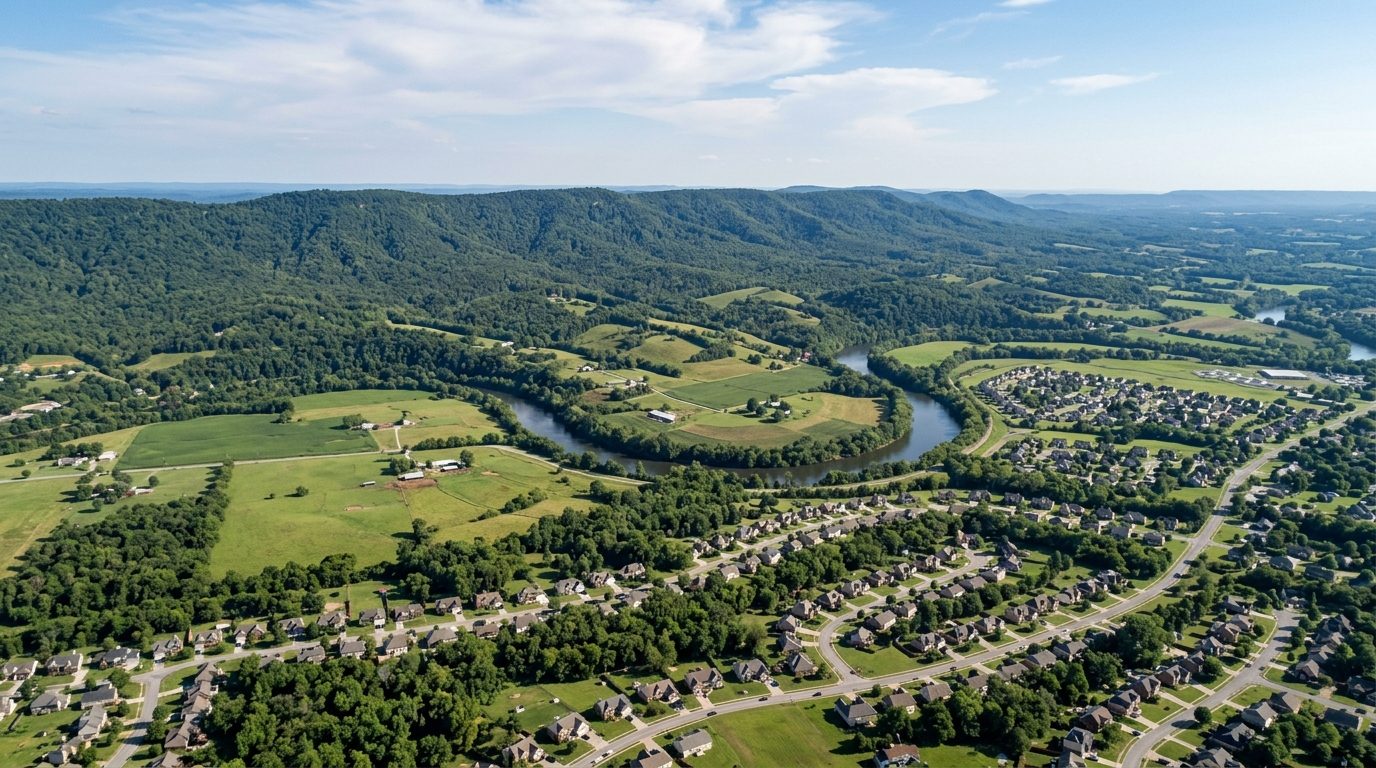
Huntsville anchors the Tennessee Valley in the far north of Alabama, spanning Madison County and, to its west, Limestone County, with the Tennessee River forming the metro’s southern edge and the wooded ridges of Monte Sano and Green Mountain rising along the city’s eastern flank. Huntsville itself sits in a broad limestone valley pocked with sinkholes and underground caves, a legacy of the karst bedrock that shapes drainage across the region. Housing stock reflects distinct building waves: antebellum and early-20th-century homes cluster in the historic core near downtown, mid-century brick ranch houses fill out older neighborhoods, and newer vinyl-and-brick subdivisions spread west and north into Madison and Limestone County, where farmland continues to give way to new rooftops.
Within the city, the historic districts closest to downtown and the base of Monte Sano carry a premium for older architecture, mature tree canopy, and walkability to restaurants and parks, while established mid-century neighborhoods in the southeast trade some of that character for larger lots and mountain views. South Huntsville’s master-planned golf-and-lake communities occupy a similar upper tier, built around clubhouses, trails, and private lakes rather than age or location alone. Western Huntsville and the city of Madison, where much of the tech and defense workforce settled after the base realignment years, mix established subdivisions with continuing new construction in the middle tiers. Farther out, in Limestone County towns and unincorporated northern Madison County, newer construction and larger acreage tend to come at a relative discount tied to longer commutes into the arsenal and research park corridor.
The metro’s economy centers on Redstone Arsenal, the Army post that hosts NASA’s Marshall Space Flight Center, the Army’s aviation and missile programs, and dozens of other federal tenants, alongside a growing FBI campus. Cummings Research Park, one of the largest research parks in the country, houses defense and aerospace contractors including Boeing, Lockheed Martin, and Northrop Grumman, plus newer entrants such as Blue Origin, which builds rocket engines locally. Manufacturing has diversified the base further: Mazda Toyota Manufacturing operates a large assembly plant in Huntsville producing Toyota and Mazda models and employing thousands. That mix of federal, aerospace, and manufacturing employment has made the region one of the more consistently growing labor markets in the South, drawing engineers and skilled tradespeople from across the country.
Buyers should confirm a property’s flood designation before making an offer, since the Tennessee River, the Flint River, and a network of urban creeks and karst drainage put parts of the metro inside mapped flood zones, and cave-prone limestone can carry sinkhole or foundation considerations a routine inspection may not catch. The region also sits in an active severe-weather corridor, so tornado history and the presence of a safe room or nearby shelter are worth asking about. Outside incorporated city limits, Madison and Limestone counties historically apply lighter land-use and zoning rules than Huntsville or Madison proper, so vacant land nearby can turn into new development with little warning. School district lines matter as much as distance: Huntsville City, Madison City, Madison County, and Limestone County each operate separate systems, and attendance zones can differ from one side of a road to the other. Annexation is ongoing, so a parcel’s city limits, tax rate, and utility provider can change over time even without the owner moving.
Cities and Towns in the Huntsville Metro Area
Notable Communities and Neighborhoods
Huntsville Real Estate Market FAQ
How is the Huntsville metro area organized geographically?
The metro covers Madison County, anchored by Huntsville and its close-in suburb Madison, plus Limestone County to the west, home to Athens and smaller towns like Ardmore, Elkmont, Lester, and Mooresville. The Tennessee River defines the southern boundary near Triana and New Hope, while wooded ridgelines including Monte Sano and Green Mountain rise along Huntsville’s eastern and southeastern edge. Redstone Arsenal, a large federal enclave, sits along the Tennessee River south of downtown and separates several residential areas from one another.
Which parts of the metro tend to carry higher prices, and why?
Huntsville’s historic districts near downtown and neighborhoods at the base of Monte Sano command a premium for older architecture, mature landscaping, and walkable access to restaurants and parks. South Huntsville’s master-planned communities built around golf courses and lakes occupy a similar tier for their amenity packages. Newer growth areas farther from the urban core, including much of Limestone County and the unincorporated edges of northern Madison County, tend to be more moderately priced, generally tracking with distance from Redstone Arsenal and Cummings Research Park.
What should buyers verify locally before making an offer?
Confirm which school system and specific attendance zone a property falls into, since Huntsville City, Madison City, Madison County, and Limestone County each run independent districts that can split neighborhoods. In unincorporated areas, check whether the home relies on well water or a septic system rather than municipal service, and review any HOA covenants in planned communities. It’s also worth confirming whether a parcel sits inside city limits or unincorporated county land, since that affects zoning predictability, tax rate, and which utilities or services apply.
What’s a region-specific risk worth factoring into a purchase?
The Tennessee Valley sees regular severe thunderstorm and tornado activity, so it’s worth asking whether a home has a safe room or nearby community shelter and reviewing a homeowners policy’s windstorm terms. Separately, the area’s limestone karst geology and network of rivers and creeks mean some properties fall inside FEMA-mapped flood zones or in areas with a history of localized flash flooding; checking a specific address against current flood maps before closing is a reasonable step anywhere in the metro.
Nearby Markets