
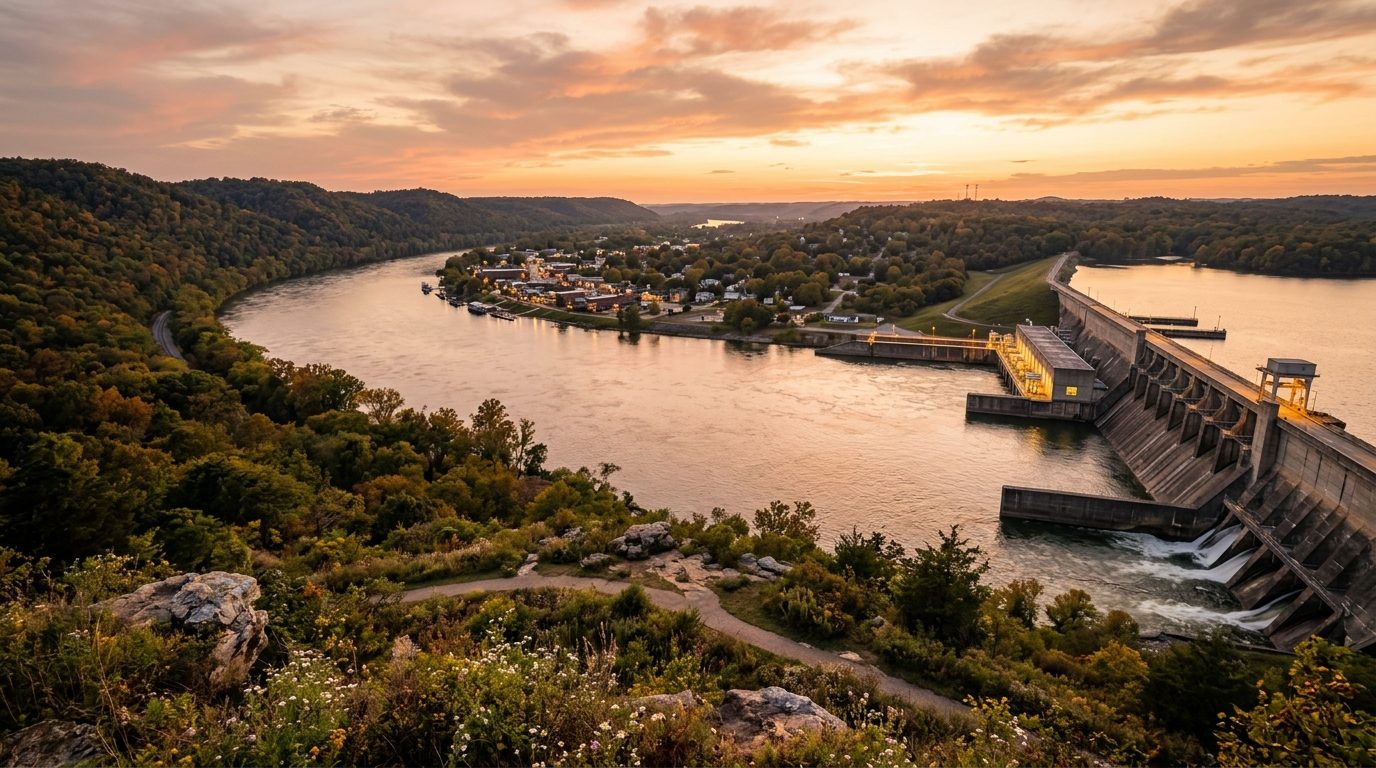
Current real estate market data, news and analysis for the Florence-Muscle Shoals, AL metropolitan area — 156,609 residents across Colbert and Lauderdale counties.
Data as of May 2026. Sources: Redfin Data Center, U.S. Census Bureau.
Latest Florence Real Estate News
Coverage of this market is coming soon. Browse all housing market news.
Florence Real Estate Market Overview
The Florence-Muscle Shoals metro straddles the Tennessee River in northwestern Alabama, with Florence set on a bluff above the north bank in Lauderdale County and Muscle Shoals, Sheffield, and Tuscumbia clustered along the south bank in Colbert County near Wilson Dam. The river was historically shallow and rocky here, giving the region its name, and it now forms Wilson Lake and Pickwick Lake, reservoirs defining the metro’s northern and western edges. Away from the water, the land rolls through wooded hills and limestone karst terrain marked by sinkholes and caves before leveling into farmland toward the smaller outlying towns. Housing stock is layered: brick and frame homes in Colonial Revival, Queen Anne, and Craftsman styles fill downtown Florence’s older streets, mid-century brick ranch houses surround them, and newer subdivisions spread across the outskirts, with custom waterfront homes lining Wilson Lake and the river.
Home values across the metro track proximity to water, the age and preservation of housing stock, and distance from the urban core. Waterfront property on Wilson Lake, including the area near Turtle Point Yacht and Country Club, carries a premium for shoreline access, golf frontage, and views. Florence’s historic districts near downtown and the University of North Alabama, where preserved older homes sit on walkable, tree-lined streets, also draw stronger interest than comparably aged housing elsewhere. Newer subdivisions on the edges of Florence and Muscle Shoals sit in a more moderate tier, valued for newer construction rather than location or history. The older residential cores of Sheffield and Tuscumbia hold more modest housing stock from those towns’ industrial-era growth, while rural land toward Cherokee, Waterloo, and Rogersville is priced mainly by acreage and land character.
The Shoals economy rests heavily on manufacturing tied to automotive and building-materials supply chains. Constellium operates a large aluminum plant in Muscle Shoals, North American Lighting runs a major automotive lighting facility there, and Southwire manufactures copper building wire at an expanding campus in Florence, alongside Essity, Linamar, and Tarkett. Healthcare is another pillar, led by North Alabama Medical Center in Florence and Helen Keller Hospital in Sheffield, both major regional employers. The University of North Alabama and Northwest-Shoals Community College round out the area’s largest employers. The Tennessee Valley Authority’s Wilson Dam, one of the earliest hydroelectric projects in the TVA system, remains a defining feature of the local economy and landscape. The Shoals is also known for its recording-studio heritage, with FAME Studios in Muscle Shoals and Muscle Shoals Sound Studio in Sheffield supporting a steady music-tourism sector.
Low-lying property near the Tennessee River, Wilson Lake, and Pickwick Lake can fall within mapped flood zones, so flood insurance and elevation certificates are worth confirming before buying. Alabama assesses property taxes on a fraction of appraised value, generally light compared with many other states, though rates and homestead exemptions differ between Colbert and Lauderdale counties. Public transit is limited, and most residents rely on personal vehicles. Land-use regulation varies between the incorporated cities, which maintain zoning and building codes, and unincorporated county areas, where fewer restrictions apply and homes may rely on septic systems and private wells. Development has generally followed the river and highway corridors linking the four core cities, and buyers near the water should confirm shoreline rules, since TVA holds authority over reservoir land use.
Cities and Towns in the Florence Metro Area
Notable Communities and Neighborhoods
Florence Real Estate Market FAQ
What is the Florence-Muscle Shoals metro known for?
The area is known as the Shoals, named for the once-shallow stretches of the Tennessee River that ran through it before dams created the current reservoirs. It has a long recording-studio heritage tied to FAME Studios and Muscle Shoals Sound Studio, along with a manufacturing base built around automotive and building-materials suppliers, and it is home to the University of North Alabama and Wilson Dam, one of the original Tennessee Valley Authority hydroelectric projects.
Is flooding a concern for property near the Tennessee River in this area?
Land close to the Tennessee River and the reservoirs it forms, such as Wilson Lake and Pickwick Lake, can sit within mapped flood zones because water levels are managed by upstream and downstream dam operations. Anyone considering a property near the water should check its flood zone designation and understand how insurance and building requirements apply before purchasing.
What industries support jobs in the Florence-Muscle Shoals area?
The local economy is anchored by manufacturing, including aluminum, automotive lighting, and wire production, alongside healthcare systems, higher education, and hydroelectric power generation tied to the Tennessee Valley Authority. Tourism connected to the region’s music history also contributes to the local economy.
Does the Florence-Muscle Shoals metro have public transportation?
The metro is largely car-dependent, and residents generally rely on personal vehicles to travel between the cities of Florence, Muscle Shoals, Sheffield, and Tuscumbia and the surrounding towns, since the region does not have an extensive public transit network.
Nearby Markets