
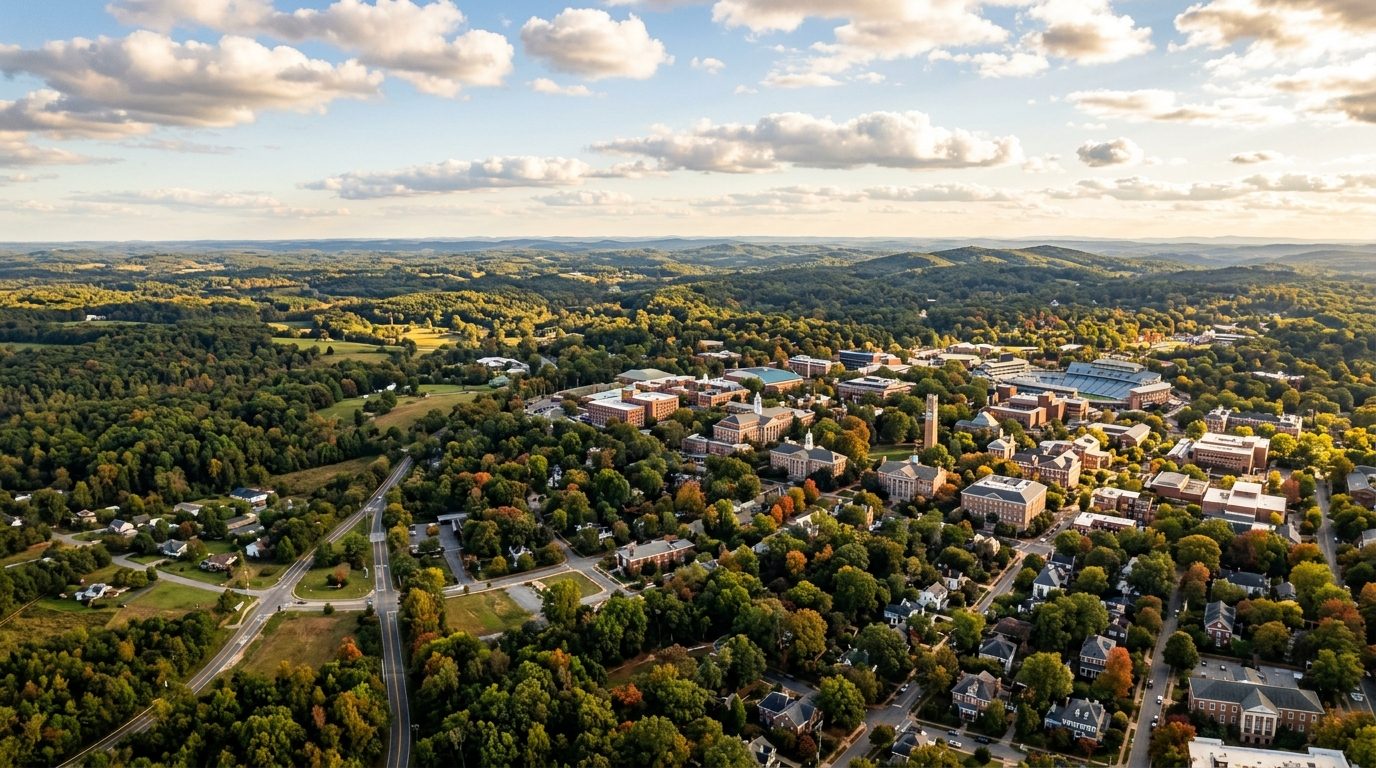
Current real estate market data, news and analysis for the Durham-Chapel Hill, NC metropolitan area — 625,485 residents across Chatham, Durham, Orange and Person counties.
Data as of May 2026. Sources: Redfin Data Center, U.S. Census Bureau.
Latest Durham Real Estate News
Durham Real Estate Market Overview
The Durham-Chapel Hill metro sits in the North Carolina Piedmont, a belt of rolling hills and hardwood forest between the coastal plain and the mountains, drained by the Eno, Haw, and New Hope rivers and bordered in part by Jordan Lake. Durham, Chapel Hill, Carrboro, and Hillsborough form the more urban and suburban eastern core, while Chatham County stretches southwest through Pittsboro, Siler City, and Goldston into farmland and forest, and Person County extends north toward Roxboro near the Virginia line. The climate is humid subtropical, with hot, humid summers and mild, wet winters that occasionally bring ice storms. Housing stock ranges from early twentieth-century mill housing, bungalows, and brick ranch homes near Durham’s urban core to postwar suburban subdivisions, newer master-planned developments on the metro’s growing edges, and farmhouses on larger rural lots across Chatham and Person counties.
Homes closest to Duke University and to the University of North Carolina at Chapel Hill tend to sit at the higher end of the market, reflecting walkability, mature tree canopy, historic architecture, and access to the Chapel Hill-Carrboro City Schools district, which draws sustained buyer interest. Established in-town neighborhoods near Duke’s East and West campuses, private communities built around golf courses, and newer village-style developments with retail centers also command a premium. Farther from the university corridors and Research Triangle Park job centers, in the smaller Chatham County towns, in Roxboro and Person County, and on Durham’s outer edges, homes tend to be older or more modest and commutes to major employers run longer, which keeps pricing more moderate.
The metro’s economy centers on higher education, medicine, and research. Duke University and Duke University Health System together form the largest employer based in Durham, and the University of North Carolina at Chapel Hill and North Carolina Central University add further university and hospital employment. Research Triangle Park, whose eastern edge lies within Durham County, hosts U.S. operations of companies including IBM, GlaxoSmithKline, Biogen, Cisco, and IQVIA, alongside the National Institute of Environmental Health Sciences and the nonprofit research institute RTI International. Durham is also headquarters to semiconductor maker Wolfspeed, which is building a large wafer-fabrication plant in Chatham County near Siler City, while Vietnamese automaker VinFast has an assembly plant under development in the Chatham County community of Moncure, extending the region’s manufacturing base to the west.
Summer and early fall bring the risk of heavy rain and inland flooding from the remnants of Atlantic hurricanes and tropical storms, and spring storm systems can produce isolated tornadoes across the Piedmont, so flood-zone status and local storm history are worth checking parcel by parcel. Property taxes are set separately by Durham, Orange, Chatham, and Person counties and by individual municipalities, so rates and reassessment schedules can differ across county lines within the same metro. Public transit is limited to regional and local bus service, so most residents drive, and roads connecting Durham, Chapel Hill, and the Research Triangle Park corridor can see heavy traffic at peak hours. Chapel Hill, Carrboro, and Durham each apply their own zoning, historic-district, and design-review rules, while Chatham County’s growth around Chatham Park and new industrial sites is reshaping local road and utility capacity, so buyers should confirm water and sewer service, septic and well status, and any HOA obligations before purchasing in outlying areas.
Cities and Towns in the Durham Metro Area
Notable Communities and Neighborhoods
Durham Real Estate Market FAQ
How is the Durham-Chapel Hill metro organized geographically?
The metro spans Durham, Orange, Chatham, and Person counties. Durham and Chapel Hill, along with Carrboro and Hillsborough, form the more urban and suburban core around Duke University and the University of North Carolina at Chapel Hill. Chatham County extends southwest through Pittsboro, Siler City, and Goldston into more rural, farmland terrain, while Person County reaches north to Roxboro near the Virginia state line.
Which parts of the metro tend to be pricier, and why?
Areas closest to Duke University and UNC-Chapel Hill’s campuses, along with neighborhoods zoned to the Chapel Hill-Carrboro City Schools district, generally command higher prices because of walkability, mature landscaping, historic housing stock, and short commutes to major employers. Private golf-course communities and newer village-style developments with their own retail centers also sit toward the upper end. Smaller towns farther from the university corridors and Research Triangle Park, including parts of Chatham and Person counties, tend to be more moderately priced.
What should buyers verify locally before purchasing in this metro?
Because the metro crosses four counties and numerous municipalities, buyers should confirm which county and school district a property falls in, whether it is served by public water and sewer or relies on well and septic systems, current zoning and any historic-district design rules, homeowners association requirements in planned communities, and flood-zone status, since flood maps and local ordinances vary by jurisdiction even within the same metro.
What is the main region-specific risk to be aware of?
The Piedmont location means exposure to heavy rain and inland flooding from the remnants of Atlantic hurricanes and tropical storms, particularly in late summer and early fall, as well as occasional tornadoes from spring storm systems. Because flood risk is localized to specific waterways and low-lying parcels rather than the metro as a whole, checking a property’s individual flood-zone designation and storm history is more informative than relying on countywide risk labels.
Nearby Markets