
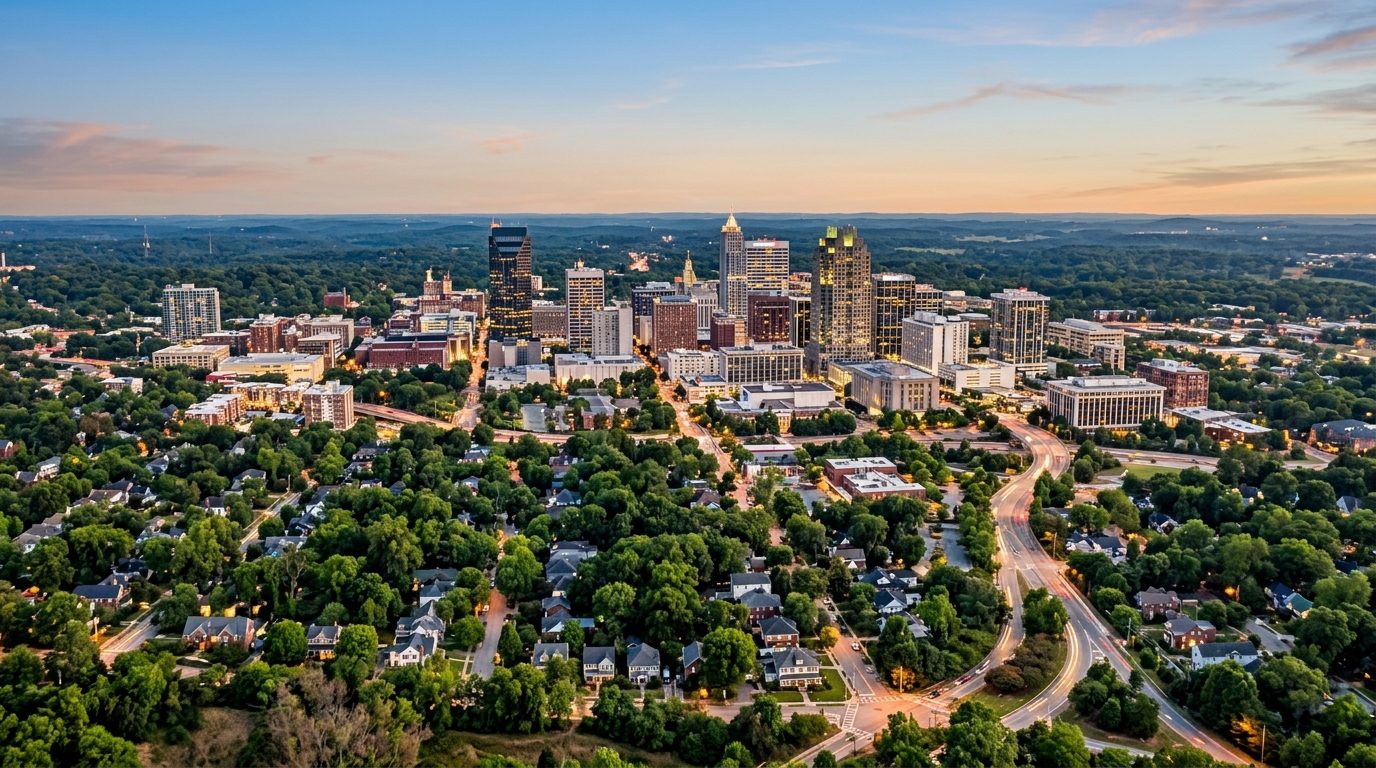
Current real estate market data, news and analysis for the Raleigh-Cary, NC metropolitan area — 1.6M residents across Franklin, Johnston and Wake counties.
Data as of May 2026. Sources: Redfin Data Center, U.S. Census Bureau.
Latest Raleigh Real Estate News
Raleigh Real Estate Market Overview
Raleigh-Cary covers Wake, Johnston and Franklin counties in central North Carolina. Raleigh contains early neighborhoods near downtown, mid-century subdivisions, apartments, condominiums, townhouses and extensive infill. Cary developed largely as a suburban employment and residential center and includes established subdivisions, planned communities and mixed-use districts. Apex, Holly Springs, Fuquay-Varina, Garner, Knightdale, Wake Forest and Wendell form additional growth corridors across Wake County. Johnston County contains expanding suburban communities near Clayton and Archer Lodge as well as older towns, farms and rural properties. Franklin County adds small municipalities, larger parcels and commuter-oriented development north and northeast of Raleigh.
Higher price tiers are generally associated with Hayes Barton, parts of North Hills, Five Points, established central Raleigh neighborhoods, western Cary and selected communities in Apex and Wake Forest. These areas tend to combine mature landscaping, limited infill land, larger lots, school access or proximity to major employment centers. More attainable choices are often found in eastern and southern Wake County, Johnston County towns such as Selma and Smithfield, and Franklin County communities farther from central Raleigh. Outer areas may offer newer housing or more land, but buyers should consider commuting distance, road capacity, utility availability, school assignments and whether surrounding rural land is planned for development.
The economy is supported by state government, higher education, technology, life sciences, health care, professional services and advanced manufacturing. The State of North Carolina and North Carolina State University anchor employment in Raleigh. Major health systems, public agencies and corporate employers are distributed across the city and suburban business corridors. Research Triangle Park lies between Raleigh, Durham and Chapel Hill and influences housing demand in western Wake County and Cary. Technology, biotechnology and pharmaceutical employers operate throughout the broader Triangle, while Johnston and Franklin counties add manufacturing, logistics, agriculture and local-government employment.
Development patterns are influenced by municipal annexation, utility extensions, watershed protections and the conversion of farms and forested tracts into subdivisions. Public transportation serves Raleigh and selected regional routes, but most suburban and outer-county households remain automobile-dependent. Heavy rain, hurricanes, severe thunderstorms and occasional winter freezes can affect roofs, trees, drainage and crawl spaces. Clay soils and sloped lots may contribute to foundation or retaining-wall concerns. Buyers should verify sewer or septic service, homeowners association obligations, stormwater facilities, construction permits and future road plans. Properties near lakes, streams or protected watersheds may also face flood, buffer or development restrictions that require parcel-specific review.
Cities and Towns in the Raleigh Metro Area
Notable Communities and Neighborhoods
Raleigh Real Estate Market FAQ
How is the Raleigh-Cary housing market geographically organized?
The market is centered on Raleigh and Cary, with suburban growth extending through Wake County and into Johnston and Franklin counties. Employment nodes, highway corridors, school systems, municipal utilities and the transition from urban neighborhoods to rural land create distinct submarkets.
Which Raleigh-area locations generally sit in higher price tiers?
Hayes Barton, parts of North Hills, Five Points, established central Raleigh neighborhoods, western Cary and selected communities in Apex and Wake Forest generally occupy higher tiers. Limited infill land, mature housing, school access, larger lots and proximity to major employment centers contribute.
What should buyers verify in a new Raleigh-area community?
Buyers should review homeowners association rules, builder warranties, school assignments, utility providers, road plans and nearby approved development. They should also confirm whether recreation amenities, retail centers and transportation improvements are complete, funded or still proposed.
What property conditions should Raleigh-area buyers investigate?
Buyers should examine drainage, grading, crawl spaces, foundations, roofs, retaining walls and sewer or septic systems. Heavy rain, severe storms, clay soils, mature trees and occasional hurricanes or winter freezes can create property-specific concerns.
Nearby Markets