
Current real estate market data, news and analysis for the Las Vegas-Henderson-North Las Vegas, NV metropolitan area — 2.4M residents across Clark county.
Data as of May 2026. Sources: Redfin Data Center, U.S. Census Bureau.
Latest Las Vegas Real Estate News
Las Vegas Real Estate Market Overview
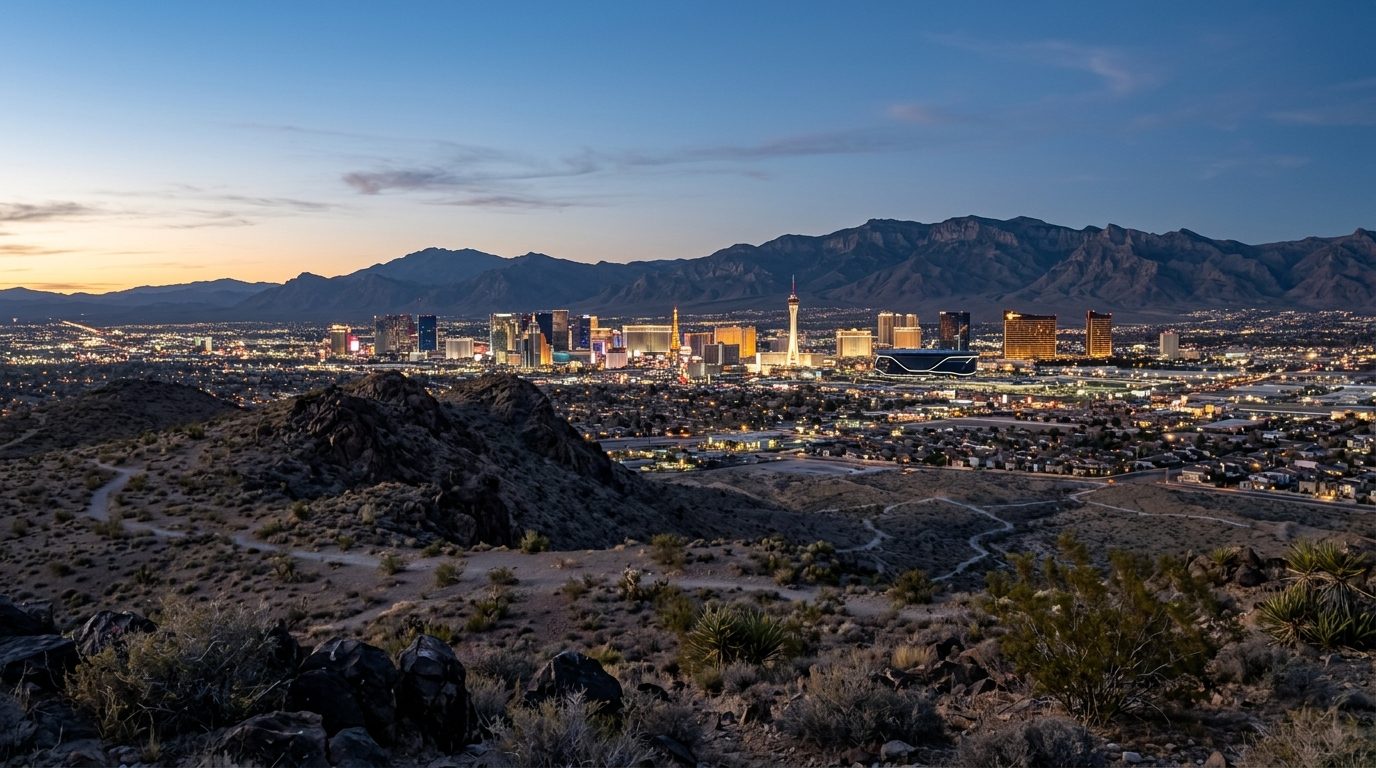
Las Vegas-Henderson-North Las Vegas consists entirely of Clark County and is centered on the Las Vegas Valley, a desert basin bordered by mountain ranges. Most residential development lies in Las Vegas, Henderson and North Las Vegas, with additional communities extending toward the foothills and along the principal freeway corridors. Housing includes mid-century ranch homes, stucco tract houses, townhouses, condominiums, high-rise residences and extensive master-planned development. Boulder City has a smaller-town layout and a distinct development history, while Mesquite forms a separate golf, retirement and resort-oriented market near the Arizona border. Unincorporated areas such as Paradise, Spring Valley and Enterprise contain substantial housing even though they do not appear in the incorporated-city list.
Higher price tiers are generally associated with The Ridges, MacDonald Highlands, Seven Hills, Southern Highlands, Anthem, Queensridge and selected sections of Summerlin and Lake Las Vegas. These areas tend to combine elevated views, gated access, custom construction, golf or club amenities and proximity to western or southern employment corridors. More attainable options are commonly found in older central neighborhoods, parts of east Las Vegas, established sections of North Las Vegas and outer subdivisions without extensive private amenities. Buyers comparing newer communities should account for homeowners association structures, sub-associations, special assessments, landscaping obligations and commuting distance rather than focusing only on the age or size of the home.
Tourism, gaming, conventions and hospitality remain central to the regional economy, supported by casino resorts, entertainment venues and the Las Vegas Convention Center. Additional employment comes from health care, logistics, construction, government, education, professional services and military activity. Harry Reid International Airport supports passenger travel and related businesses, while Nellis Air Force Base anchors defense employment in the northeast valley. Distribution and industrial development have expanded along the interstate corridors, and Henderson contains office, medical, retail and light-industrial employment outside the resort corridor.
Extreme heat, limited rainfall, flash flooding and water management are defining real-estate considerations. Air-conditioning condition, insulation, roof materials, window exposure and shade can materially affect comfort and operating demands. Desert washes may carry water rapidly during storms, so a property outside an obvious river setting can still face drainage concerns. Southern Nevada water policy encourages conservation and limits certain forms of ornamental turf, making landscaping rules relevant in both new and established communities. Buyers should also investigate expansive soils, pool condition, solar agreements, homeowners association restrictions and whether adjacent desert parcels are entitled for future development. Public transportation serves selected routes, but most households remain automobile-dependent, and freeway access strongly influences commute patterns.
Cities and Towns in the Las Vegas Metro Area
Notable Communities and Neighborhoods
Las Vegas Real Estate Market FAQ
How is the Las Vegas metro housing market geographically organized?
Most housing is concentrated in the Las Vegas Valley, with Las Vegas, Henderson and North Las Vegas surrounded by master-planned communities and mountain-edge development. Boulder City and Mesquite operate as smaller, more geographically separate submarkets within Clark County.
Which Las Vegas-area locations generally sit in higher price tiers?
The Ridges, MacDonald Highlands, Anthem, Seven Hills, Southern Highlands and selected sections of Summerlin and Lake Las Vegas generally occupy higher tiers. Views, gated access, golf or club amenities, larger lots and newer custom construction contribute to those differences.
What should buyers verify in a Las Vegas master-planned community?
Buyers should review homeowners association rules, sub-association fees, special-improvement obligations, recreation privileges and restrictions on rentals or exterior changes. They should also confirm which amenities are complete and whether nearby vacant land has approved development plans.
What climate and property issues should Las Vegas buyers investigate?
Buyers should examine cooling systems, roof condition, window performance, desert drainage, expansive soils and water-efficient landscaping. Properties near washes, foothills or open desert may also require review of flash-flood exposure, wildfire conditions and access during extreme weather.
Nearby Markets