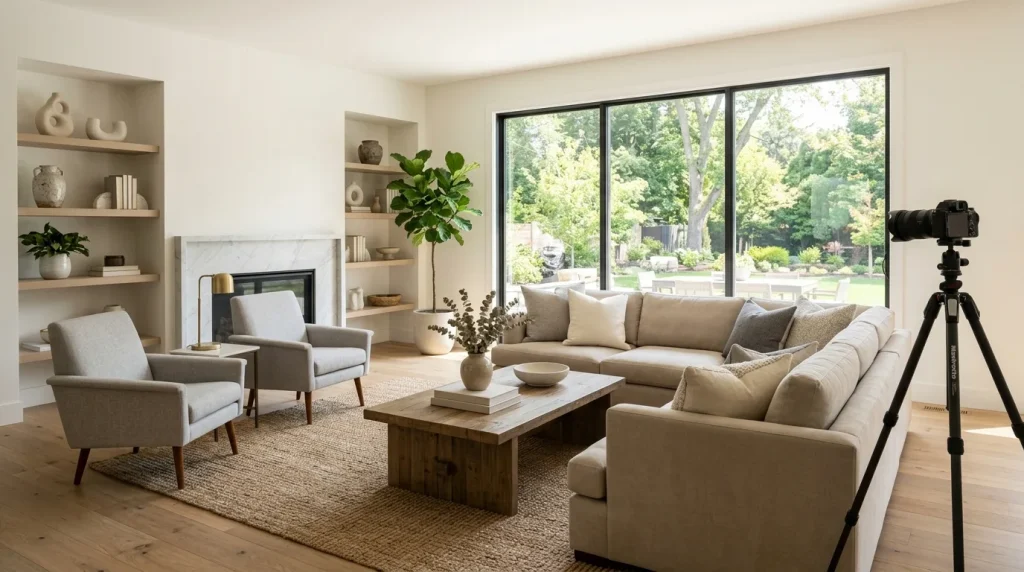
Home staging still matters in 2026, but sellers do not need to stage every room or chase every design trend.
The best staging strategy is practical: help buyers understand the space, make the home look clean and move-in ready, and remove distractions that make buyers focus on the seller instead of the property.
NAR’s 2025 Profile of Home Staging found that 83% of buyers’ agents said staging made it easier for buyers to envision a property as their future home. That is the core value of staging. It is not decoration for decoration’s sake. It is a marketing tool.
Key takeaways
- Staging helps buyers picture themselves in the home.
- NAR said 83% of buyers’ agents reported staging made visualization easier.
- The living room, primary bedroom and kitchen matter most to buyers.
- Photos, video and virtual tours are part of the staging strategy.
- Sellers do not always need full professional staging.
- Decluttering, cleaning and small repairs can make a major difference.
The rooms buyers care about most
Not every room carries the same weight.
NAR reported that buyers considered the living room the most important room to stage, at 37%, followed by the primary bedroom at 34% and the kitchen at 23%. Among sellers’ agents, the most commonly staged rooms were the living room, primary bedroom, dining room and kitchen.
That gives sellers a clear priority list. Start where buyers spend the most mental energy: the main living space, the bedroom they imagine using, and the kitchen.
A perfectly staged guest room matters less if the living room feels cramped or the kitchen looks cluttered.
Staging starts online
Staging is not only about what buyers see in person. It starts with the listing photos.
NAR said buyers’ agents emphasized the importance of photos, traditional physical staging, videos and virtual tours to their clients.
That means staging should be done before photography, not after the listing has already gone live. A home with weak photos may lose buyers before they ever schedule a showing.
What still matters to buyers
The most effective staging choices are often basic.
Sellers should focus on removing clutter, cleaning deeply, improving lighting, arranging furniture to show room function, neutralizing bold personal decor, removing oversized furniture, making bedrooms look calm, clearing kitchen counters, improving curb appeal and fixing distracting maintenance issues.
Staging should not feel like a disguise. If there are real condition problems, staging will not fix them.
Professional staging vs. DIY staging
Professional staging can help, especially for vacant homes, luxury listings, unusual floor plans or properties that have struggled to sell.
But full staging is not always necessary. NAR reported that 51% of sellers’ agents did not stage homes before listing but recommended that sellers declutter or correct property faults.
That matters for sellers watching costs. A vacant property may need furniture to show scale. An occupied property may need editing, cleaning and rearranging more than rented furniture.
Does staging increase value?
Staging can affect buyer perception, but sellers should be careful about overpromising.
NAR reported that 29% of agents said staging their sellers’ homes led to a 1% to 10% increase in the dollar value offered. It also said 49% of sellers’ agents observed staging reduced time on market.
Those findings support staging as a useful tool, but they do not mean staging guarantees a higher offer. Price, condition, location and market demand still matter.
What this means
Home staging in 2026 should be targeted, not excessive.
Sellers should focus first on the rooms buyers care about most, the photos that drive online interest and the condition issues that create doubt. A clean, bright, uncluttered home with clear room function can often outperform a more expensive but poorly planned staging effort.
FAQ
Is home staging worth it in 2026?
It can be, especially if the home is vacant, cluttered, dated or difficult to understand from photos. The value depends on the property and market.
Which room is most important to stage?
NAR reported that buyers considered the living room the most important room to stage, followed by the primary bedroom and kitchen.
Do sellers need professional staging?
Not always. Some homes need professional staging, while others only need decluttering, cleaning, better furniture placement and minor repairs.
Does staging help homes sell faster?
NAR reported that nearly half of sellers’ agents observed staging reduced time on market, but results vary by property and market.
Is virtual staging enough?
Virtual staging can help buyers understand an empty room online, but it should be clearly presented and should not mislead buyers about the property’s condition.
Sources
- NAR 2025 Profile of Home Staging Press Release
- NAR 2025 Profile of Home Staging Report
- NAR Profile of Home Staging Research Page