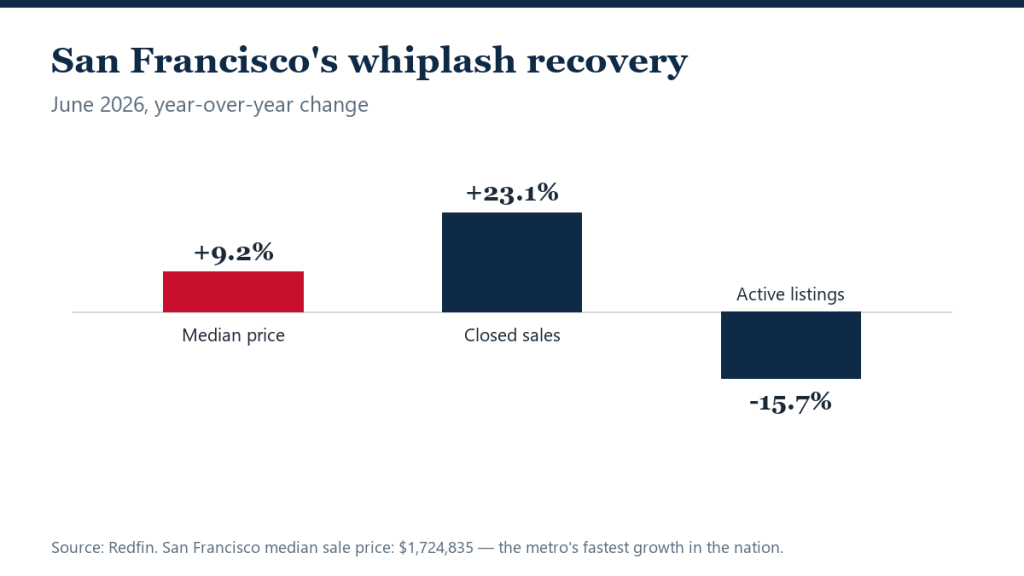
San Francisco has gone from national cautionary tale to national outlier — in the opposite direction. The metro’s median sale price hit $1,724,835 in June, up 9.2% from a year earlier and the fastest growth among major U.S. metros, while closed sales surged 23.1% and active listings fell 15.7%, Redfin data shows.
Every component of that combination — prices, volume and shrinking supply moving together — describes a market tightening at speed. Three years after leading the nation’s pandemic-era declines, San Francisco is leading its recovery.
The rebound in numbers
- Median sale price: $1,724,835 — up 9.2% year over year, the strongest among major metros.
- Closed sales: up 23.1% — the biggest jump in the nation alongside West Palm Beach.
- Active listings: down 15.7%; homes go pending in a median of about 20 days.
- Momentum: pending sales rose 16.4% year over year, the second-highest level in four years.
What flipped
Three forces converged. Technology wealth returned to the city — visible most dramatically in the doubling of $5 million-plus sales ahead of anticipated AI IPOs. Supply never really arrived: San Francisco builds little, and pandemic-era sellers already sold, leaving inventory to shrink into recovering demand. And the discount got noticed — after years of price declines, the city offered relative value its own residents recognized first, the same luxury-led mechanics lifting metro medians nationally.
The rebound’s texture matters as much as its size: it is luxury-weighted, cash-heavy and concentrated — a wealth recovery more than a broad-based one, mirroring the statewide pattern of records on thin volume. Middle-market buyers face the recovery’s costs (competition, urgency) without its fuel (equity windfalls), and the metro’s affordability, briefly improved by decline, is deteriorating again.
What it means
For sellers, the drought is over — well-priced San Francisco listings now clear in under three weeks with competition, and the 15.7% inventory decline says the leverage shift has room to run. For buyers, the calculus has hardened: waiting has visible costs, but so does chasing a market accelerating on anticipated wealth; disciplined offers with strong terms beat emotional escalation. For everyone watching housing’s map, San Francisco’s whiplash is the reminder that no market narrative — doom or boom — survives contact with three years of supply scarcity.
The forward indicators say the tightening has momentum: pending sales rose 16.4% year over year to their second-highest level in four years, while new listings citywide fell to their lowest level since December. Demand accelerating into shrinking supply is the setup that precedes bidding-war springs — San Francisco’s 2027 selling season is being loaded now.
The company it keeps tells the story’s shape: Pittsburgh (+9.1%) and West Palm Beach (+8.6%) round out the national growth podium — one recovering legacy city and one wealth-migration magnet — but San Francisco is the only member combining top-tier price growth with a 23% sales surge and double-digit inventory decline simultaneously. Nothing else in the major-metro data looks like it.
The distributional footnote matters for anyone reading this as simple good news: a recovery driven by equity events and cash concentrates its benefits on owners and its costs on aspiring entrants. The city’s teachers, service workers and young families face 2018 affordability with 2026 prices — the recovery is real, and so is who it leaves out.
FAQ
Is San Francisco really the fastest-growing housing market?
By June median-price growth among major metros, yes — 9.2%, ahead of Pittsburgh (9.1%) and West Palm Beach (8.6%) in Redfin’s data.
Didn’t San Francisco crash after 2021?
It corrected hard — among the deepest declines of any major metro through 2023. The current surge partly recovers that lost ground, which flatters the growth rate.
Can the rebound outlast the IPO cycle?
Supply says it can persist: the city adds little housing regardless of demand. But the current pace is anticipation-fueled, and a disappointing IPO season would test how much of the recovery stands on fundamentals.