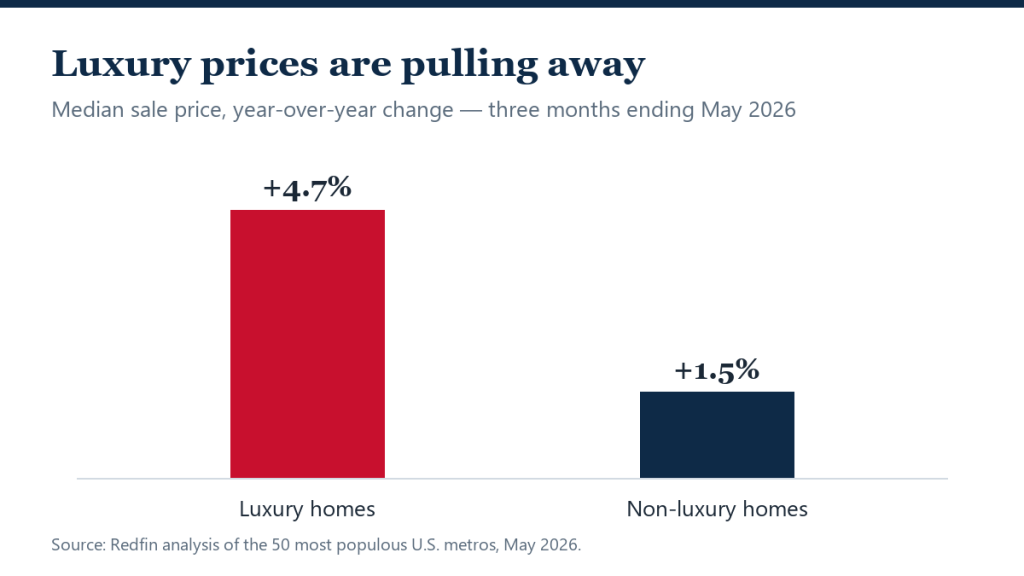
Luxury home prices climbed 4.7% year over year in the three months ending May 2026 — more than three times the 1.5% gain for the rest of the market, according to a Redfin analysis of the 50 largest U.S. metros. The median luxury sale price reached $1,374,470, versus $377,477 for non-luxury homes.
The gap extends beyond prices. Pending luxury sales rose 5.2% from a year earlier, ahead of the 3.6% increase for the broader market, even as high mortgage rates continue to sideline mainstream buyers. Redfin defines luxury as the homes estimated to be in the top 5% of their metro area by market value.
The divergence underscores a two-speed housing market in 2026: affluent buyers — more likely to pay cash or carry smaller mortgages relative to income — are largely insulated from the financing costs that dominate the price softness spreading through the broader market.
The numbers behind the gap
- Median sale price: $1,374,470 for luxury homes (+4.7% year over year) versus $377,477 for non-luxury (+1.5%).
- Pending sales: +5.2% for luxury versus +3.6% for non-luxury.
- Days on market: a median 49 days for luxury homes and 44 for the rest of the market — both slower than a year earlier.
- New listings: up 1% for luxury while non-luxury listings slipped 0.4%.
Notably, even the high end is not immune to the market’s slower metabolism: the typical luxury home took five days longer to go under contract than a year ago. Wealthy buyers are winning on price growth, not urgency.
Where luxury is hottest — and where it is cooling
Florida leads the price gains. Luxury prices jumped 15.6% in Tampa and 14.2% in Miami, followed by Las Vegas at 13.7%. Prices fell in only four of the 49 metros analyzed: New Brunswick, N.J. (-4.3%), Oakland (-1.8%), Detroit (-1.0%) and Dallas (-0.3%).
The most dramatic activity shift is in San Francisco, where pending luxury sales surged 45.9% and closed luxury sales rose 46.3% from a year earlier — by far the largest increases in the country, as anticipated technology-sector wealth flows into a thin supply of high-end homes.
There are stretch marks in the Sun Belt boom, though. In Miami, the typical luxury home took 24 more days to go under contract than a year earlier — the biggest slowdown Redfin measured — suggesting sellers’ price expectations are running ahead of what buyers will move quickly on. Rising insurance and association costs are part of that hesitation, as Florida’s condo and insurance rules reshape high-end ownership costs.
Why the high end is outrunning the market
Three forces separate luxury performance from the mainstream market. First, financing: luxury buyers are far more likely to pay cash or borrow well below their capacity, muting the effect of mortgage rates. Second, wealth effects: equity markets near records and maturing stock compensation have expanded high-end purchasing power. Third, supply: luxury inventory grew just 0.4% year over year, so even moderate demand meets little competition.
International demand adds a fourth layer in gateway markets. Foreign buyers purchased $56 billion of U.S. homes in the most recent NAR data, concentrated in exactly the metros where luxury prices are rising fastest.
What it means for sellers and agents
For luxury sellers, pricing power is real but local: a Tampa or Miami listing carries momentum a Dallas or Oakland listing does not. For agents, the data argues for segment-specific advice — the national headlines describing a cooling market simply do not describe the top 5%, and treating the two markets as one leads to mispriced listings in both directions.
FAQ
What counts as a luxury home in this data?
Redfin defines luxury as the homes estimated to be in the top 5% of their metro area by market value. The threshold varies widely by metro — the luxury median is $5.3 million in Anaheim but under $1 million in several Midwest markets.
Why are luxury prices rising faster than regular home prices?
Luxury buyers are less dependent on mortgages, benefit from strong equity markets, and face very limited inventory. The broader market, by contrast, is constrained by financing costs and expanding supply.
Is the luxury market slowing anywhere?
Yes. Prices fell modestly in New Brunswick, Oakland, Detroit and Dallas, and luxury homes nationally are taking five days longer to sell than a year ago — with Miami slowing the most at 24 additional days.