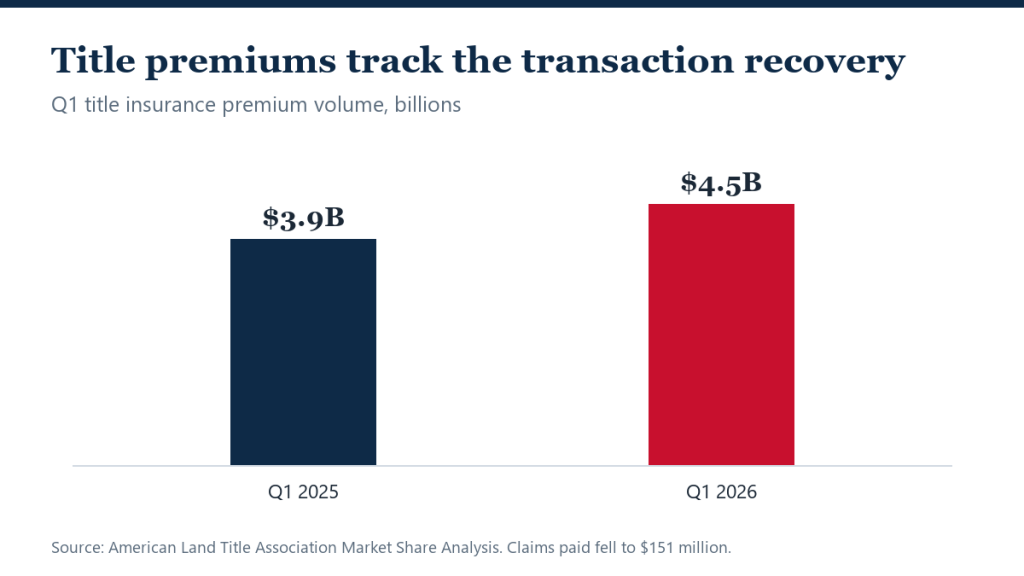
The title insurance industry wrote $4.5 billion in premiums in the first quarter — up from $3.9 billion a year earlier — and because title premiums are generated only when transactions close, the 15% jump doubles as one of the cleanest readings yet on housing’s volume recovery, per the American Land Title Association’s Market Share Analysis.
Claims moved the other way: insurers paid $151 million in the quarter, down from about $161 million a year earlier — rising volume with falling claims, the industry’s best-case quadrant.
Where the growth landed
- Premiums: $4.5 billion, up from $3.9 billion in Q1 2025.
- Claims paid: nearly $151 million, down from about $161 million.
- Top states: Texas ($628M, +8.0%), Florida ($493M, +10.1%), California ($371M, +15.3%), New York ($323M, +18.7%) — and Pennsylvania, up a remarkable 46.4% to $203M.
- Market share: First American led underwriters at 24.2%, followed by Fidelity National (13.9%) and Old Republic (13.7%).
“Every real estate transaction represents a significant financial investment, and title professionals are working behind the scenes to ensure those transactions can close safely and securely,” said ALTA CEO Chris Morton, adding that the results reflect demand for work that identifies “hidden risks” as fraud threats grow.
The fraud subtext
Morton’s fraud reference is not boilerplate. Title and escrow sit at the choke point of real estate wire fraud — the fastest-growing threat to closing funds — and seller-impersonation schemes targeting vacant land have pushed title verification work well beyond the traditional lien search. Rising premium volume funds that defense exactly as the threat scales.
What it means
For consumers, the report is a reminder that the title line on the closing sheet — often $1,000–$2,000 of total closing costs — buys both a claims backstop and, increasingly, fraud interdiction. For industry watchers, premium volume rising 15% while national sales counts grew single digits suggests the recovery is strongest in higher-priced coastal transactions — consistent with the luxury-led pattern in June’s price data.
The market-share table doubles as a concentration report: the top four underwriting families — First American, Fidelity, Old Republic and Chicago Title — wrote roughly 64% of national premium. That concentration is why regulators watch title pricing closely, and why the industry leans on state-level data like this to argue competition is working; Pennsylvania’s 46% growth, for instance, came alongside independent underwriters gaining share in several states.
The claims math explains the business model’s resilience. At $151 million paid against $4.5 billion written, claims consumed barely 3% of premium — title insurance prevents losses through the search process rather than paying them afterward, the inverse of most insurance lines. Falling claims in a rising-volume quarter suggests the industry’s fraud and defect screening is holding up under load.
ALTA releases its second-quarter analysis around September 1 — a report worth watching as a check on whether spring’s transaction recovery carried through the summer.
FAQ
Why do title premiums track the housing market?
A title policy is purchased at closing, so premium volume moves nearly one-for-one with transaction volume and price levels — making it a useful confirmation of sales data reported elsewhere.
Is title insurance required?
Lenders require a lender’s policy on financed purchases; the owner’s policy is optional but broadly recommended, since it protects the buyer’s equity against title defects for as long as they own the home.
Why is Pennsylvania up 46%?
ALTA’s data does not break out causes, but a jump that size typically reflects both stronger transaction volume and higher insured values in the state’s recovering metros.