California has written what the governor’s office calls the country’s first enforceable rules for wildfire smoke-damage insurance claims, and has made disaster mortgage forbearance an automatic protection in state law rather than something negotiated after each fire, under four bills Gov. Gavin Newsom signed in Altadena, Calif., on Sept. 15.
The package answers a problem that surfaced after the January 2025 Eaton and Palisades fires and has no precedent in insurance law: what happens to a house that never burned but is full of smoke contamination. The state Department of Insurance estimates that more than 13,000 of the roughly 40,000 claims filed after those fires involve smoke damage to homes that were left standing, according to the governor’s office. Until now, the announcement says, no state had enforceable standards for how those homes should be tested, cleaned or restored.
What the smoke bills require
Assembly Bills 1642, by Assemblymember Harabedian, and 1795, by Assemblymember Mike A. Gipson, D-Carson, direct the Department of Toxic Substances Control and the California Air Resources Board to write the state’s first standards for testing, remediating and restoring lead and asbestos contamination from wildfire smoke in homes inside a fire’s ZIP codes. DTSC is also directed to issue guidance for schools recovering after a fire.
The insurance obligations are the part carriers will feel. Insurers must pay for lead and asbestos testing and remediation in smoke-damaged homes within a wildfire zone, cover full cleanup and restoration to pre-loss condition, and may not cut off Additional Living Expense coverage — the money that pays for a rental while a family is displaced — until a home has actually been remediated and is safe to occupy.
“Science, not an insurance company’s opinions, will determine whether a home is safe,” Harabedian said. Gipson framed the change as shifting the burden of proof: “Insurers, not survivors, must bear the responsibility of proving that a home is safe.”
Forbearance becomes automatic
The mortgage half of the package matters beyond California’s fire perimeter. Assembly Bills 1842 and 1847, both by Harabedian, convert into statute the forbearance terms Newsom negotiated directly with loan servicers after the Los Angeles fires, so that comparable protections switch on automatically after a future disaster rather than depending on a governor’s leverage.
The laws also double the forbearance window available by law to Los Angeles fire survivors, from 12 months to 24, and require servicers to offer borrowers the option to defer repayment of missed payments to the end of the loan — with a carve-out where investor contract terms or servicing guidelines prohibit it. That carve-out is not small: a servicer’s discretion ends where its obligations to the investors who own the loan begin.
AB 1847 separately extends the Mortgage Relief Act, Harabedian’s AB 238 from last year, for another year for Los Angeles fire survivors still rebuilding.
“AB 1842 creates a national model for granting mortgage forbearance to future wildfire survivors so no family has to immediately pay a mortgage for a home that no longer exists,” Harabedian said.
Separately from the new statutes, the state’s CalAssist Mortgage Fund offers survivors up to 12 months and $100,000 of mortgage relief that does not have to be repaid, and a recently appropriated $100 million Disaster Rebuilding Fund is intended to make rebuilding loans cheaper and easier to get.
Where the rebuild stands
The scale of the claims tells you why the legislature acted. As of March 2026, nearly 42,000 insurance claims had been filed from the Los Angeles fires and more than 40,000 had been at least partially paid, totaling $23.7 billion, according to the Department of Insurance.
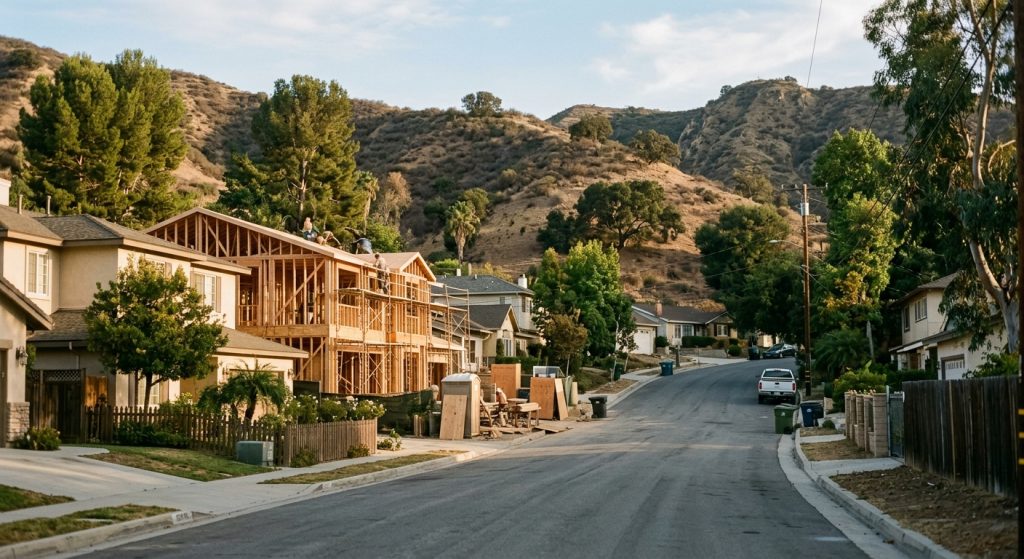
Rebuilding is further along than the claims picture suggests. Local building departments have issued 8,450 permits, the governor’s office said this week; the state does not issue local permits but has funded permitting staff, systems and an AI plan-check tool called Archistar that lets homeowners catch code problems before they file. Newsom has issued 28 executive orders since the fires to speed debris removal, temporary housing and rebuilding, and to tighten price-gouging and land-speculation rules.
“These new protections will make insurer obligations clearer and give homeowners more financial flexibility when they need it most,” Newsom said.
Why other states will read this
Smoke-damage disputes and forbearance mechanics are now standing features of the property market in every fire-exposed state, not one-off emergencies. Analysis from Cotality has put $1.4 trillion of Western U.S. property value in wildfire risk zones, and regulators elsewhere are under the same pressure — Texas Gov. Greg Abbott ordered his state’s insurance regulators to act after home premiums climbed 79% in six years.
On our reading, the durable export from this package is not the money but the procedure: a written test-and-clear standard that decides when a house is habitable, and a default forbearance that does not have to be renegotiated each time. Both are things a state can copy without appropriating anything. Whether they hold up depends on the standards DTSC and the Air Resources Board actually write, which have not been issued yet. More policy coverage is on RealtyWire’s Mortgage page.