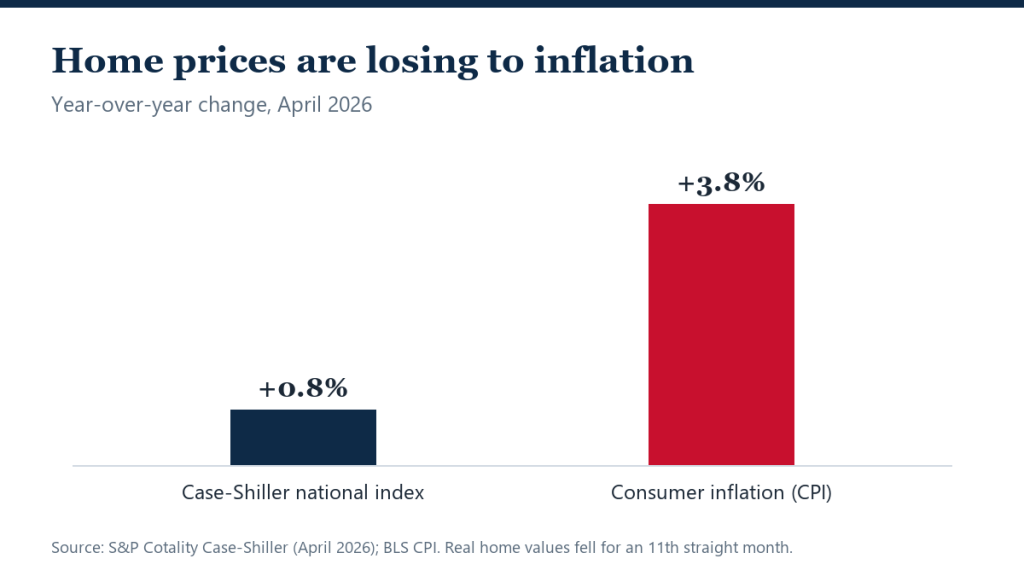
U.S. home prices rose 0.8% in the year through April, the S&P Cotality Case-Shiller national index shows — but with consumer inflation running at 3.8% over the same period, the real, inflation-adjusted value of American housing fell for an 11th consecutive month.
The distinction matters more than it sounds. Nominal prices — the sticker numbers — keep setting records and grabbing headlines. Real prices measure what a home is worth against everything else money buys, and by that measure the average American home has been quietly losing ground for nearly a year.
Nominal gain, real decline
- Case-Shiller national index: +0.8% year over year in April; -0.1% month over month, seasonally adjusted.
- April CPI inflation: 3.8% — meaning real home values fell roughly 3% over the year.
- The streak: 11 consecutive months of real (inflation-adjusted) price declines.
- The spread: Chicago led major metros at +6.5%; Seattle fell 2.3%.
A homeowner’s instinct that “my house is still going up” and an economist’s observation that housing wealth is shrinking are both correct — they are just measured in different units. The same split runs through the question of whether home prices are falling in 2026: nominally mostly no, really mostly yes.
Why real prices are the number that matters
For owners, real declines erode housing’s role as an inflation hedge: equity is growing slower than the cost of living, which changes the math on true ownership costs once taxes, insurance and maintenance — all inflating faster than home values — are counted.
For buyers, the silver lining is genuine: when incomes grow faster than house prices, affordability improves even without price cuts. That is precisely the mechanism NAR credits for its improving affordability index, and it compounds in markets like Seattle where even nominal prices are down.
For the market as a whole, 11 months of real declines is what a soft landing actually looks like — the froth of 2020–2022 deflating through time and inflation rather than through a crash.
The metro split beneath the average
Chicago’s 6.5% gain — comfortably beating inflation — against Seattle’s 2.3% nominal decline illustrates the same regional divergence running through every 2026 dataset: supply-tight Midwest and Northeast markets posting real gains while the West and parts of the Sun Belt give ground in both nominal and real terms.
The monthly reading adds texture: seasonally adjusted, the national index slipped 0.1% in April — a small decline, but notable in what is normally the spring market’s strongest stretch. Nominal weakness during peak season is how longer real-terms slides typically begin.
Streaks like this are uncommon. Real home values also fell during the 2022–2023 rate shock, and before that the pattern belongs to the post-2008 era — but today’s version has a gentler mechanism: sticky inflation eroding flat prices rather than nominal prices collapsing. For long-term owners the equity cushion remains enormous; it is the most recent buyers, purchasing at 2024–2025 prices, for whom the inflation-adjusted math stings.
FAQ
What is the difference between nominal and real home prices?
Nominal is the dollar figure; real subtracts inflation. A home that gains 0.8% while prices overall rise 3.8% has lost about 3% of real value — it buys less of everything else than it did a year ago.
Does this mean home values are crashing?
No. Nominal prices are roughly flat to slightly up. Real declines of this size describe stagnation and inflation catch-up, not distress — sellers still walk away with record dollar amounts.
Is real estate still an inflation hedge?
Over long horizons, historically yes. Over the past 11 months, no — housing has trailed inflation, which is unusual and worth watching as leases, insurance and taxes reprice.
Sources
- S&P Dow Jones Indices — Case-Shiller April 2026 results
- Bureau of Labor Statistics — Consumer Price Index