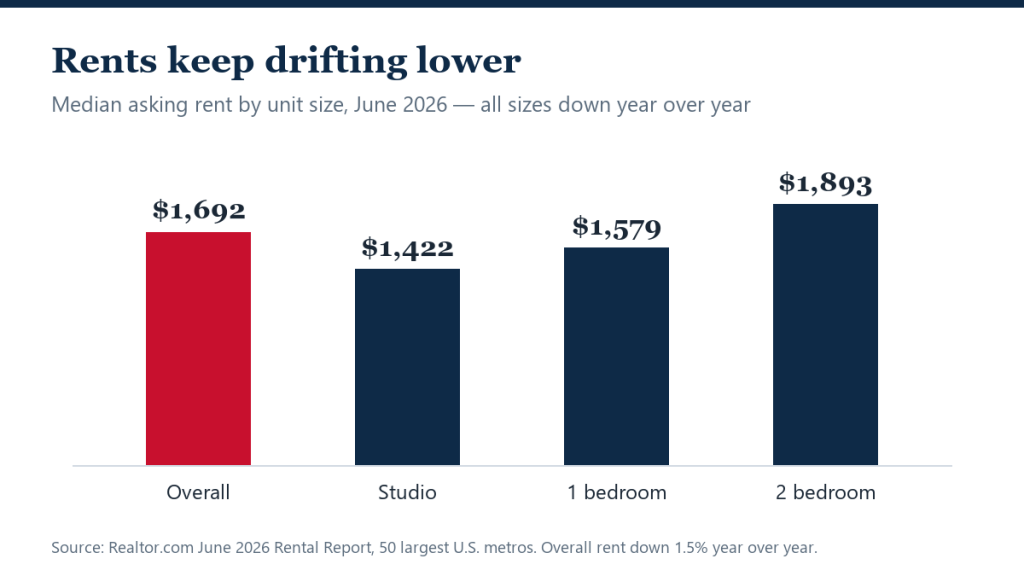
The median asking rent across the 50 largest U.S. metros fell to $1,692 in June — down $25, or 1.5%, from a year earlier — marking the 35th consecutive month of annual rent declines, according to Realtor.com’s June Rental Report.
Rents are now $72 below their August 2022 peak, and the relief spans every unit size: studios fell 2.2% year over year, with one- and two-bedroom units each down 1.4%. The cause remains the same one documented all year — a historic wave of new apartment supply still working through lease-ups — but the report adds a warning about what happens when that wave ends.
June’s rental numbers
- Median asking rent: $1,692 — down 1.5% year over year, the 35th straight annual decline.
- Versus the peak: $72 (4.1%) below August 2022; still 16.4% above pre-pandemic June 2019.
- By size: studios $1,422 (-2.2%); one-bedrooms $1,579 (-1.4%); two-bedrooms $1,893 (-1.4%).
The supply warning behind the relief
The report pairs today’s renter-friendly data with a caution about tomorrow’s pipeline: multifamily permitting in 2025 across the 50 largest metros ran 13.1% below 2019 levels. That is a separate, earlier data series than June’s rent figures — but it describes the supply that will (or won’t) exist when the current construction wave is absorbed, the dynamic RealtyWire examined in its look at the coming multifamily supply cliff.
Where permits are recovering, the report finds it concentrated: Florida metros lead, and Columbus, Ohio stands out after its “Zone In” rezoning cleared the way for up to 88,000 new residential units over the next decade. At the other end, New York and Boston — the centers of 2026’s rent-control debate — posted their lowest permit rates since 2019, which Realtor.com reads as evidence that tenant protections alone cannot deliver the supply that actually lowers rents.
What it means for renters and investors
For renters, the practical advice is unchanged from RealtyWire’s concessions guide: the leverage is real — use lease renewals to negotiate, and shop buildings still in lease-up for free weeks and waived fees. Realtor.com expects seasonal month-to-month uticks this summer but continued year-over-year declines through 2026.
For landlords and investors, the split map matters more than the national number: markets with collapsing permit pipelines are the ones where today’s soft rents are most likely to firm first — the calculus behind the vacancy math covered here.
Realtor.com does expect the usual seasonal pattern — month-over-month upticks through the summer — while the year-over-year trend stays negative as the construction pipeline keeps delivering. For a renter signing today, perspective cuts both ways: the median unit costs $25 less than last year but $238 more than in June 2019. The relief is real; the pandemic reset is not undone.
For operators and investors, 35 consecutive months of falling asking rents is quietly rewriting underwriting. Pro formas built on the industry’s habitual 3% annual rent-growth assumption have now missed for almost three years running in these metros — and the markets where permits have collapsed are precisely where that assumption becomes defensible again first.
FAQ
Are rents actually falling, or just rising more slowly?
Falling — the median asking rent is $25 lower than a year ago and $72 below the 2022 peak. But context matters: rents remain 16.4% above pre-pandemic levels.
Why are rents falling while home prices set records?
Different supply stories. Apartments saw a record construction wave that is still delivering units; for-sale housing remains supply-constrained in much of the country.
Will rent relief continue into 2027?
Realtor.com expects year-over-year declines to continue through 2026. Beyond that, weak 2025 permitting suggests the supply cushion thins — which is why the report flags the permit slowdown as the key risk to renters.