U.S. employers added 29,000 jobs in September, the Bureau of Labor Statistics reported at 8:30 a.m. Eastern on Oct. 2 — a gain the agency described as little changed and well short of the 45,000 average monthly increase of the prior 12 months. Construction accounted for 11,000 of that total, and nearly all of it came from work that has nothing to do with housing.
The unemployment rate held at 4.2%, with 7.1 million people unemployed. BLS noted the rate has stayed within a narrow band of 4.1% to 4.3% since March. The labor force participation rate was 61.8% and the employment-population ratio 59.2%, both little changed. The long-term unemployed — people out of work 27 weeks or longer — made up 27.1% of the jobless.
Revisions did more damage than the headline number. July’s change was revised down by 31,000, from a gain of 21,000 to a loss of 10,000, and August was cut by 29,000, from 162,000 to 133,000. Together the two months lost 60,000 jobs from the record. The August figure was the one that revived talk of another Federal Reserve rate increase when it was first published a month ago.
Construction’s gains skip residential
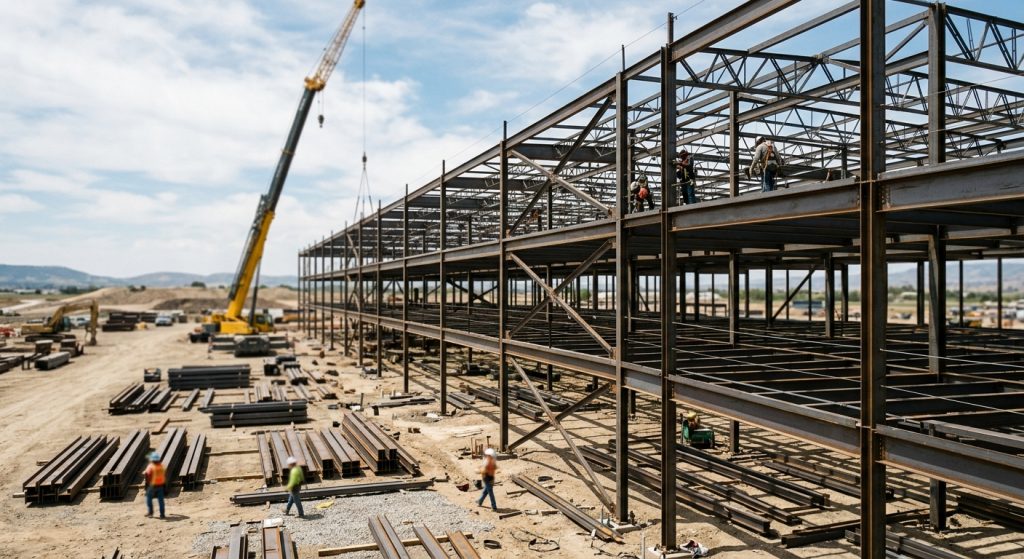
Within construction, the split between commercial and residential work is now stark. Associated Builders and Contractors, which analyzes the BLS payroll data each month, calculated that nonresidential construction added 16,100 jobs in September: 12,300 among nonresidential specialty trade contractors, 2,600 in heavy and civil engineering and 1,200 in nonresidential building. Because the industry’s total gain was 11,000, that arithmetic leaves the residential side in the red for the month. ABC put residential construction employment down 1.0% from a year earlier.
BLS reported the same specialty-trade strength in its own release, saying employment among nonresidential specialty trade contractors “continued to trend up (+12,000).”
Construction employment is up 109,000 over the past year, or 1.3%, and the unemployment rate within the industry was 3.5% — well below the 4.2% national figure, according to ABC’s analysis.
“The construction industry added jobs for the seventh straight month in September,” said Anirban Basu, ABC’s chief economist. “Contractor hiring expectations remain elevated, according to ABC’s Construction Confidence Index, an outlook that seems justified given the insatiable demand for new data centers.”
The division those numbers describe has been building all year: crews are being added for power-hungry computing campuses and other commercial work, while the residential trades employ fewer people than they did a year ago.
Wages, hours and the rest of the economy
Average hourly earnings for private-sector workers rose 5 cents, or 0.1%, to $37.81 in September, and were up 3.0% over 12 months. The average workweek was unchanged at 34.4 hours.
Elsewhere, health care added 17,000 jobs, continuing its upward trend but at a slower pace than its 33,000 monthly average over the prior year. Manufacturing was little changed at 9,000 but has recovered 72,000 positions since a low in December 2025. Financial activities — the category that contains real estate, rental and leasing along with banking and insurance — lost 7,000 jobs.
What it means for rates
The report lands three and a half weeks before the Federal Open Market Committee meets Oct. 27-28. At its last meeting, on Sept. 16, the Fed raised the federal funds target range by a quarter point to 3.75% to 4.00% in a unanimous 12-0 vote, saying inflation “remains elevated” and that the move would support a timelier return to its 2% goal. The statement characterized the labor market as one where “job gains have kept pace with the workforce.”
On our reading, September’s numbers and the downward revisions complicate that characterization and weaken the case for a second consecutive increase this month. But borrowers should be careful about assuming relief at the mortgage window, because the pressure on home loans is currently coming from the long end of the bond market rather than from the Fed’s policy rate. The 10-year Treasury par yield closed at 5.01% on Oct. 1, according to Treasury Department data, with the two-year at 4.13%. That narrow gap between short- and long-dated yields has been a feature of the market since the 10-year yield reached its 2026 high, and the 30-year mortgage tracks the long end rather than the funds rate.
Mortgage rates have followed. Freddie Mac’s Primary Mortgage Market Survey put the 30-year fixed average at 7.28% on Oct. 1, up from 7.03% a week earlier and 6.34% a year ago. The 15-year average was 6.60%, up from 6.42% the prior week and 5.55% in October 2025.
For agents and builders, the two halves of the report pull in the same direction. Payroll growth of 29,000 a month and 3.0% annual wage gains give households less room to trade up, and a 30-year rate near 7.3% leaves monthly payments close to a full percentage point above where they sat last October. Neither number argues for a quick thaw in resale volume.
The next Employment Situation report, covering October, is scheduled for release on Nov. 6 — nine days after the FOMC decision.