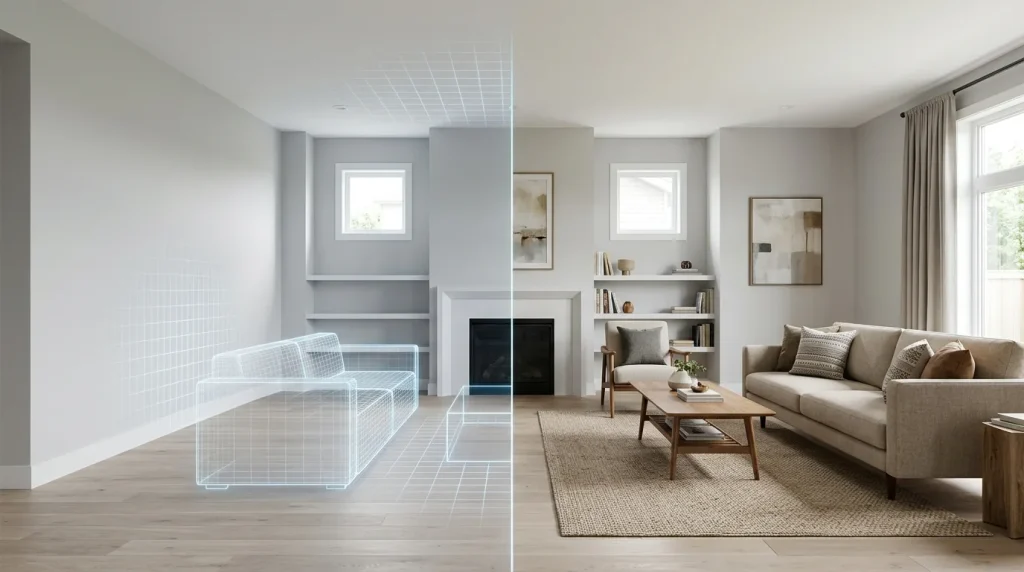
Virtual staging and physical staging can both help sellers present a home, but they solve different problems.
Physical staging changes the actual property before showings. Virtual staging changes the listing photos by digitally adding furniture, decor or visual design. One improves the in-person experience. The other improves the online first impression. In a market where buyers often judge a home from photos before scheduling a showing, both can matter.
The best choice depends on the property, budget, showing strategy and how much the home needs help in person.
Key takeaways
- Physical staging changes the home itself.
- Virtual staging changes listing images.
- NAR reported that 83% of buyers’ agents said staging made it easier for buyers to visualize the property as a future home.
- NAR found buyers’ agents rated photos, traditional physical staging, videos and virtual tours as more important than virtual staging.
- Virtual staging can be faster and cheaper, but it must not mislead buyers.
- Physical staging may work better for homes that need in-person emotional impact.
- Sellers should disclose digitally altered images where required by law, MLS rules or broker policy.
What is physical staging?
Physical staging means preparing the actual home for listing and showings.
That can include decluttering, cleaning, rearranging furniture, bringing in rented furniture, adding art, improving lighting, refreshing paint, creating defined room functions and improving curb appeal.
NAR’s 2025 Profile of Home Staging found that 83% of buyers’ agents said staging a home made it easier for buyers to visualize the property as a future home. The same report found the living room was the most important room to stage, followed by the primary bedroom and kitchen.
Physical staging is especially useful when a home is vacant, awkwardly laid out, dated, cluttered or difficult for buyers to understand.
What is virtual staging?
Virtual staging uses software or AI tools to add furniture, decor or visual design to listing photos.
It can be useful for vacant rooms, empty new construction, investor listings or properties where the seller cannot afford or coordinate physical staging. Virtual staging can help online buyers understand scale, room function and design possibilities.
But virtual staging has a major limitation: it does not change what buyers see when they walk in the door.
What NAR staging data says
NAR’s staging report gives sellers a practical hierarchy.
Among buyers’ agents, photos were rated much more or more important by 73%, traditional physical staging by 57%, videos by 48% and virtual tours by 43%. Virtual staging was viewed less favorably.
That does not mean virtual staging is useless. It means sellers should not assume digital furniture replaces real presentation.
When virtual staging makes sense
Virtual staging may make sense when the home is vacant, the seller has a limited budget, the listing needs better online presentation quickly, the room function is unclear, the property is new construction or the seller cannot move furniture in.
It is most useful when the goal is to help buyers understand potential, not to hide condition.
When physical staging makes sense
Physical staging may be stronger when the home is vacant and feels cold, the layout is awkward, the home needs emotional impact during showings, the price point supports staging cost, competition is strong or the seller needs to overcome dated presentation.
Physical staging can help buyers feel the space. It can also improve photography, video and open-house impressions at the same time.
Disclosure and accuracy matter
Virtual staging must be handled carefully.
Real estate professionals are facing more scrutiny over digitally altered images, and some states have adopted disclosure requirements. Even where a specific state law does not apply, sellers and agents should avoid misleading buyers.
Virtual staging should not remove defects, change room dimensions, add views, alter permanent features or imply that items are included when they are not. A safe practice is to label virtually staged images clearly and provide original photos as well.
What this means
Virtual staging is a useful marketing tool. Physical staging is a property-presentation tool.
Sellers should choose based on the home’s problem. If the listing photos need help, virtual staging may work. If the in-person experience needs help, physical staging may be worth more. If the home is high-value, vacant or hard to understand, using both may make sense.
The goal is not to make the home look unreal. The goal is to help buyers understand the space honestly.
FAQ
What is the difference between virtual staging and physical staging?
Virtual staging digitally alters listing photos. Physical staging changes the actual home with furniture, decor, cleaning and presentation.
Is virtual staging worth it?
It can be worth it for vacant homes or rooms that need visual context online, but it does not improve the in-person showing experience.
Is physical staging better than virtual staging?
Physical staging is often better for showings because buyers experience the staged space in person. Virtual staging is mainly an online-photo tool.
Does virtual staging need to be disclosed?
Disclosure rules vary by state, MLS and brokerage policy. Sellers and agents should clearly label digitally staged photos and check local rules.
What rooms should sellers stage first?
NAR’s 2025 report found buyers’ agents ranked the living room, primary bedroom and kitchen among the most important rooms to stage.
Sources with clickable URLs
- NAR — 2025 Profile of Home Staging
- NAR — 2025 Profile of Home Staging PDF
- NAR — Home Staging Press Release
- NAR — Digitally Altered Listing Photos and Disclosure Concerns