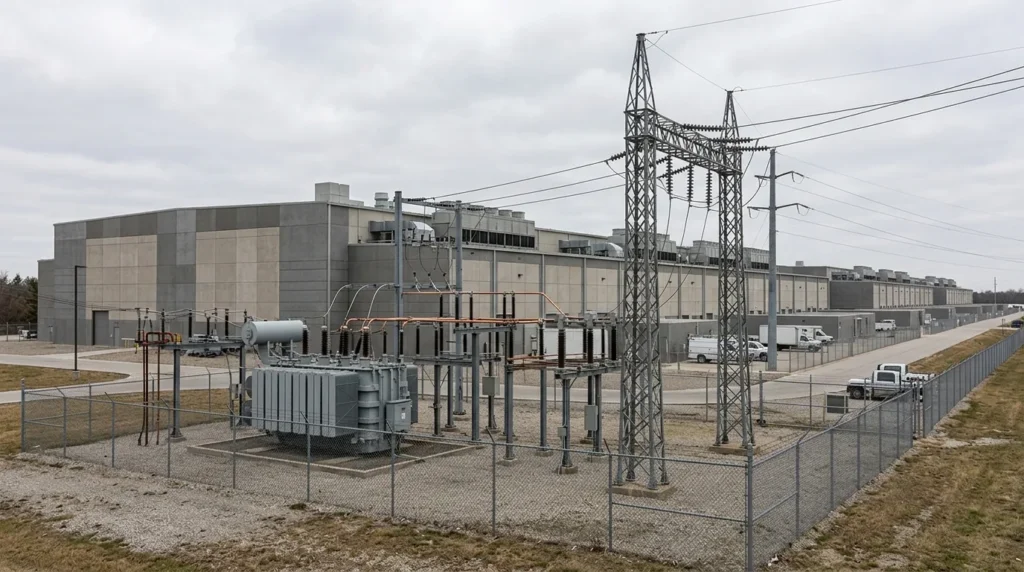
Virginia has enacted a temporary tax on electricity consumption of $0.011 per kilowatt-hour, under budget language that takes effect July 1, 2026 and runs until before July 1, 2028. The provision includes refunds if annual collections exceed $600 million.
For the largest data center market in the world, this converts a policy debate into a line item. Northern Virginia’s data center corridor now carries a direct, per-kilowatt-hour operating cost that did not exist before — and because the tax is levied on consumption rather than property, it scales with exactly the thing these facilities do most.
Key facts
- Rate: $0.011 per kilowatt-hour of electricity consumed.
- Effective period: begins July 1, 2026, running until before July 1, 2028.
- Refund trigger: the budget language provides for refunds if annual collections exceed $600 million.
- Structure: a consumption tax, not a property or transaction tax.
What the rate costs a real facility
A penny per kilowatt-hour sounds immaterial until it is multiplied by data center load factors.
A 100-megawatt facility running near continuous utilization consumes roughly 876 million kilowatt-hours in a year. At $0.011, that is approximately $9.6 million in additional annual operating cost — for a single campus, before any escalation in the underlying power rate.
That figure is large enough to matter in underwriting. In triple-net data center leases, operating costs of this kind typically pass through to tenants, which means hyperscale and colocation customers absorb it directly. Where leases are structured differently, or where a landlord has agreed to a gross or capped structure, the cost lands on ownership — and existing contracts signed before the tax was contemplated may not have a clean mechanism to recover it.
Why the two-year sunset is the critical detail
The provision expires before July 1, 2028, while the state studies how rapidly expanding power demand should be financed. That sunset creates a genuine underwriting problem.
Data center assets are underwritten over 15- and 20-year horizons. A two-year tax with an explicit study period attached is not a settled cost — it is an unresolved one. Buyers and lenders must decide whether to model the tax as temporary, as permanent, or as the opening position in a longer negotiation over who pays for grid expansion.
That ambiguity tends to widen bid-ask spreads on transactions. It also gives developers a concrete reason to accelerate site selection in competing states, where power costs are known and stable, even if Virginia retains structural advantages in fiber density and interconnection.
The underlying fight is about who funds the grid
The tax is best understood as one answer to a question spreading well beyond Virginia: when a small number of extremely large customers drive most new load growth, who pays for the transmission and generation to serve them?
The pressure is real. Power demand has become the binding constraint on data center development nationally, a dynamic examined in our analysis of how power demand is reshaping industrial markets. Meanwhile capital keeps arriving — including Digital Realty’s $7.8 billion purchase of Blackstone’s Virginia stakes, a transaction concentrated in exactly the market this tax now touches.
What it means
Owners with Northern Virginia exposure should confirm, lease by lease, whether the new charge is recoverable. That determination drives whether this is a tenant cost or a direct hit to net operating income.
Developers evaluating new sites now have a quantifiable number to weigh against alternative markets — roughly $9.6 million a year per 100 megawatts — and should model both the sunset and a scenario in which the tax is extended.
For investors, the broader signal is that jurisdictional risk has become a real variable in data center underwriting. The sector’s growth has made it visible enough to tax, and Virginia is unlikely to be the last state to test the idea.
—