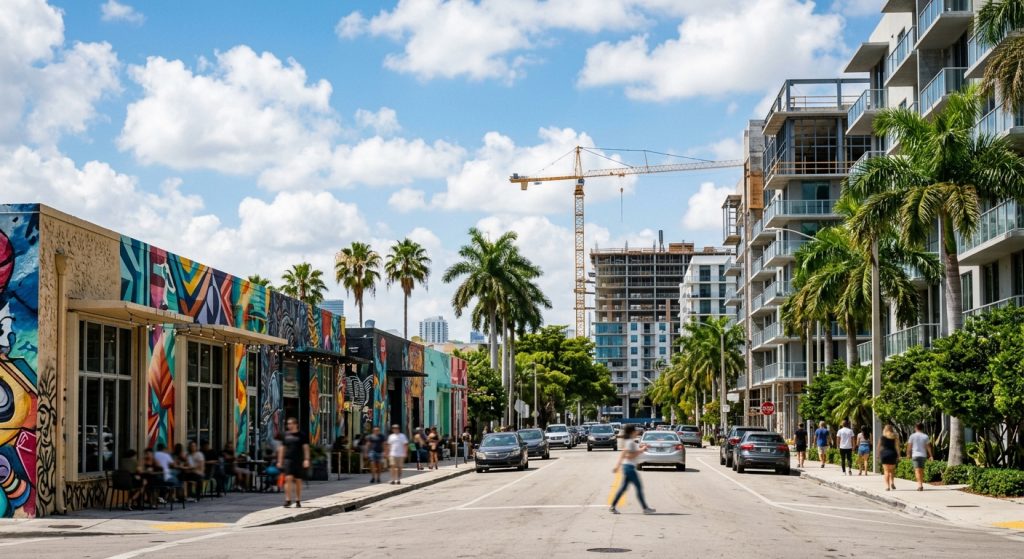
Carnegie Mellon University said Sept. 30 that Citadel founder and chief executive Ken Griffin has given it $3 billion, and that $2 billion of it will pay for a new 35-acre campus in Miami’s Wynwood neighborhood, one of the city’s densest and most tightly held redevelopment districts.
The university described the gift, disclosed in an announcement on its newsroom, as the largest individual gift in the history of higher education. It is also Griffin’s largest, according to Carnegie Mellon, which said the money reflects the priorities of Griffin Catalyst, his civic engagement initiative.
How the $3 billion splits
One billion dollars goes to the Pittsburgh campus, divided evenly: $500 million in flexible support for university priorities and $500 million for the School of Computer Science, which will be renamed the Kenneth C. Griffin School of Computer Science. The remaining $2 billion launches CMU Miami. Griffin will also join Carnegie Mellon’s Board of Trustees.
For the real estate industry, the Miami piece is the substantive one. Carnegie Mellon said the campus will sit on more than 35 acres in Wynwood and, once complete, support more than 3,500 undergraduate, master’s and PhD students, nearly 300 faculty and more than 600 staff. Plans include industry research labs and venture studios alongside conventional academic and student space.
Construction is slated to begin in 2027. The current plan, the university said, has the first students enrolling in 2028 — a timeline it twice qualified as contingent on regulatory approvals. A caption on the rendering released with the announcement states plainly that the plans “are subject to necessary regulatory approvals.”
What the announcement does not say
The release does not identify the specific parcels, name a seller, disclose whether the land has been acquired or under contract, or give a construction budget separate from the $2 billion gift. Nor does it name a developer, architect or contractor. Those are the details that will determine how quickly a 35-acre assemblage can move through Miami’s entitlement process, and the university has not yet put them on the record.
The site area is the figure worth watching. Assembling more than 35 contiguous acres under one owner in an established Miami neighborhood is a substantial undertaking in itself, and the announcement leaves open how much of that assemblage is already in hand.
A campus organized around problems, not majors
Carnegie Mellon said CMU Miami will “invert the traditional higher education model” by organizing teaching and research around societal challenges rather than academic departments. At launch it will focus on human health and biological discovery; national security and strategic capabilities; energy and climate resilience; and advanced manufacturing and industrial transformation.
The university was explicit that this is not a satellite. CMU Miami “is designed to move beyond the traditional hub-and-spoke model of university expansion,” the announcement said, and will develop into a comprehensive campus where education and research are equally central.
“We are deeply grateful to Ken Griffin for his extraordinary vision, partnership and belief in what Carnegie Mellon can achieve,” said CMU President Farnam Jahanian. He framed the investment as a response to artificial intelligence, which he called “one of the defining intellectual developments of our time,” demanding that the university “rethink how we educate students, conduct research and partner with others.”
Jahanian also signaled the community-relations work ahead: “Our relationship with Pittsburgh has shaped CMU for more than a century, and we believe the connections we build in Miami will enrich both cities. We look forward to listening, learning and working alongside our neighbors.”
Griffin, in the announcement, tied the campus to the city’s ambitions. “The opportunity to bring Carnegie Mellon to Miami places our city at the heart of humanistic and scientific advancement,” he said. “CMU Miami represents a generational opportunity to build a new center of research and intellectual life — one that will attract exceptional students, scholars, and researchers from across the globe.”
Griffin’s expanding property footprint
Griffin has become a recurring name in large real estate transactions. In August, a Griffin- and Citadel-affiliated entity took a 60% stake in a joint venture with Vornado and Rudin Management to redevelop 350 Park Avenue into a 1.9 million-square-foot Manhattan office tower with a $6.2 billion development budget, with Citadel Enterprise Americas signing a 15-year anchor lease.
The campus lands in a market that has drawn sustained high-end capital. Miami has moved ahead of New York and the Bay Area as the country’s top ultra-luxury home market, and institutional owners have been assembling large South Florida holdings — Related Ross, for one, bought the 1.7 million-square-foot former IBM campus in Boca Raton in September.
A research university with 3,500 students and 900 employees is a different kind of demand driver than a trophy office tower or a condo tower. On our reading, the nearer-term effects in Wynwood are likely to be felt in land pricing and in the housing needed for students and faculty, well before the first building opens. Carnegie Mellon has not published a housing plan, and the 2028 enrollment date remains conditional on approvals the university has not yet obtained. For more on projects like this, see our commercial real estate coverage.