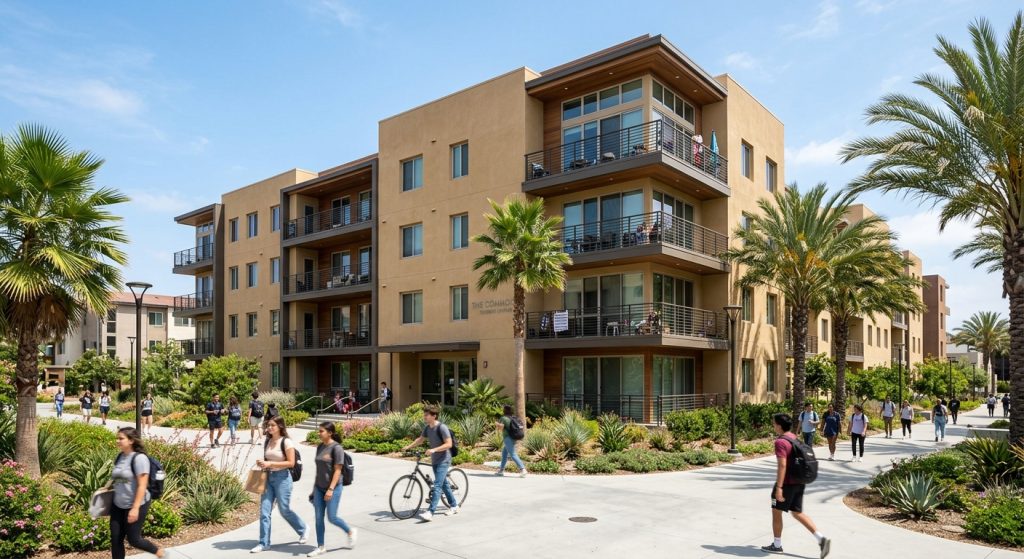
The University of San Diego has agreed to let a private investor and developer build and run its next residence hall, a $230 million, 700-bed project called Presidio Terrace Apartments that the university says is the first public-private partnership in its history.
Harrison Street Asset Management and The Michaels Organization announced the agreement on Sept. 15. The building will hold 321 units and is scheduled for completion in August 2029. Michaels will develop and operate it; Harrison Street is the capital partner.
The structure is the story
The deal is built on a 99-year ground lease with the university, under which USD keeps ownership of the land while the private partners finance, build and run the housing on it. Because the building will be a university-affiliated facility, the announcement says it will carry a full real estate tax exemption.
That combination is what makes campus public-private partnerships work for schools facing a housing shortage and a capital budget that will not stretch to cover it. The university avoids putting construction debt on its own balance sheet and hands off operations; the investor gets a long-dated, tax-advantaged asset with a captive demand base.
“Today, we are seeing more PPP activity than ever before, as more universities recognize that these structures allow them to focus on their core academic mission while conserving capital and transferring operational responsibilities to a private partner,” said Jim Hennessy, head of PPP business development at Harrison Street.
He added that the project is “a strong example of how PPPs can help universities address critical infrastructure needs, creating a win-win situation for academic institutions, investors, and college communities.”
Who the beds are for
Presidio Terrace is planned for upperclassmen, graduate and professional students rather than first-year undergraduates. The site sits on USD’s campus between the university’s academic center and a nearby retail corridor, with proximity to its business, nursing, engineering and law schools — the populations most likely to leave campus for the San Diego rental market if the university cannot house them.
The demand case rests on enrollment. Total enrollment at USD has risen 13.2% since 2020, according to the announcement. Apartment-style units for older students are the segment campus housing offices most often cannot supply from mid-century dormitory stock.
A platform milestone
Harrison Street said the transaction pushes the Chicago-based firm past $6 billion in public-private partnership assets. The firm, founded in 2005, launched its PPP business in 2018 and says it has completed 64 PPP transactions across its platform and now counts more than 237,000 student housing beds across 432 properties. It describes Presidio Terrace as the first deal closed through its dedicated public-private partnership strategy, and puts total assets under management at $110 billion.
“We’ve focused on real asset innovation since our founding in 2005,” said Christopher Merrill, co-founder and global chief executive of Harrison Street. “In 2018, we saw another pioneering opportunity to launch a PPP business to help universities modernize and expand essential infrastructure through well-structured public-private partnerships.”
Merrill said the project “reflects the continued evolution of our investment capabilities in the higher education sector and builds on Harrison Street’s long history of innovation and serving as a partner of choice for on-campus student housing and other mission-critical social infrastructure.”
Capital keeps finding the sector
Student housing has drawn steady institutional money through 2026 even as conventional multifamily has been harder to underwrite. Scion and Ares bought four communities with 2,316 beds for more than $400 million at the start of September. Campus-adjacent development has kept moving too: Wentworth Institute of Technology broke ground on a $200 million Boston residence tower, and Varcity closed financing on a university-based retirement community at Purdue.
The through-line is that beds tied to an institution — students, or in Varcity’s case alumni retirees — carry demand that is easier to forecast than a suburban lease-up, which is a meaningful advantage at current construction costs and debt pricing. On our reading, that is why partnership structures like the one at USD are spreading faster than campus construction budgets are growing. More development coverage sits on RealtyWire’s Commercial Real Estate page.