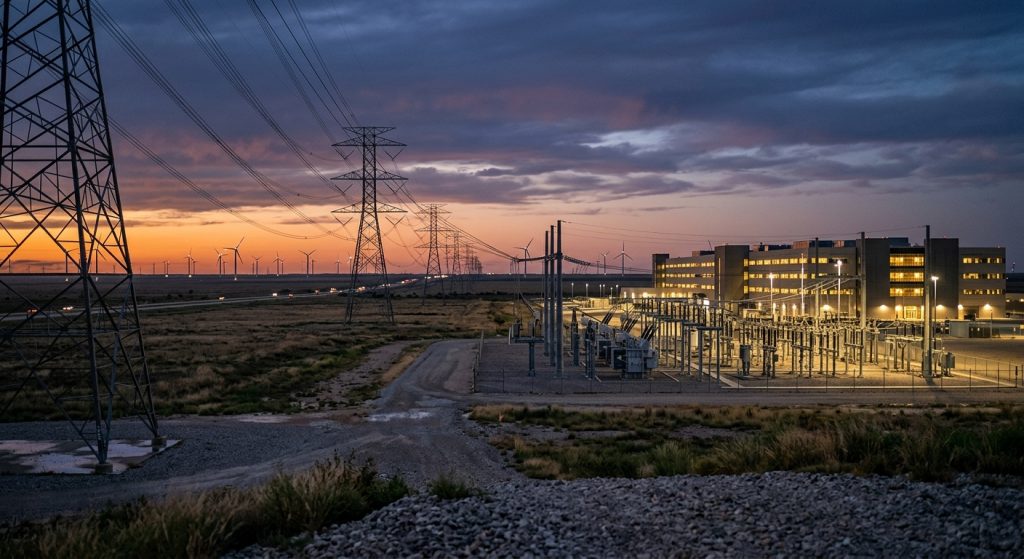
Gov. Greg Abbott on Monday ordered Texas grid regulators to audit every data center project seeking to connect to the state’s power grid before any new hookups proceed, a directive that could stall a development pipeline of more than 1,800 projects representing over 474 gigawatts of requested capacity. The order, addressed to the Public Utility Commission of Texas (PUCT) and the Electric Reliability Council of Texas (ERCOT), marks the state’s most direct intervention yet in the fight over who pays for the infrastructure that AI-driven data center growth demands.
“Our top priority is to protect Texans’ safety and quality of life,” Abbott said in the directive. “Any project that fails to comply with the requirements set forth by the PUCT and ERCOT, and by state law, must be denied connection to the Texas grid. Simply put, Texans must come first.”
What the audit requires
Abbott’s letter instructs the PUCT and ERCOT to conduct a “comprehensive verification and audit” of every project in ERCOT’s interconnection queue before it can advance toward energization. Developers must now document five categories of information: state and local tax incentives, grants and other public funding received or expected; on-site power generation plans and projected annual and peak electricity consumption; water usage volumes, sourcing and cooling technology, including whether facilities use air-cooled or closed-loop systems; measures to mitigate noise, light and traffic impacts on surrounding communities; and the identity of each project’s controlling ownership.
Projects that fail to meet those disclosure requirements, or otherwise fall short of state law and PUCT/ERCOT rules, are to be denied grid access, according to the governor’s office. Neither agency has published a timeline for completing the reviews or for when project approvals will resume.
ERCOT confirmed it is reviewing the order and will postpone the “Batch Zero” transmission planning study currently underway, an ERCOT spokesperson told the Texas Tribune. Batch Zero, approved by the PUCT in June, was the grid operator’s first attempt to sort a backlog of large-load interconnection requests — nearly 90% of which come from data centers — into groups that could be studied and connected in an orderly sequence. It is not yet clear whether Monday’s audit order applies only to Batch Zero applicants or to the full queue of roughly 1,800 to 2,000 projects.
The second move in a widening standoff
Monday’s directive follows an earlier letter Abbott sent the agencies in June ordering the PUCT to make data center operators, not residential ratepayers, bear the full cost of the electric infrastructure built to serve them, and directing the commission to open a proceeding to lower residential transmission rates. The PUCT and ERCOT responded with a joint memo in July asking state lawmakers for expanded authority to manage large-load growth — a sign the agencies see the current legal framework, including 2025’s Senate Bill 6 interconnection and curtailment rules, as insufficient on its own.
Abbott has also said he intends to push the Legislature next session for water-efficient cooling mandates, mandatory reporting of electricity and water consumption, elimination of what he called outdated tax incentives, and new setback and noise-mitigation requirements for data center sites.
What it means
The facts of the order — its scope, its five disclosure categories, and ERCOT’s decision to pause Batch Zero — come directly from the governor’s office and ERCOT’s own confirmation to reporters. Neither agency has set a timeline for completing the reviews or defined which of the roughly 1,800 queued projects fall inside the pause; those details remain for the PUCT and ERCOT to spell out.
For real estate and construction interests, the order adds a new layer of regulatory risk to a sector that has moved at breakneck speed. Texas has become one of the country’s largest hosts of hyperscale AI campuses, from gigawatt-scale projects in West Texas to fully leased Nvidia-anchored developments and bond-financed builds like CoreWeave’s Dickens County campus. Site selection, land acquisition and lease timing for those projects have generally assumed grid interconnection would keep pace with construction. An indefinite audit that can deny connection outright inserts new uncertainty into that assumption, particularly for projects that have not yet documented tax incentives, water sourcing or community-impact plans to state standards.
The order also sharpens a debate playing out in grid regions well beyond Texas: whether data center operators or the broader ratepayer base should absorb the cost of new transmission and generation capacity, and how much visibility state regulators should have into water and power use before granting connections. Texas, with the country’s largest interconnection queue for large loads, is now testing how far a state can go in slowing that growth without driving developers to other markets.
What to watch
Key unknowns include how long the PUCT and ERCOT take to complete the audits, whether the pause extends beyond Batch Zero to the full interconnection queue, and how developers with projects already under construction respond if their grid connection dates slip. Reaction from data center developers and real estate investors with Texas exposure had not been published as of Monday afternoon.