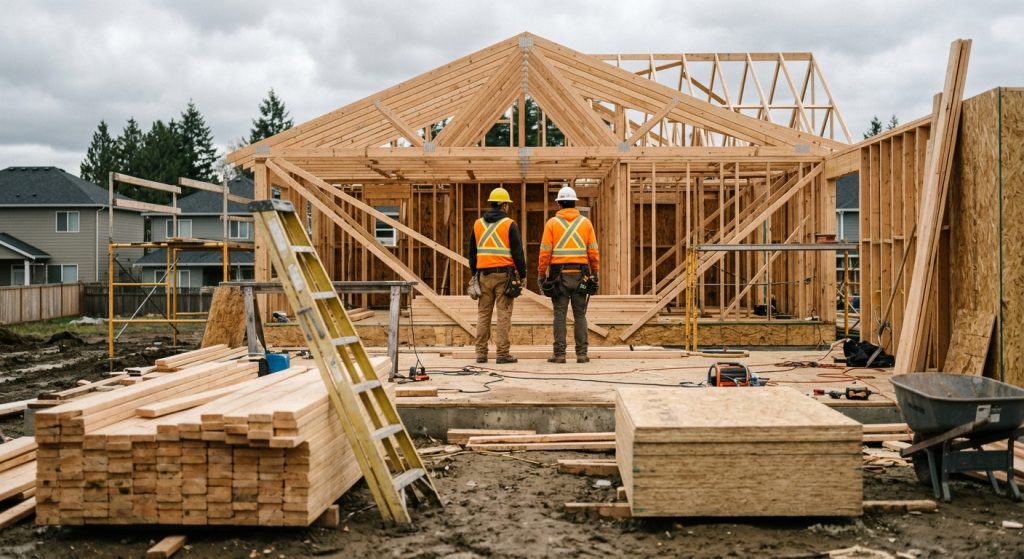
Of 47 construction occupations the National Association of Home Builders examined, exactly two rate “high” for exposure to artificial intelligence: construction managers, and construction and building inspectors. The other 45 — about 96% — rate low or moderate, and none rate very high. NAHB economist Jing Fu published the analysis Oct. 1.
The classification is not NAHB’s own. It comes from a supplemental table the Bureau of Labor Statistics’ Employment Projections program built to accompany its 2025–35 projections, “AI Exposure Categories and Employment Projections, 2025–35.” BLS combined five external data sources — three theoretical exposure measures and two based on observed AI usage mapped to occupational tasks — to sort every detailed occupation into four bands: low, moderate, high and very high. NAHB pulled the construction occupations out of that table.
What separates the two high-exposure jobs from the rest is the nature of the work. Construction managers and inspectors spend their days on planning, documentation, scheduling, compliance, reporting and communication — the information-handling that current AI tools reach most directly. The low-exposure group is the field: carpenters, construction laborers, roofers, operating engineers. Those roles turn on physical execution, changing jobsite conditions, safety judgment, coordination with other trades and handling materials and equipment, characteristics that NAHB says limit “the direct reach of current software-based AI.”
Exposure and growth are not the same thing
The analysis sets AI exposure against projected employment growth from 2025 to 2035, and the two do not line up in any obvious direction. Construction managers, high exposure, are projected to grow 9%. Inspectors, also high exposure, are projected to stay essentially flat. The fastest-growing occupation in the set is solar photovoltaic installers at a projected 37% — and its exposure is rated moderate.
That is a useful corrective to the shorthand that high AI exposure equals shrinking headcount. BLS is explicit about what its measure does and does not say: it indicates whether AI technology could be, or has been, used to assist with or complete some tasks in an occupation. It is not a forecast of employment growth or decline, a wage forecast, an estimate of adoption probability or a worker-replacement estimate, and it does not distinguish augmentation from automation.
NAHB’s own survey work points the same way. Special questions on the association’s Housing Market Index have found builders using AI mainly for information-intensive work — advertising and marketing, project planning, project design — rather than for field work. Builders also named technological advances as a positive long-term force for the industry in those questions.
Low exposure now, not permanently
NAHB is careful not to read the finding as insulation. Near-term AI adoption in construction, the analysis says, is likelier to augment existing work — faster estimating and planning, better document management, safety analysis, progress monitoring, decision support — than to replace anyone. Changes to field operations “may emerge more gradually,” through AI-enabled equipment, robotics and computer vision rather than through software alone.
That distinction matters for how builders should read the number. An occupation rated low exposure today is rated against the tools that exist today. AI embedded in equipment and cameras rather than in office software is exactly the channel NAHB expects to reach the field, and it sits outside what a task-level exposure measure captures today.
The scope of the analysis is worth noting. It covers 47 standard occupational classification construction occupations, excluding extraction occupations, plus construction managers. It leaves out the adjacent roles that construction firms also employ in volume: architects, engineers, cost estimators, accountants, sales staff, technology staff and administrators. Occupations are counted wherever the workers are employed, not only at construction companies.
The finding lands against a labor market that is tight for reasons having nothing to do with AI. Construction job openings were 251,000 in August, above year-ago levels, with data center work pulling crews away from housing, and one in six contractors in the Associated Builders and Contractors survey is under contract on a data center. For now, the constraint on the trades is finding people, not being replaced by software. More technology and AI coverage is on RealtyWire.