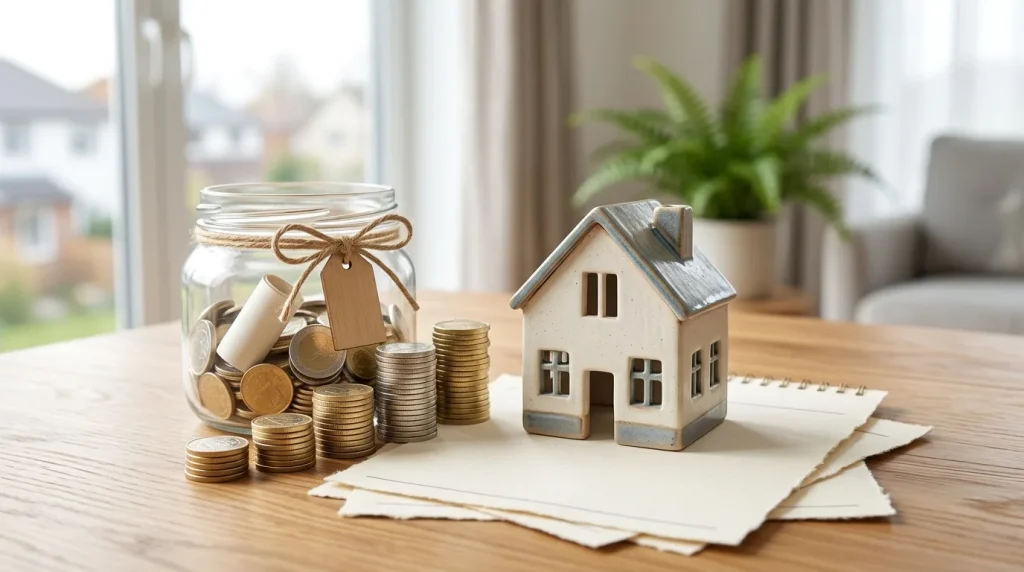
Saving for a down payment in 2026 can take months or years, depending on income, savings rate, home price, loan program and local market.
Related: Down Payment Guide 2026: How Much Buyers Are Really Putting Down
Realtor.com reported that the median down payment fell to $23,400 in the first quarter of 2026, equal to 12.8% of the purchase price. That was down 19% from a year earlier and marked the lowest level in four years.
That figure gives buyers a useful benchmark, but it should not be treated as a universal target. Some buyers put down more. Some qualify for low-down-payment or no-down-payment loan programs. Others need more cash because prices, taxes, insurance and closing costs are higher in their market.
Key takeaways
- Realtor.com reported a $23,400 median down payment in Q1 2026.
- The median down payment share was 12.8%.
- A buyer saving $500 per month would need about 47 months to save $23,400.
- A buyer saving $1,000 per month would need about 24 months.
- Closing costs and reserves are separate from the down payment.
- Buyers should compare down payment requirements by loan type.
A simple savings timeline
Using Realtor.com’s $23,400 median down payment figure, the savings timeline depends on how much a buyer can set aside each month.
| Monthly savings | Time to save $23,400 |
|---|---|
| $250 | 94 months |
| $500 | 47 months |
| $750 | 31 months |
| $1,000 | 24 months |
| $1,500 | 16 months |
This is a simple calculation and does not include investment returns, interest, gifts, grants, down payment assistance or changes in home prices. It also does not include closing costs.
Why the target keeps moving
Saving for a home is frustrating because the target can change.
If home prices rise while a buyer is saving, the required down payment may rise too. If mortgage rates change, the buyer’s monthly payment target may change. If insurance or property taxes are higher than expected, the buyer may need to reduce the purchase price or save more cash.
Zillow reported a typical U.S. home value of $368,720 in May 2026 and a typical monthly mortgage payment of $1,861, assuming 20% down and excluding taxes and insurance.
The “excluding taxes and insurance” part is important. A buyer who focuses only on down payment may miss the full cost of ownership.
20% down is not the only path
A buyer does not always need to save 20% before purchasing.
FHA loans can allow eligible buyers to put as little as 3.5% down. Freddie Mac’s HomeOne and Home Possible programs describe 3% down options for qualified borrowers. VA and USDA programs may allow no-down-payment financing for eligible buyers.
That does not mean lower down payments are always better. A smaller down payment can increase the loan amount and may add mortgage insurance or other costs.
Do not forget closing costs
The down payment is only one part of the cash needed to buy.
Buyers should also budget for lender fees, appraisal, inspection, title and escrow fees, prepaid taxes, prepaid insurance, moving costs, repairs and emergency savings after closing.
The CFPB’s Loan Estimate tool is designed to help buyers review loan terms, estimated loan costs and closing costs before choosing a mortgage.
What this means
Saving for a down payment in 2026 is not just about hitting one national number. Buyers need a savings plan based on local prices, loan type, closing costs and post-closing reserves.
The best plan is flexible: know the target, review assistance programs, compare loan options and avoid draining every dollar at closing.
FAQ
How long does it take to save for a down payment in 2026?
It depends on how much you save each month. Based on a $23,400 target, saving $500 per month would take about 47 months, while saving $1,000 per month would take about 24 months.
What is the median down payment in 2026?
Realtor.com reported a median down payment of $23,400 in Q1 2026.
Do I need 20% down to buy a home?
No. Many buyers use lower-down-payment loan programs, though monthly costs and mortgage insurance may be higher.
Are closing costs included in the down payment?
No. Closing costs are separate and can include lender fees, title charges, escrow deposits, prepaid taxes and insurance.
Should I use all my savings for a down payment?
Usually no. Buyers should keep reserves for repairs, emergencies and moving costs.
Sources
- Realtor.com Down Payment Report May 2026
- Zillow May 2026 Market Report
- HUD FHA Loans
- Freddie Mac HomeOne
- VA Purchase Loan
- USDA Single Family Housing Guaranteed Loan Program
- CFPB Loan Estimate Explainer