U.S. employers added 165,000 jobs in October, more than three times the average monthly gain of the past year, but the construction workforce did not share in it. Total construction employment slipped by 3,000 to 8.367 million, and the industry’s residential side shed about 16,400 jobs, according to the Bureau of Labor Statistics’ October Employment Situation report, released at 8:30 a.m. ET on Nov. 6, 2026.
BLS put the average monthly increase over the prior 12 months at 48,000. The unemployment rate was little changed at 4.1%, with 7.1 million people out of work; the rate has stayed between 4.1% and 4.3% since March.
Revisions make the October jobs report stronger still
The headline number was not the only upside. BLS revised August’s payroll change up from 133,000 to 186,000 and September’s from 29,000 to 60,000, leaving employment in those two months a combined 84,000 higher than previously reported. September’s initial print was the weak reading behind our earlier coverage, when payroll growth nearly stalled; the revised figure more than doubles it.
The gains were concentrated in a handful of sectors. Professional and business services added 70,000 jobs, health care 42,000, transportation and warehousing 25,000 and manufacturing 19,000. BLS listed construction among the industries where employment “showed little change over the month,” alongside retail, financial activities, leisure and hospitality and government.
Wages kept rising. Average hourly earnings for private-sector workers increased 14 cents, or 0.4%, to $38.00, and were up 3.1% from a year earlier. The labor force participation rate held at 61.9%. One soft spot in the household survey: the number of people working part time for economic reasons rose by 339,000 to 4.8 million.
Homebuilding jobs fall while nonresidential work grows
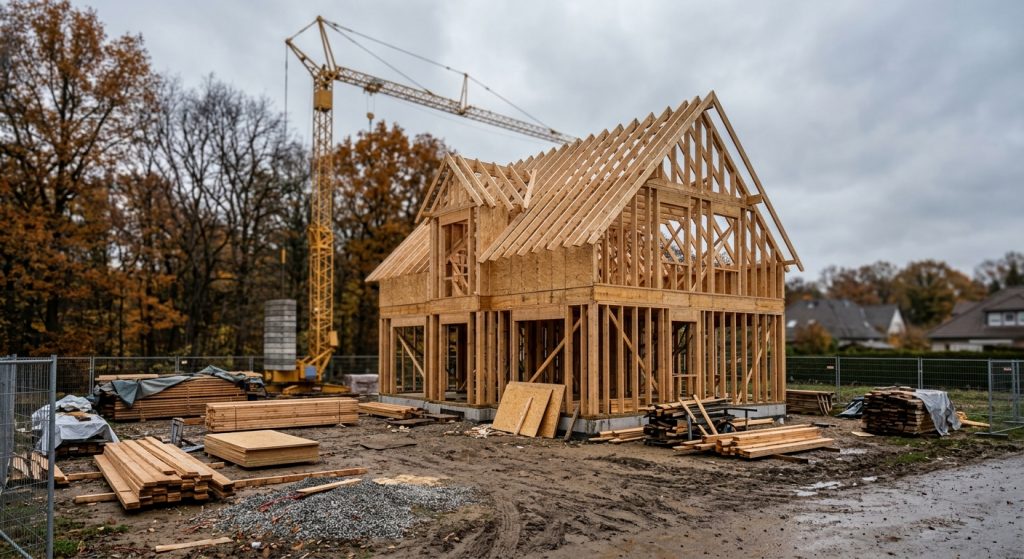
The construction total masks a split that has been widening for a year. In the BLS industry detail (Table B-1), all the October losses came from the residential side:
- Residential building construction fell by 1,200 jobs to 920,900.
- Residential specialty trade contractors, the framers, roofers, plumbers and electricians who work on homes, fell by 15,200 to 2.332 million.
- Nonresidential building construction rose by 2,900 to 952,600, and nonresidential specialty trade contractors added 7,900 to reach 2.949 million.
- Heavy and civil engineering construction, which covers roads, utilities and similar infrastructure, added 2,500 to 1.213 million.
Over 12 months the gap is larger. Combined residential construction employment, meaning building plus specialty trades, stood at about 3.253 million in October, roughly 40,000 below October 2025. Combined nonresidential building and specialty-trade employment rose by about 135,000 over the same period, to 3.901 million. That is how total construction employment ended up 124,000 higher than a year ago even as homebuilding payrolls shrank. These are preliminary figures, and BLS will revise both September and October next month.
BLS does not say why homebuilding employment is falling. The data line up, though, with what builders have been reporting about demand. The 30-year fixed mortgage rate averaged 7.18% in Freddie Mac’s survey for the week ending Nov. 5, down for a third straight week but nearly a full percentage point above the 6.22% of a year earlier, as we noted in our Nov. 5 rate coverage. On our reading, commercial, industrial and infrastructure contractors are doing the hiring that homebuilders are not.
Elsewhere in real estate, the BLS data show real estate employment up 4,300 in October to 1.849 million, and credit intermediation, which includes banks and mortgage lenders, up 4,000 to 2.528 million.
What a strong report means for the Fed and rates
The report arrives nine days after the Federal Reserve held its benchmark rate at a target range of 3.75% to 4% on Oct. 28. In that statement the Federal Open Market Committee said “inflation remains elevated” and described economic activity as “expanding at a strong pace.” Two voters, Governor Lisa D. Cook and Cleveland Fed President Beth M. Hammack, dissented because they wanted to raise rates by a quarter point.
A payroll gain well above the recent trend, upward revisions and 0.4% wage growth give those in favor of tightening more to work with. That would not help housing: mortgage rates follow longer-term Treasury yields more closely than the federal funds rate, but expectations of tighter Fed policy tend to keep those yields high. The committee’s next scheduled decision comes at its Dec. 8–9 meeting, the last of 2026.
For housing, the question is whether the recent run of slightly lower mortgage rates survives a labor market that looks stronger than it did a month ago. More coverage of rates and lending is on our mortgage page.