International home shoppers made up a smaller share of U.S. home shopping this summer, but Canadians came back. Canada’s share of international traffic recovered to near its level before the tariff fights, while Europe’s fell to its lowest third-quarter level since 2019. Those findings come from Realtor.com’s international demand report for the third quarter of 2026, published Nov. 25.
The report tracks views of U.S. for-sale listings on Realtor.com from outside the country. From July through September 2026, international shoppers accounted for 1.3% of the site’s traffic, down from 1.5% a year earlier and in line with the 1.2% recorded in the third quarter of 2019, before the pandemic.
Canada’s share of U.S. home searches recovers
Canadian shoppers accounted for 35.9% of international traffic in the quarter, the largest share of any country. That is up from 32.3% a year earlier, when Realtor.com says Canadian interest in U.S. real estate “declined sharply” in 2025. It is close to the 36.1% and 36.9% shares Canada held in 2023 and 2024, which the report calls “pre-tariff levels.” Including Canada, North American shoppers outside the U.S. made up 47.7% of international traffic, up 5 percentage points in a year.
The rebound is a change from earlier this year, when Redfin reported Canadian searches for U.S. homes down 15% amid trade uncertainty. The two companies measure different things. Realtor.com tracks Canada’s share of a shrinking pool of foreign traffic, so a larger share does not necessarily mean more Canadian shoppers in absolute terms.
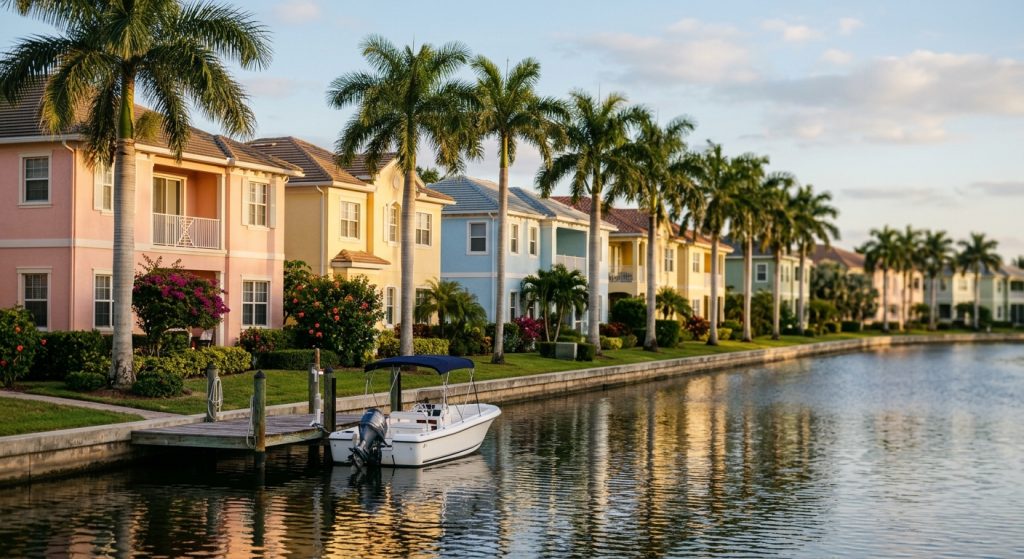
Florida remains the first stop for Canadians. Realtor.com’s figures show Florida-area markets at the top of the metro list for Canadian interest. In Cape Coral, Fla., 65.9% of international demand came from Canada. It was followed by Naples, Fla., at 65.4%; Phoenix at 62.6%; and North Port, Fla., at 61.4%. The same markets posted some of the fastest growth in Canadian interest from a year earlier, led by Cape Coral (up 8.9 points), Riverside, Calif. (6.4), Naples (5.4) and Dallas (5.0). Canadian interest slipped in Chicago and Las Vegas, both down 1 point, and edged lower in New York and San Francisco.
Texas has already passed California among Canadian shoppers, drawing 8.8% of Canadian traffic to California’s 8.6%. Canadians also lean north and toward the mountains more than other foreign shoppers do. Montana drew 2.0% of Canadian traffic, up from 1.3% in the third quarter of 2019. Idaho doubled from 0.5% to 1.0%, and Tennessee rose from 1.3% to 2.0%.
Europe pulls back
European shoppers moved the other way. Their share of international traffic fell to 24.5%, the lowest third-quarter reading since 2019. The U.K., at 6.2% of international traffic, and Germany, at 3.7%, are still among the largest sources of interest, but both hit their lowest third-quarter levels since 2019.
Realtor.com said the drop “coincides with weaker European travel to the U.S., suggesting that European interest in U.S. homes may be cooling alongside interest in visiting.” The European shoppers who are still looking are moving toward New York and Texas. New York drew 8.1% of European traffic, up from 6.0% in 2019, and Texas drew 8.0%, up from 7.1%.
Texas closes in on California among international home shoppers
Across all foreign shoppers, Florida, California and Texas together drew 43.1% of international traffic. Florida led with 21.9%. Its share peaked at 24.5% in 2022 and has since settled around 21% to 22%. Miami alone drew 8.3% of all U.S. international traffic, ahead of New York at 5.9% and Los Angeles at 4.7%.
California’s share has slipped to 10.8%, from 14.2% in 2019 and a 2020 peak of 16.6%. Texas’s share has risen every year since 2022 and is now 0.5 point behind California, down from a 5.7-point gap in 2019. Dallas and Houston were its top metros for international shoppers. “If the trend holds, Texas could overtake California as soon as next year,” the report said.
Smaller states are gaining from low bases. Montana’s share of all international traffic doubled from 0.6% in 2019 to 1.2%. Idaho, Vermont, Alaska and West Virginia also rose, and Tennessee climbed from 1.5% to 1.9%. Realtor.com said the steady gains “suggest growing interest in outdoor and rural markets.”
Search traffic is not the same as sales. The most recent transaction data point the same way, though. NAR’s annual survey, covering April 2025 through March 2026, found that foreign buyers bought 67,100 U.S. homes, down 14%. That was the second-lowest count since 2009. Canada was the top country of origin in that survey, at 16% of foreign purchases.
More on buyer demand is in RealtyWire’s housing market coverage.