
Current real estate market data, news and analysis for the Spokane-Spokane Valley, WA metropolitan area — 608,012 residents across Spokane and Stevens counties.
Data as of May 2026. Sources: Redfin Data Center, U.S. Census Bureau.
Latest Spokane Real Estate News
Spokane Real Estate Market Overview
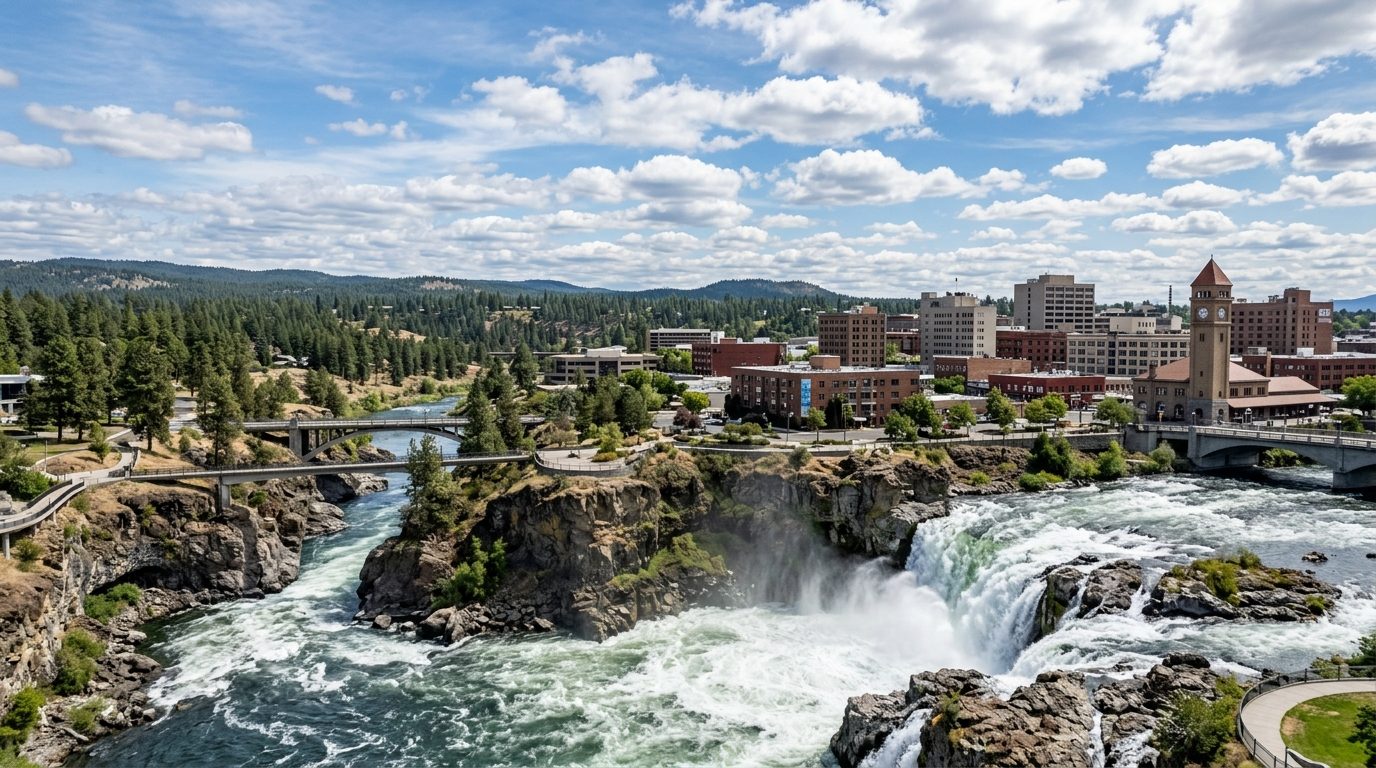
Spokane sits along the Spokane River at the eastern edge of the Columbia Plateau, where the flat basin gives way to rolling hills, basalt outcroppings, and ponderosa pine climbing toward the Rocky Mountain foothills near the Idaho border. The river drops through falls in the downtown core, giving the city its topographic anchor, while the metro spreads across prairie, forested ridges, and small lakes. Winters are cold and snowy and summers are warm and dry, a semi-arid pattern shaped by mountain ranges that block much of the moisture reaching the rest of the region. Housing stock reflects this geography: dense pockets of early twentieth-century craftsman and foursquare homes near the urban core, mid-century ranch houses in the older inner suburbs, and newer subdivisions pushing outward into Spokane Valley, Liberty Lake, and Airway Heights. Beyond the urban fringe, small towns such as Cheney, Deer Park, Colville, and Chewelah keep a rural, small-lot-to-acreage character tied to farming, timber, and college-town life.
Pricing tends to track proximity to the river, tree cover, and topography as much as school boundaries. Hillside neighborhoods on Spokane’s South Hill, along with lakefront and newer master-planned sections of Liberty Lake, sit toward the upper end of the market because of mature landscaping, curb appeal, and easy access to parks, golf, and downtown. Newer construction in North Spokane and parts of Spokane Valley also commands a premium simply for being recently built. Older, denser neighborhoods closer to the urban center and former industrial corridors carry more modest values, reflecting smaller lots and aging housing stock. Farther out, the small towns of Stevens County and the northern reaches of Spokane County are generally more affordable, a function of distance from job centers and a longer commute into the city.
The metro’s economy is anchored by health care and education alongside manufacturing and government employment. Providence and MultiCare operate major hospital systems in the city, and Gonzaga University, Washington State University’s Spokane campus, and Eastern Washington University in nearby Cheney give the area a strong academic presence. Fairchild Air Force Base, home to an aerial refueling mission, is one of the region’s largest employers, bringing a steady military and civilian workforce to the west side of the metro. Manufacturing has deep roots too, led by Kaiser Aluminum’s rolling mill near Spokane Valley and aerospace-composite makers supplying the Northwest aviation industry, while the city’s position along interstate and rail corridors has made it a logistics and distribution hub for the Inland Northwest.
Buyers should weigh a few region-specific factors before purchasing. Wildfire is a real concern away from the urban core, particularly in the forested, wildland-urban interface areas of outer Spokane County and Stevens County, and insurance availability and pricing in those zones can shift from year to year. Washington has no state income tax, so property taxes carry more of the local funding load and vary by taxing district, making it worth confirming the levy rate tied to a specific parcel. Public transit is concentrated in the urban core and a few key corridors, so most of the metro remains car-dependent. Development is guided by the state’s growth management framework, which channels new building toward designated urban growth areas, so buyers looking at outlying or unincorporated parcels should check zoning, septic and well requirements, and fire-district coverage before committing.
Cities and Towns in the Spokane Metro Area
Notable Communities and Neighborhoods
Spokane Real Estate Market FAQ
How is the Spokane-Spokane Valley metro organized geographically?
The metro centers on the city of Spokane along the Spokane River and extends east into the incorporated cities of Spokane Valley and Liberty Lake near the Idaho border, north into Spokane County towns like Deer Park, Mead-area communities, and Airway Heights near the airport and Fairchild Air Force Base, and further north into Stevens County towns such as Colville, Chewelah, and Kettle Falls. Spokane County holds most of the population and job base, while Stevens County is more rural and forested.
Which parts of the metro tend to be pricier, and why?
Hillside and view areas on Spokane’s South Hill and lakefront or newer master-planned sections of Liberty Lake tend to command more because of mature trees, topography, and proximity to parks, golf courses, and downtown. Newer subdivisions in North Spokane and parts of Spokane Valley also carry a premium simply for their newer construction. Older core neighborhoods and the more distant small towns in Stevens County are generally more affordable, reflecting smaller lots, older housing stock, and longer commutes.
What should buyers verify locally before purchasing in this metro?
Buyers should confirm the specific taxing district and levy rate tied to a parcel, since Washington funds local services through property taxes rather than a state income tax. In outlying or unincorporated areas, it is worth checking zoning under the state’s growth management rules, septic and well requirements, fire-district coverage, and whether a property sits in a wildland-urban interface zone with elevated wildfire exposure.
What is the main region-specific risk to be aware of here?
Wildfire is the primary regional risk, particularly in forested and rural areas of outer Spokane County and Stevens County where development meets timber and rangeland. Homeowners in these wildland-urban interface zones can face tighter insurance availability and shifting premiums from year to year, so confirming current coverage terms for a specific property is advisable before buying.
Nearby Markets