
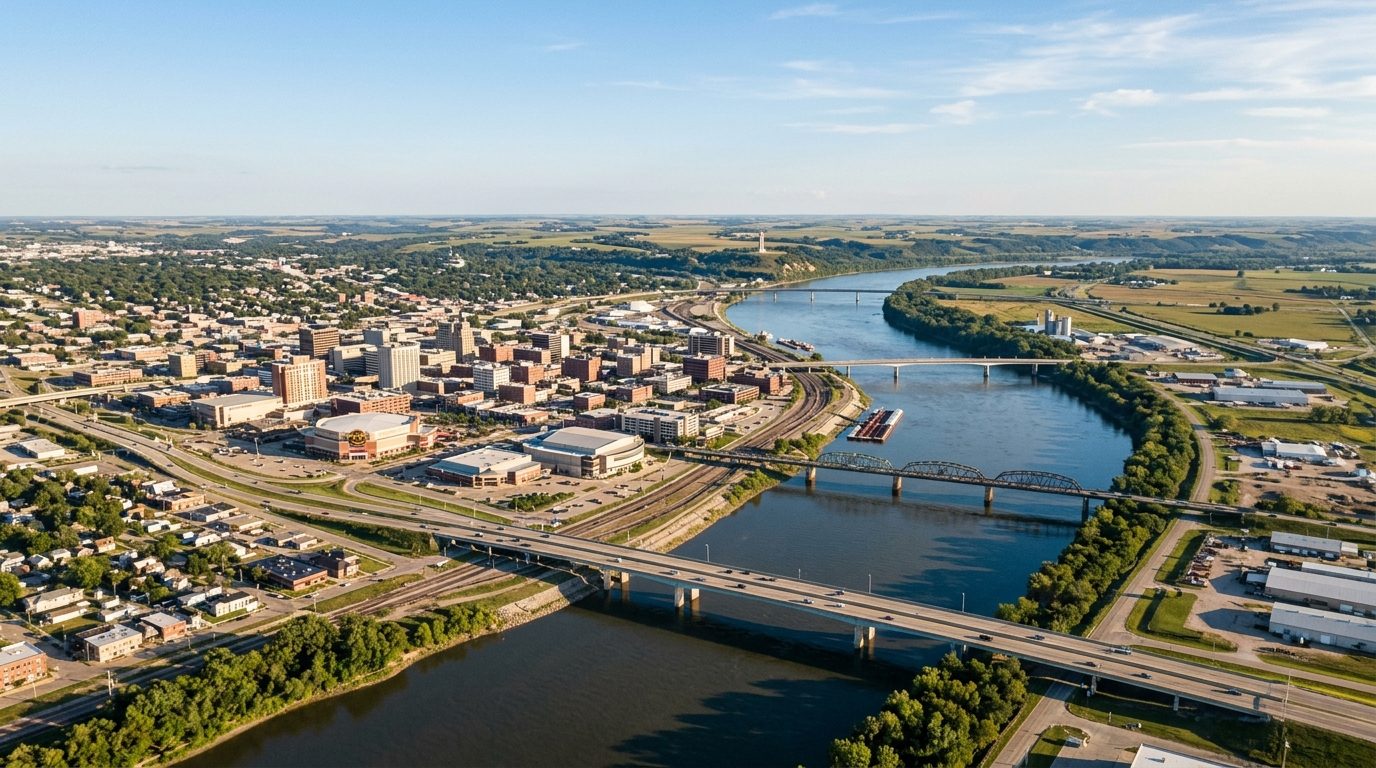
Current real estate market data, news and analysis for the Sioux City, IA-NE-SD metropolitan area — 145,738 residents across Dakota, NE, Union, SD and Woodbury, IA counties.
Data as of May 2026. Sources: Redfin Data Center, U.S. Census Bureau.
Latest Sioux City Real Estate News
Coverage of this market is coming soon. Browse all housing market news.
Sioux City Real Estate Market Overview
Sioux City anchors a tri-state metro where Iowa, Nebraska, and South Dakota converge along the Missouri River. The core city sits on the Iowa side, with South Sioux City directly across in Nebraska and North Sioux City and Dakota Dunes across the Big Sioux River confluence in South Dakota. The metro also reaches into surrounding farm counties, taking in smaller river and prairie towns such as Sergeant Bluff, Sloan, Moville, Lawton, Correctionville, Elk Point, Dakota City, and Beresford. Housing stock reflects this history: established Iowa-side neighborhoods carry early-twentieth-century bungalows and brick apartment buildings on a traditional grid, while newer subdivisions on the metro’s edges and across the river feature ranch and split-level homes on larger lots. Bluffs above the river valley on the Iowa side give way to flatter floodplain terrain nearer the water, a split that shapes both views and risk.
Within the core city, bluff-top and hillside neighborhoods southeast and west of downtown occupy some of the more sought-after ground, prized for mature tree canopy, architectural character, and separation from the industrial river bottoms. Areas closer to the stockyards, rail corridors, and processing plants along the river tend toward more modest, older housing built for industrial-era workers. Across the river, the South Dakota community anchored by a planned golf-course and country-club development has built out as a higher-end enclave, drawing buyers to newer construction, recreational amenities, and South Dakota’s lack of a state income tax. Smaller outlying towns in each state offer a more rural alternative, trading proximity to downtown employers for larger lots and quieter settings.
The metro’s economy centers on food processing and agribusiness, reflecting its location amid highly productive farmland and its historic role as a livestock and grain hub. Large-scale pork processing in Sioux City and beef processing across the river in Dakota City, Nebraska, rank among the region’s largest private employers, alongside agricultural input and grain-handling companies. Healthcare is another major pillar, anchored by hospital systems on the Iowa side with large clinical and administrative workforces. Higher education contributes too, with a private university, a Catholic university, and a community college in the core city, along with a longstanding ice cream manufacturer and several trailer, industrial equipment, and packaging manufacturers. Public sector employment, including city, county, and school district jobs, rounds out the base.
Buyers should first confirm which state, county, and school district a property falls in, since Iowa, Nebraska, and South Dakota differ meaningfully on income tax treatment, property tax structure, and school funding, and a home just across a bridge can carry a different tax profile than one a few blocks away. Proximity to the Missouri River and its tributaries is a recurring consideration; low-lying areas near the river and its confluence with the Big Sioux River have experienced periodic flooding, and flood insurance requirements, levee protection, and elevation should be checked parcel by parcel rather than assumed from a neighborhood’s reputation. The region has a continental climate with cold winters and warm summers. Public transit is limited and largely bus-based, so most residents rely on cars, and commuting often crosses state lines. Development has followed river-valley and highway corridors, with growth pushing into bluff-top and outlying farmland areas; buyers should verify zoning, annexation status, and any river-adjacent building or insurance restrictions with the relevant city or county before purchasing.
Cities and Towns in the Sioux City Metro Area
Notable Communities and Neighborhoods
Sioux City Real Estate Market FAQ
How is the Sioux City housing market organized across three states?
The metro spans Woodbury County, Iowa; Dakota County, Nebraska; and Union County, South Dakota, all connected by bridges over the Missouri River. Because each state sets its own income tax, property tax rules, and school funding, buyers should treat the metro as three linked but distinct markets rather than one uniform area, and should confirm the exact state and county for any property under consideration.
Which parts of the metro tend to be pricier, and why?
Bluff-top and hillside neighborhoods on the Iowa side, away from the industrial river bottoms, generally command a premium for mature landscaping, architectural character, and elevation above flood-prone ground. Newer planned development on the South Dakota side, built around golf and country-club amenities and benefiting from that state’s lack of an income tax, has also emerged as a higher-end option. Older neighborhoods closer to rail yards and processing plants tend to be more affordable, reflecting their industrial-era origins and proximity to heavy industry.
What should buyers verify locally before purchasing in this metro?
Confirm the property’s state, county, and school district, since these vary within a short drive and carry different tax and funding implications. Check flood zone status and any levee or elevation certificates for property near the Missouri River or Big Sioux River, verify municipal water and sewer service for outlying towns, and confirm zoning and annexation status with the relevant city or county planning office, since development patterns vary significantly between the urban core and outlying farm towns.
What is the main region-specific risk buyers should understand?
Periodic flooding along the Missouri River and its confluence with the Big Sioux River has affected low-lying communities on both the Iowa and South Dakota sides of the metro, at times prompting evacuations and infrastructure damage. Buyers considering property near the river or its tributaries should review flood insurance requirements, historical flood extent, and any local floodplain management rules before purchasing, since risk varies considerably by elevation and distance from the water even within the same neighborhood.
Nearby Markets