
Current real estate market data, news and analysis for the Des Moines-West Des Moines, IA metropolitan area — 758,539 residents across 6 counties in Iowa.
Data as of May 2026. Sources: Redfin Data Center, U.S. Census Bureau.
Latest Des Moines Real Estate News
Des Moines Real Estate Market Overview
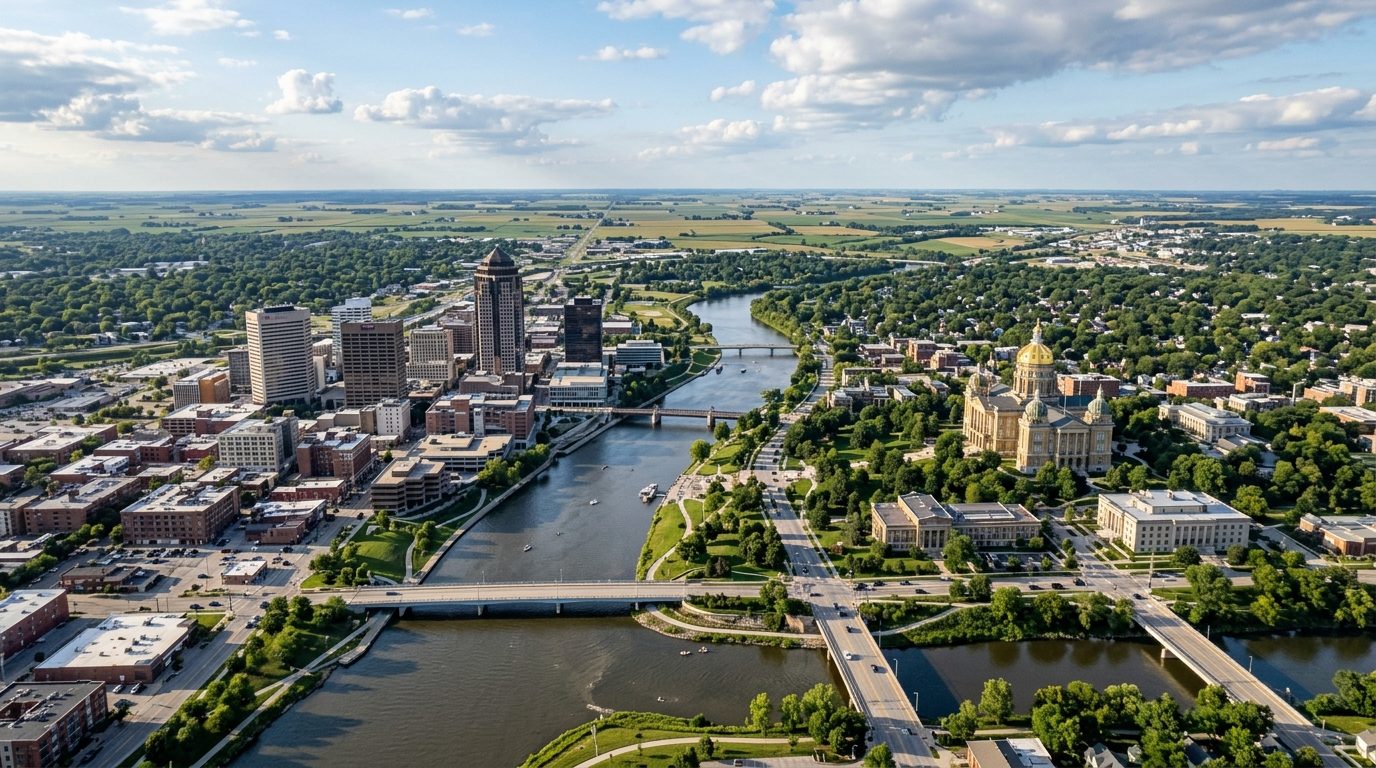
Des Moines sits in south-central Iowa at the confluence of the Des Moines River and the Raccoon River, and serves as both the state capital and the seat of Polk County. The metro spans six counties across gently rolling terrain shaped by glacial till, with the urban core concentrated along the two rivers and suburban growth radiating outward into what was, within living memory, cropland. The housing stock reflects this layered history: early twentieth-century bungalows, Tudor cottages, and foursquares fill the older neighborhoods close to downtown, mid-century ranch homes line the first-ring suburbs built after World War II, and large-lot new construction dominates the outer suburbs where subdivisions continue to replace row-cropped fields. Detached single-family homes are the norm throughout; multifamily and mixed-use buildings are concentrated downtown and in a handful of redeveloped commercial corridors.
The higher-priced end of the market is generally found in the western and northwestern suburbs — West Des Moines, Clive, Waukee, Johnston, and parts of Ankeny — where newer housing stock, planned commercial districts, and proximity to corporate campuses have drawn sustained building activity. Older central neighborhoods vary block by block: some, prized for tree canopy, walkability, and pre-war architecture, carry a premium, while others closer to industrial corridors or the river’s floodplain trade at more modest levels. The rural counties on the metro’s edges — Guthrie, Madison, and much of Jasper and Warren — offer more land and lower density but longer commutes into the job centers along the I-235, I-35, and I-80 corridors.
Des Moines’ economy is anchored by insurance and financial services, a concentration substantial enough that the sector shapes the city’s civic identity. Principal Financial Group is headquartered downtown, Wells Fargo operates a major home-mortgage servicing complex in the metro, Nationwide and Athene Holding both maintain large regional operations, and Wellmark Blue Cross and Blue Shield is based in Des Moines. Agricultural science and equipment manufacturing are also significant: Corteva Agriscience is headquartered in Johnston, and John Deere operates facilities in Ankeny, Johnston, and Urbandale. State government, centered on the Iowa Capitol, is a large employer in its own right. Retail and grocery chains headquartered in the metro — Hy-Vee in West Des Moines, Casey’s General Stores in Ankeny, and Kum & Go in West Des Moines — add another layer of corporate presence, alongside health systems UnityPoint Health and MercyOne.
Several local factors shape ownership decisions here. The region has a full continental climate with cold winters and a spring severe-weather season that includes tornado risk, and low-lying neighborhoods near the Des Moines and Raccoon Rivers have flooded historically, so flood-zone status is worth confirming for any property near the rivers. Property taxes are assessed under Iowa’s rollback system, and land recently annexed from agricultural use may carry different assessment histories that buyers should ask about directly. Public transit is limited to the DART bus network centered on Des Moines and a handful of suburbs; most of the metro is built around car travel. Many suburban communities have grown through rapid annexation and tax-increment-financed development of former farmland, which means school district boundaries, special assessments for new infrastructure, and municipal service areas can shift as a subdivision is built out — details buyers should verify with the relevant city or county rather than assume.
Cities and Towns in the Des Moines Metro Area
Show all 74
Notable Communities and Neighborhoods
Des Moines Real Estate Market FAQ
How is the Des Moines metro organized geographically?
The metro is centered on the city of Des Moines at the confluence of the Des Moines and Raccoon Rivers, in Polk County, and extends across six counties — Dallas, Guthrie, Jasper, Madison, Polk, and Warren. Suburban growth is heaviest to the west and northwest along the I-235, I-35, and I-80 corridors, with a ring of established suburbs closer in and newer, still-developing communities farther out on former farmland.
Which areas of the Des Moines metro are pricier, and why?
The western and northwestern suburbs — including West Des Moines, Clive, Waukee, Johnston, and parts of Ankeny — tend to carry higher prices, reflecting newer housing stock, master-planned commercial districts, and proximity to corporate employers. Pricing within the older core city varies block by block depending on architectural character and condition, while the outer rural counties offer more land at lower cost in exchange for longer commutes.
What should buyers verify locally before purchasing in this metro?
Buyers should confirm a property’s flood-zone status if it sits near the Des Moines or Raccoon River, check current school district assignment (which can change as suburbs annex new land), ask about any special assessments tied to new subdivision infrastructure, and review how agricultural land was assessed and taxed if the parcel was recently converted from farmland.
What is a region-specific risk to be aware of in the Des Moines metro?
River flooding is the most concrete local risk: the Des Moines and Raccoon Rivers have flooded the city’s core in the past, including major events in 1993 and 2008 that affected downtown and the Birdland neighborhood north of it. The metro is also within Iowa’s broader tornado risk area, with spring and early summer being the most active season for severe storms.
Nearby Markets