
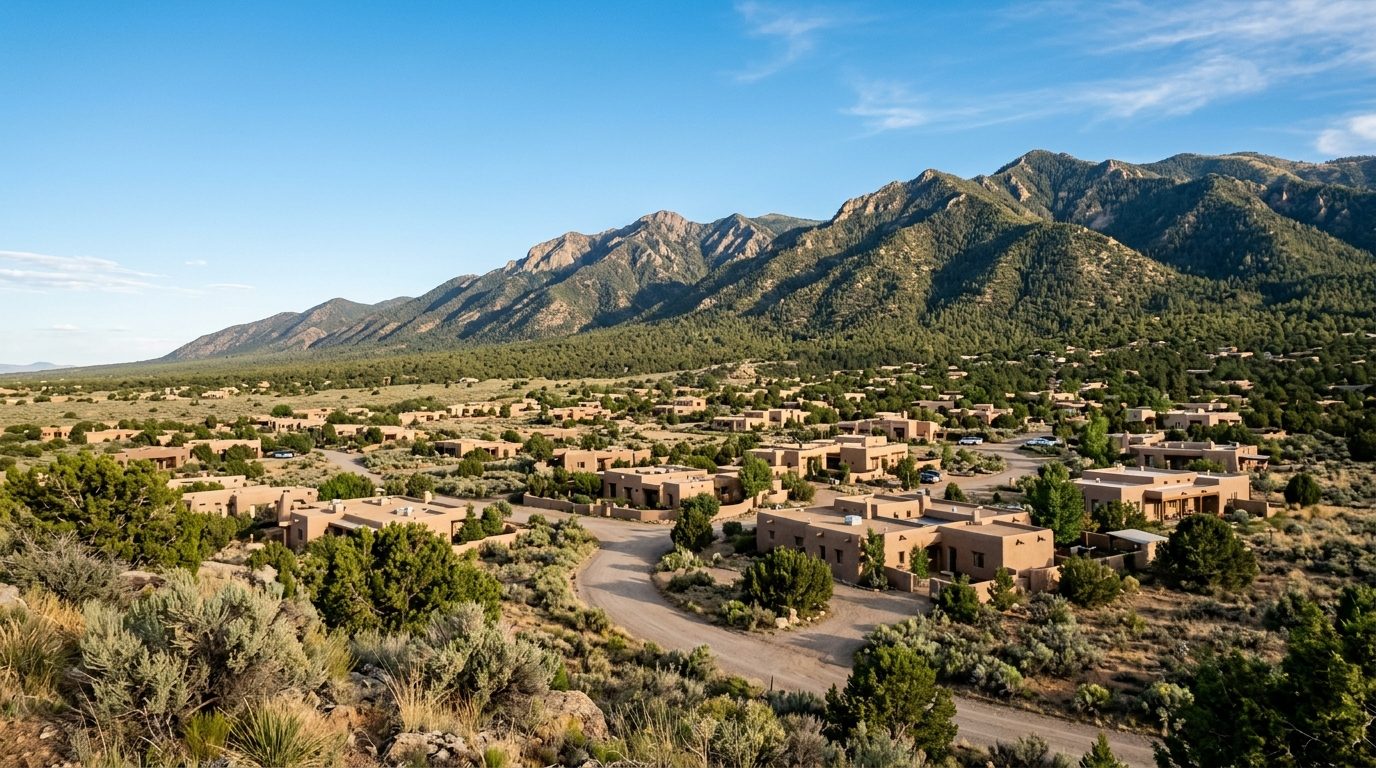
Current real estate market data, news and analysis for the Santa Fe, NM metropolitan area — 156,907 residents across Santa Fe county.
Data as of May 2026. Sources: Redfin Data Center, U.S. Census Bureau.
Latest Santa Fe Real Estate News
Coverage of this market is coming soon. Browse all housing market news.
Santa Fe Real Estate Market Overview
Santa Fe sits at the base of the southern Sangre de Cristo Mountains on a high desert plateau where the Rocky Mountains meet the Rio Grande Rift Valley. As the highest-elevation state capital in the country, it has a semi-arid mountain climate with intense sun, cold nights, and wide seasonal swings that shape how homes are built and insulated. The valley floor is cut by the Santa Fe River and seasonal arroyos, with piñon-juniper woodland covering the surrounding foothills and mesas. The metro radiates from a compact historic core near the Plaza, extending southwest toward Eldorado, northwest toward the Jemez Mountains, and southeast along US 285 toward Edgewood. Housing stock is dominated by adobe and adobe-style construction: flat or low-pitched roofs, rounded parapets, exposed roof beams, and earth-toned stucco known as Santa Fe Style, alongside Territorial Revival homes with brick coping. Older homes cluster on narrow, sometimes unpaved downtown lanes; newer subdivisions extend across the mesas with larger lots.
Homes closest to the Plaza and Canyon Road command the greatest premium, reflecting walkable access to galleries and civic buildings, centuries-old construction, and small lots under historic-district design rules. Foothill areas abutting the Santa Fe National Forest carry a similar premium for mountain views and larger acreage. Gated golf and equestrian communities northwest of the city, built on former ranchland with open mountain sightlines, sit in a comparable tier due to custom construction and low density. More moderate pricing is found in planned subdivisions south and southwest of downtown, where flat, recently subdivided land allowed efficient infrastructure, and in older mid-century neighborhoods offering established trees without historic-district rules. Rural land along the Turquoise Trail corridor and toward Edgewood varies widely, since lot size, well access, and distance to services differ parcel by parcel.
Santa Fe’s economy centers on state government, since the city is the capital of New Mexico and hosts its executive, legislative, and judicial branches. Tourism and the arts support much of local business, drawing on museums, the galleries along Canyon Road, and historic architecture. Health care is anchored by CHRISTUS St. Vincent Regional Medical Center, a referral hospital for northern New Mexico, while education and public administration employ residents through Santa Fe Public Schools, Santa Fe Community College, and local government. Nearby Los Alamos National Laboratory, a research institution in adjoining Los Alamos County, draws a sizable commuter workforce from Santa Fe. Smaller sectors include custom home construction, hospitality, and independent artists and craftspeople.
Buyers should weigh conditions specific to this region. Much of the metro, including forested foothill and canyon parcels, carries elevated wildfire exposure, and homes near the national forest or wildland should be evaluated for defensible space and insurability. Water supply depends on surface diversions, a transbasin project, and groundwater, subject to periodic drought; the city and county maintain conservation rules and, for rural parcels, well-permitting requirements worth confirming before relying on a property for irrigation. Within the city’s historic districts, an ordinance dating to the mid-twentieth century restricts exterior alterations to Spanish Pueblo Revival or Territorial Revival styles and requires board review. Transit is limited outside the urban core, served by a city bus system and a regional rail line to Albuquerque, so most households rely on vehicles; rural properties may sit on unpaved roads under county septic and well rules.
Cities and Towns in the Santa Fe Metro Area
Notable Communities and Neighborhoods
Santa Fe Real Estate Market FAQ
What makes Santa Fe’s housing stock different from other Southwestern cities?
Most homes reflect a locally codified building tradition rather than national production styles. Flat or low-pitched roofs, rounded parapets, exposed roof beams, and earth-toned stucco define Santa Fe Style, and Territorial Revival variants add brick coping and trimmed windows. In the city’s historic districts these forms are not just customary but required by design ordinance, so exterior renovations and additions go through a formal review process rather than standard permitting alone.
How does the surrounding mountain and desert terrain affect where people choose to live?
The metro sits between the Sangre de Cristo foothills and lower desert mesas, and that elevation change shapes daily life as much as views. Higher, forested areas offer cooler summers and mountain scenery but longer drives on roads that can be affected by snow, while lower mesa areas are flatter, warmer, and closer to shopping and services. Many buyers weigh commute time and winter road conditions alongside setting when choosing a neighborhood.
What should a buyer understand about water and wildfire before purchasing in this area?
The region is high desert with a limited and closely managed water supply drawn from a mix of surface diversions, a transbasin delivery project, and groundwater, so conservation rules and, for rural parcels, well permitting are worth understanding in advance. Forested and piñon-juniper areas near the national forest also carry meaningful wildfire exposure, which can affect insurance availability and cost, so it is worth evaluating defensible space and a property’s specific setting rather than assuming risk is uniform across the metro.
How do commuting patterns work in the Santa Fe area?
Public transit is limited outside the compact urban core, where a city bus system and a regional rail line connect to Albuquerque, so most residents rely on personal vehicles for daily travel. Commutes vary widely by neighborhood: in-town locations near the Plaza allow walking or short drives, while outlying subdivisions, rural parcels, and communities toward the edges of the county involve longer drives, and some rural roads are unpaved or privately maintained rather than county-serviced.
Nearby Markets