
Current real estate market data, news and analysis for the Farmington, NM metropolitan area — 120,340 residents across San Juan county.
Data as of May 2026. Sources: Redfin Data Center, U.S. Census Bureau.
Latest Farmington Real Estate News
Coverage of this market is coming soon. Browse all housing market news.
Farmington Real Estate Market Overview
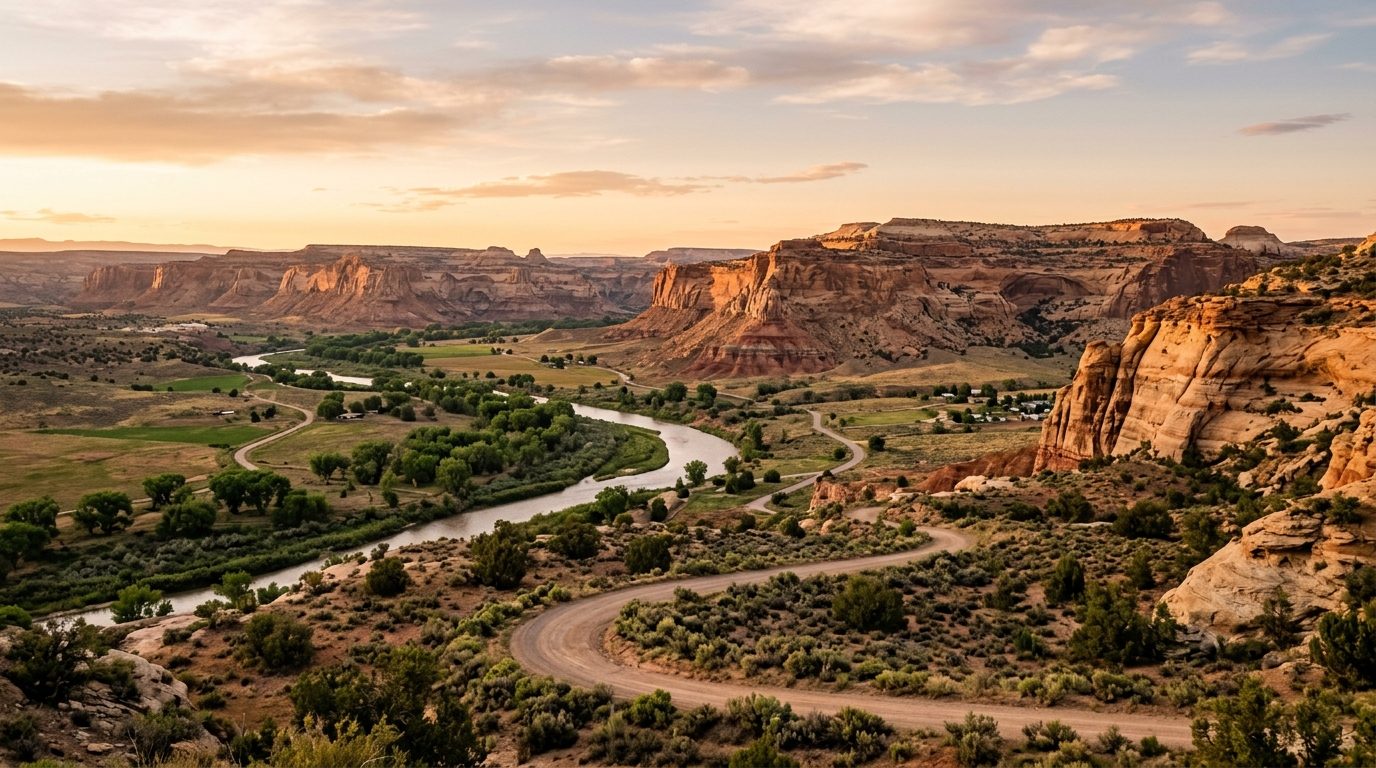
Farmington sits in the high desert of northwestern New Mexico, where the Animas, La Plata, and San Juan Rivers converge amid mesas, sandstone bluffs, and irrigated river-bottom farmland. The metro’s housing stock reflects decades of steady, incremental growth rather than a single building boom: ranch-style and split-level homes from the 1960s through 1980s dominate older core neighborhoods, while newer subdivisions on the mesa tops and foothills feature single-story stucco and brick construction on larger lots, often with detached garages or space for RVs and trailers given the region’s rural character. Manufactured and modular homes are common on the outskirts and in the smaller surrounding towns, reflecting both affordability needs and the area’s ranching and agricultural roots. Because the terrain rises sharply from the river valleys onto surrounding mesas, elevation and view exposure vary block to block, and many homes are built to withstand wide temperature swings typical of a high-desert climate.
Homes closer to the San Juan and Animas River corridors, along with established neighborhoods on Farmington’s north side near the golf course and older tree-lined streets, tend to command higher prices, prized for mature landscaping, irrigation access, and proximity to downtown amenities. Foothill and mesa-top subdivisions on the city’s edges also draw a premium for unobstructed views and newer construction, even though they sit farther from schools and shopping. Lower-cost housing is concentrated in the smaller surrounding communities and unincorporated areas of San Juan County, where lot sizes are larger but infrastructure, paved roads, and municipal services are more limited. Homes nearest industrial corridors, active well pads, or older mobile home parks also tend to sit at the lower end of the market.
The regional economy has long been anchored by energy extraction: oil and natural gas production in the San Juan Basin, along with historical coal mining, shaped the area’s employment base for generations, and companies such as ConocoPhillips, Hilcorp, and Williams continue to operate in the basin. Healthcare is another major pillar, led by San Juan Regional Medical Center, along with Indian Health Service facilities serving the region. Government and education employ a large share of the workforce through San Juan College, Farmington Municipal Schools, and San Juan County. The Navajo Nation’s proximity also supports employment through Navajo Agricultural Products Industry (NAPI) and tribal enterprises, while retail and trade serve as the commercial hub for a wide swath of the Four Corners region that lacks other large population centers.
Several factors distinguish housing and land use here from other New Mexico metros. Water is a defining constraint and asset: San Juan River flows and Navajo Reservoir releases support both municipal supply and large-scale irrigation through the Navajo Indian Irrigation Project, and water rights and allocation agreements involving the Navajo Nation and the state of New Mexico remain an active, closely watched issue amid Colorado River basin drought conditions. The retirement of the San Juan Generating Station coal plant and adjacent mine removed a long-standing source of local jobs and tax revenue, pushing the region toward economic diversification. Farmington’s location adjoins Navajo Nation trust land on multiple sides, meaning some nearby land carries different ownership, jurisdiction, and development rules than fee-simple property within city limits. New Mexico’s relatively low property tax rates also shape long-term ownership costs compared with neighboring states.
Cities and Towns in the Farmington Metro Area
Notable Communities and Neighborhoods
Farmington Real Estate Market FAQ
What is the terrain like around Farmington?
Farmington sits at the confluence of the San Juan, Animas, and La Plata Rivers in a high-desert landscape of mesas, sandstone bluffs, and irrigated river valleys. Elevation and terrain change quickly from the river bottoms to the surrounding mesa tops, which affects views, sun exposure, and access in different parts of the metro.
What industries drive the local economy?
Oil and natural gas production in the San Juan Basin, healthcare, government, education, and Navajo Nation-affiliated enterprises are the leading sources of employment. Retail and services also play an outsized role because Farmington functions as the main commercial hub for a large, sparsely populated region.
How close is Farmington to the Navajo Nation?
The Navajo Nation borders San Juan County on multiple sides, and Navajo Nation trust land lies close to and in places adjacent to the Farmington metro. This proximity shapes local commerce, employment, and some land-use and jurisdictional considerations for property near reservation boundaries.
Are water rights and supply a consideration in this area?
Yes. Water in the San Juan River basin is allocated through longstanding agreements involving the Navajo Nation and the State of New Mexico, and river flows have been affected by broader Colorado River basin drought conditions. Water availability underpins both municipal use and the region’s irrigated agriculture.
Nearby Markets