
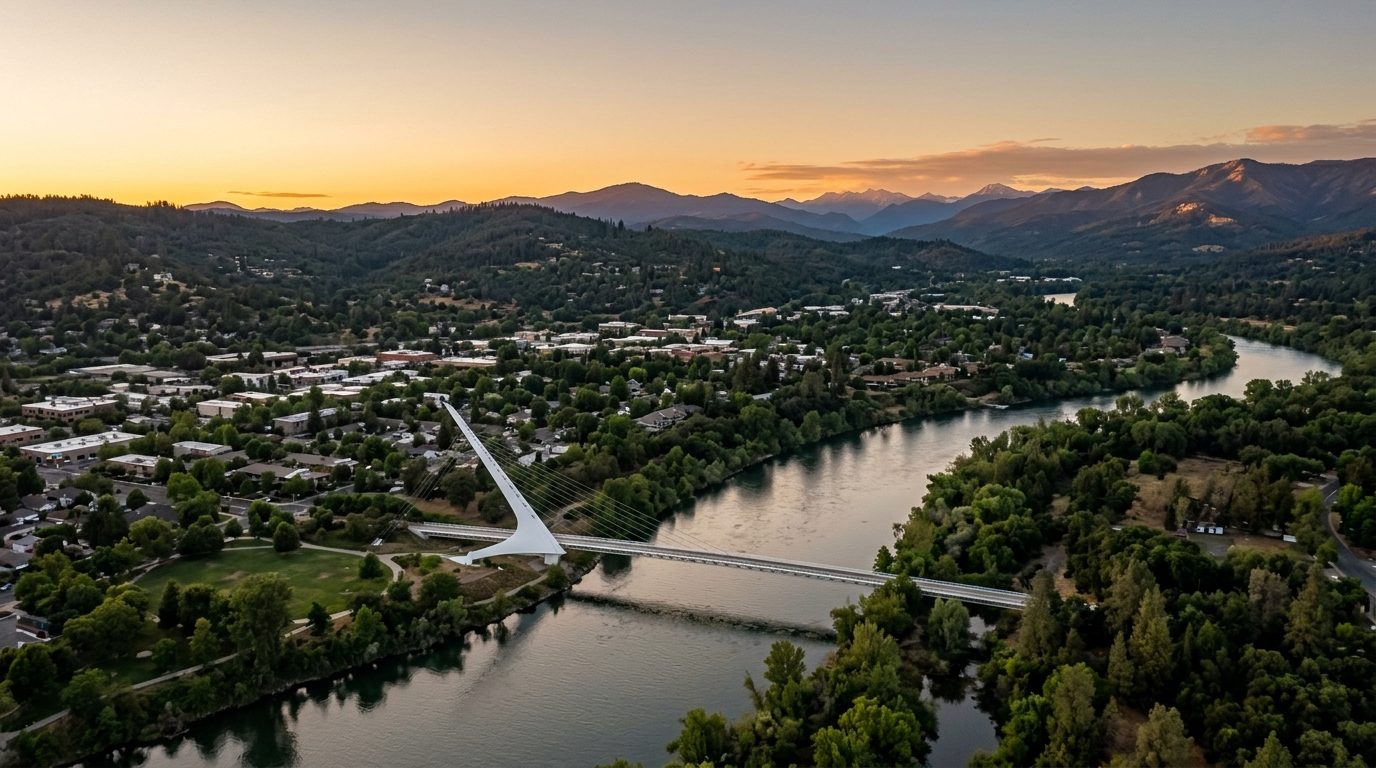
Current real estate market data, news and analysis for the Redding, CA metropolitan area — 181,648 residents across Shasta county.
Data as of May 2026. Sources: Redfin Data Center, U.S. Census Bureau.
Latest Redding Real Estate News
Coverage of this market is coming soon. Browse all housing market news.
Redding Real Estate Market Overview
Redding sits in far Northern California along the upper Sacramento River, where the flat farmland of the northern Sacramento Valley gives way to the forested foothills of the Klamath Mountains and southern Cascade Range. Shasta Lake and the Trinity Alps lie just to the north and west, and the city serves as the last major urban center before Interstate 5 climbs into rugged mountain terrain toward the Oregon border. Housing stock reflects this layered growth: older, tree-shaded ranch and bungalow-style homes fill the flatter grid neighborhoods near downtown and the river, while newer subdivisions climb the surrounding hillsides and benches. Custom homes on wooded, view-oriented lots are common on the city’s western and northern edges, and acreage properties with wells or septic systems appear on the valley’s rural fringe and in unincorporated pockets of Shasta County.
Homes command higher prices in the hillside and foothill neighborhoods west and north of downtown, where mature oak woodlands, golf-course frontage, gated access, and elevated views over the Sacramento Valley set them apart from the rest of the market. Golf-oriented and gated developments in these areas add amenities that support stronger demand. More modest pricing is typical in the older, flatter neighborhoods closer to downtown, along the industrial and commercial corridors near Interstate 5, and in the smaller cities of Anderson and Shasta Lake, where housing stock tends to be older, lots are smaller, and homes sit farther from the river frontage and hillside views that command a premium elsewhere in the metro.
Redding functions as the economic, medical, and retail hub for a wide swath of far Northern California, drawing residents from surrounding rural counties for services not available closer to home. Health care is the anchor industry, led by Mercy Medical Center and Shasta Regional Medical Center, both major hospital employers with specialized treatment programs. Government is another significant employment base, with Shasta County, the City of Redding, and state agencies such as Caltrans among the area’s largest employers. Retail trade and food service employ a large share of the workforce given the city’s role as a shopping destination for the region. Higher education also contributes through Shasta College, a public community college, and Simpson University, a private university, both based in Redding. Timber, agriculture, and outdoor recreation and tourism tied to nearby lakes, rivers, and mountains round out the local economy.
Wildfire is the defining local risk factor: the 2018 Carr Fire burned into Redding’s western neighborhoods and destroyed hundreds of homes, and the 2021 Fawn Fire forced a large evacuation nearby, so buyers should check a property’s fire hazard severity zone designation, defensible-space requirements, and the availability and cost of homeowners insurance before purchasing, particularly in hillside and wildland-adjacent areas. Summers are hot and dry, which compounds fire risk and elevates cooling costs. Parts of the city near the Sacramento River and its tributaries carry flood-zone considerations worth verifying through FEMA maps. Public transit is limited, and most residents rely on cars, so commute patterns and road access matter when evaluating outlying subdivisions. Buyers looking at rural or unincorporated pockets of Shasta County should also confirm whether a property relies on a private well and septic system rather than municipal water and sewer service.
Cities and Towns in the Redding Metro Area
Notable Communities and Neighborhoods
Redding Real Estate Market FAQ
How is the Redding, CA metro area organized geographically?
The metro centers on the city of Redding along the upper Sacramento River, with the smaller cities of Anderson to the south and Shasta Lake to the north forming the rest of the incorporated area within Shasta County. Beyond these cities, unincorporated communities spread into the surrounding valley farmland and Cascade and Klamath foothills, with terrain shifting from flat valley floor to increasingly wooded, hillier ground the farther one moves from the river corridor.
Which parts of Redding tend to be pricier and which are more affordable, and why?
Hillside and foothill areas to the west and north of downtown, including golf-course and gated subdivisions, tend to carry higher prices because of elevated views, mature landscaping, larger lots, and amenity access. Older, flatter neighborhoods nearer downtown and the Interstate 5 corridor, along with the cities of Anderson and Shasta Lake, tend to be more affordable, reflecting smaller and older homes, flatter terrain without valley views, and closer proximity to industrial and commercial land uses.
What should buyers verify locally before purchasing in the Redding area?
Buyers should confirm a property’s fire hazard severity zone designation and any defensible-space or fire-hardening requirements, check whether the parcel falls within a mapped flood zone near the Sacramento River or its tributaries, and verify the water and sewer setup, since many rural and hillside properties rely on private wells and septic systems rather than city service. Properties in gated or amenity subdivisions should also be checked for HOA rules and dues.
What is the biggest region-specific risk for homeowners in the Redding area?
Wildfire is the most significant regional risk. The 2018 Carr Fire burned into Redding’s western neighborhoods and destroyed a large number of homes, and later fires such as the 2021 Fawn Fire caused further destruction and evacuations nearby. This history affects homeowners insurance availability and cost, especially for properties in hillside, wooded, or wildland-urban interface locations, making insurance shopping and fire-hardening an important part of due diligence.
Nearby Markets