
Current real estate market data, news and analysis for the Port St. Lucie, FL metropolitan area — 568,721 residents across Martin and St. Lucie counties.
Data as of May 2026. Sources: Redfin Data Center, U.S. Census Bureau.
Latest Port St. Lucie Real Estate News
Port St. Lucie Real Estate Market Overview
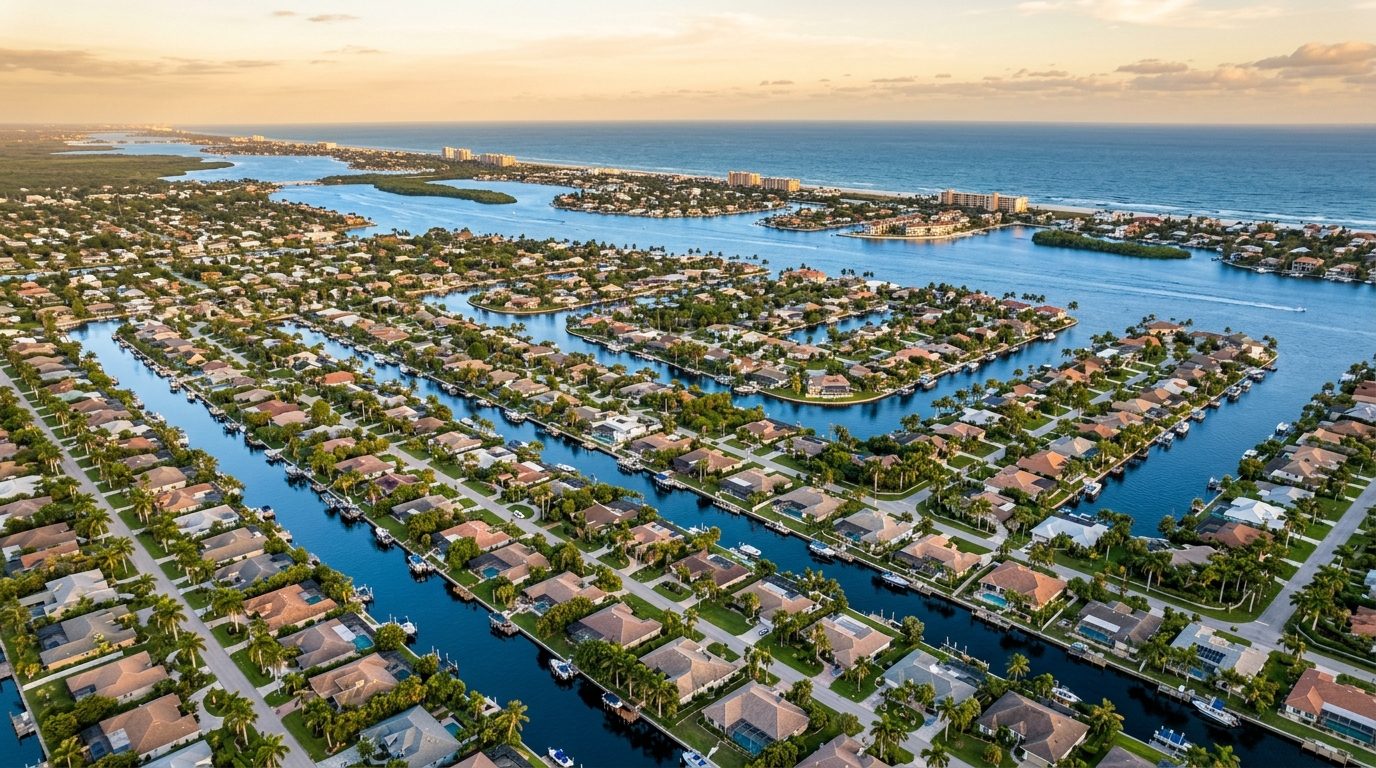
The Port St. Lucie metro covers Martin and St. Lucie counties on Florida’s Treasure Coast, between the Indian River Lagoon/St. Lucie River system and the Atlantic. Barrier islands, including Hutchinson Island and Jupiter Island, separate the mainland from open ocean and are linked by a handful of bridges. Most land west of the lagoon is flat and cut by drainage canals, a legacy of mid-20th-century platting. Port St. Lucie, the metro’s largest city, was carved from pine flatwoods in the 1960s by a single developer that laid out tens of thousands of grid-pattern lots; much of its housing stock is concrete-block single-family homes built from the 1970s onward on canal-fed lots, joined more recently by gated subdivisions. Stuart and Fort Pierce, the county seats, keep older downtown cores with early-20th-century buildings and bungalow housing near the water. Inland, Indiantown remains smaller and agricultural.
Waterfront and barrier-island addresses sit at the top of the market: Jupiter Island, Sewall’s Point, and the gated marina community of Sailfish Point front the ocean, river, or Intracoastal Waterway with large lots and private boat access rarely found elsewhere. Newer golf-oriented planned communities such as Tradition and PGA Village in western Port St. Lucie, and Martin County neighborhoods around Palm City, also draw a premium for amenities, newer construction, and school access. The bulk of Port St. Lucie’s original grid was built out lot by lot over decades, so value varies block by block with the age and condition of individual homes. Fort Pierce’s older core and inland communities such as White City, Lakewood Park, and Indiantown skew more affordable, reflecting older housing, distance from the beach, and, around Indiantown, a still-agricultural setting.
Healthcare, education, and government anchor local employment: Cleveland Clinic operates Martin Health System and Tradition Hospital in Port St. Lucie, HCA Florida runs Lawnwood and St. Lucie hospitals, and both counties’ school systems and Indian River State College are among the largest employers, alongside county and municipal government. Manufacturing has a footprint through boatbuilder Pursuit Boats in Fort Pierce and aviation and electronics suppliers based in Stuart, while Florida Power & Light runs the St. Lucie nuclear plant on Hutchinson Island and Seacoast Bank is headquartered in Stuart. Torrey Pines Institute for Molecular Studies and Florida Atlantic University’s Harbor Branch Oceanographic Institute add biomedical and marine-science research. Agriculture around Indiantown, trucking carrier Armellini Express Lines, and a Walmart distribution center round out the base, and the Mets hold spring training at Clover Park in Port St. Lucie.
Hurricane exposure shapes much of what makes this market distinctive: wind and flood insurance cost and availability vary sharply between oceanfront, lagoon-front, and inland properties, and homes on barrier islands or canals should be checked against current flood-zone maps and wind-mitigation requirements. Much of Port St. Lucie’s older platted land was originally sold as vacant lots without utilities, so buyers should confirm whether a parcel is on municipal water and sewer or still relies on well and septic, and whether utility-assessment or septic-to-sewer conversion charges attach to it. Newer planned communities often carry community development district assessments on top of HOA dues, separate from county property taxes. Canal-front lots typically come with owner-maintained seawalls. Growth has been rapid and largely low-density, so it’s worth checking zoning and any pending nearby development with local planning before closing.
Cities and Towns in the Port St. Lucie Metro Area
Notable Communities and Neighborhoods
Port St. Lucie Real Estate Market FAQ
How is the Port St. Lucie metro area laid out geographically?
It spans two counties, Martin and St. Lucie, running along the Indian River Lagoon and Intracoastal Waterway. Barrier islands such as Hutchinson Island and Jupiter Island hold the direct oceanfront and are reached by bridges from the mainland. Most of the population lives on the mainland side, with Port St. Lucie’s mid-20th-century grid of platted lots covering the bulk of the land area, Fort Pierce and Stuart serving as the older waterfront county seats, and Indiantown sitting apart as a smaller inland, agricultural town near Lake Okeechobee.
Which parts of the metro tend to be pricier, and why?
Direct waterfront tends to command the most: Jupiter Island, Sewall’s Point, and gated communities like Sailfish Point offer ocean, river, or Intracoastal frontage with private boat access and low-density zoning that can’t be replicated inland. Newer planned communities such as Tradition and PGA Village also draw a premium for amenities and newer construction. Older sections of Port St. Lucie’s original grid, along with Fort Pierce’s core and inland communities, tend to be more affordable, largely reflecting the age of the housing and distance from the water.
What should buyers verify locally before purchasing here?
Confirm the flood zone designation and elevation certificate for any property near the coast, a canal, or the lagoon. Check whether the home is on municipal water and sewer or on well and septic, since parts of Port St. Lucie’s older platted areas were sold without utilities in place and some are mid-conversion to sewer. Ask whether an HOA, a community development district, or both apply, review their fee structure and rules, and, for canal-front lots, find out who is responsible for seawall and dock maintenance.
What is the biggest region-specific risk to weigh here?
Hurricane exposure and its effect on insurance. This stretch of Florida sits directly in the Atlantic hurricane corridor, and wind and flood insurance premiums and availability differ substantially by location, construction type, and age of the roof and windows. Buyers should get a firm insurance quote, ask about wind-mitigation inspections and any windstorm or flood policy requirements, and factor those ongoing costs into affordability before making an offer, especially on older or coastal homes.
Nearby Markets