
Current real estate market data, news and analysis for the Greenville, NC metropolitan area — 182,936 residents across Pitt county.
Data as of May 2026. Sources: Redfin Data Center, U.S. Census Bureau.
Latest Greenville Real Estate News
Coverage of this market is coming soon. Browse all housing market news.
Greenville Real Estate Market Overview
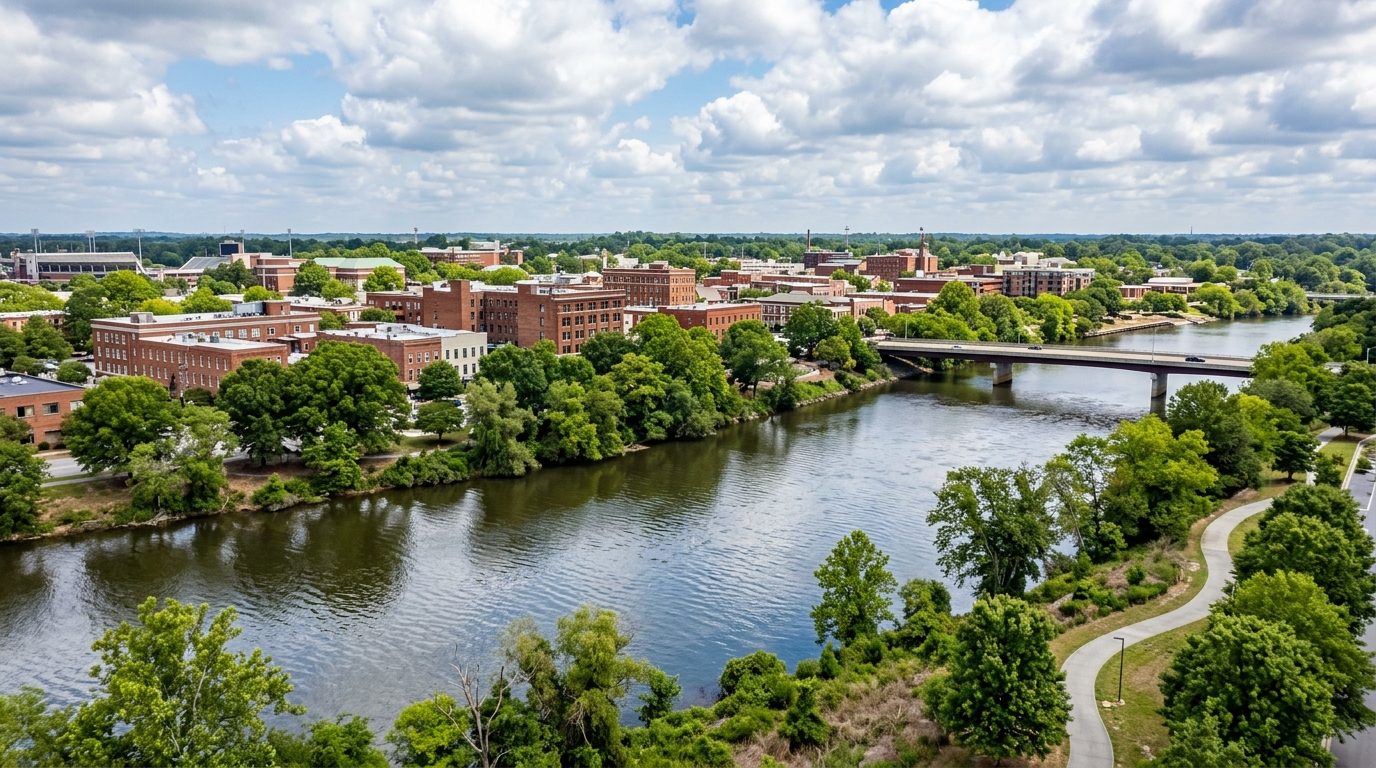
Greenville sits in the inner Coastal Plain of eastern North Carolina, in Pitt County, on the south bank of the Tar River, which winds through the city center and shapes much of its layout and green space. The city is compact and largely flat, with older, tree-lined sections near downtown giving way to newer subdivisions toward Winterville and Ayden. Housing stock is mixed in age and style: brick ranch and Cape Cod homes from the mid-twentieth century line established in-town neighborhoods, early bungalow and Craftsman houses cluster in blocks near the university that predate modern zoning, and contemporary vinyl-and-brick subdivisions with sidewalks and shared green space dominate newer construction on the outer edges of the city. Because East Carolina University drives much of the local housing market, many homes and apartments near campus function as student rentals, giving those blocks a different character than the more conventional owner-occupied neighborhoods farther out.
Neighborhoods near the Tar River corridor and long-established, club-anchored areas on the city’s east side tend to sit toward the higher end of the local market, reflecting mature tree canopy, larger lots, and proximity to golf and swim amenities. Newer planned subdivisions on the southern and western fringes also trend upward, offering updated systems and larger modern floor plans. More modest pricing clusters in older in-town neighborhoods with smaller homes, in areas mixed with student rentals near campus where investor ownership is common, and in sections closer to industrial corridors and older working-class parts of the city. Distance from downtown, the university, and the regional medical center is a consistent dividing line, as is whether a block sits inside or outside the mapped floodplain along the river and its tributary creeks.
The local economy centers on healthcare and higher education. ECU Health Medical Center, the region’s academic medical center and teaching hospital, works alongside East Carolina University and its Brody School of Medicine, and together the university and hospital system form the area’s largest employment base. Manufacturing and life sciences form a second leg: companies including Thermo Fisher Scientific, Hyster-Yale Materials Handling, Grady-White Boats, Avient, Catalent, and Nipro Medical Corporation operate plants in and around the city. Pitt Community College, county and municipal government, public education, and a retail and logistics sector serving rural eastern North Carolina round out the base, with agriculture remaining important nearby.
Eastern North Carolina’s exposure to hurricanes and tropical storm remnants is a defining local risk, and Tar River flooding tied to past major storms remains the benchmark event shaping how the city administers its floodplain rules; buyers should check FEMA flood zone status for any address near the river or its creeks, regardless of how far it appears to sit from open water. Property taxes are levied separately by Pitt County and the City of Greenville, and some addresses fall within additional fire-district or municipal service areas, so buyers should confirm the combined local rate for a specific parcel. Public transit is limited to a city bus system paired with a campus transit network, so most residents rely on personal vehicles. Buyers near campus should verify whether a rental-density or occupancy overlay applies, and, as in much of rural Pitt County outside city limits, whether a parcel is served by municipal water and sewer or relies on a private well and septic system.
Cities and Towns in the Greenville Metro Area
Notable Communities and Neighborhoods
Greenville Real Estate Market FAQ
How is the Greenville, NC metro area organized geographically?
The metro is coextensive with Pitt County and centers on the city of Greenville, which sits on the Tar River in the inner Coastal Plain of eastern North Carolina. Smaller towns including Winterville, Ayden, Farmville, Grifton, Bethel, Fountain, Grimesland, Simpson, and Falkland ring the county, transitioning from Greenville’s more urban core into surrounding farmland. East Carolina University and its medical campus sit near the center of the city and strongly influence the surrounding street grid and land use.
Which areas of Greenville tend to be pricier or more affordable, and why?
Areas along the Tar River corridor and long-established, club-anchored neighborhoods on the city’s east side tend to command higher prices because of mature landscaping, larger lots, and recreational amenities, and newer planned subdivisions on the southern and western edges of the city trend upward for similar reasons tied to updated construction. More affordable options cluster in older in-town neighborhoods with smaller homes, in areas near campus with a heavy mix of student rentals, and in sections closer to industrial corridors, generally reflecting age of construction, lot size, and distance from downtown and the university.
What should buyers verify locally before purchasing in Greenville, NC?
Buyers should check FEMA flood zone status for any property near the Tar River or its tributary creeks, since flood risk is not always obvious from a home’s apparent distance from water. It is also worth confirming the combined city and county property tax rate for a specific parcel, checking whether a home relies on municipal water and sewer versus a private well and septic system in outlying parts of the county, and, for property near East Carolina University, verifying whether any rental-density or occupancy overlay applies.
What region-specific risks affect the Greenville, NC housing market?
Eastern North Carolina’s exposure to hurricanes and tropical storm remnants is the area’s most significant environmental risk, and past major storms have produced serious flooding along the Tar River, which continues to shape local floodplain regulation. The local economy’s concentration in higher education and healthcare through East Carolina University and its affiliated hospital system also means that housing demand and employment are closely tied to the health of those two institutions.
Nearby Markets