
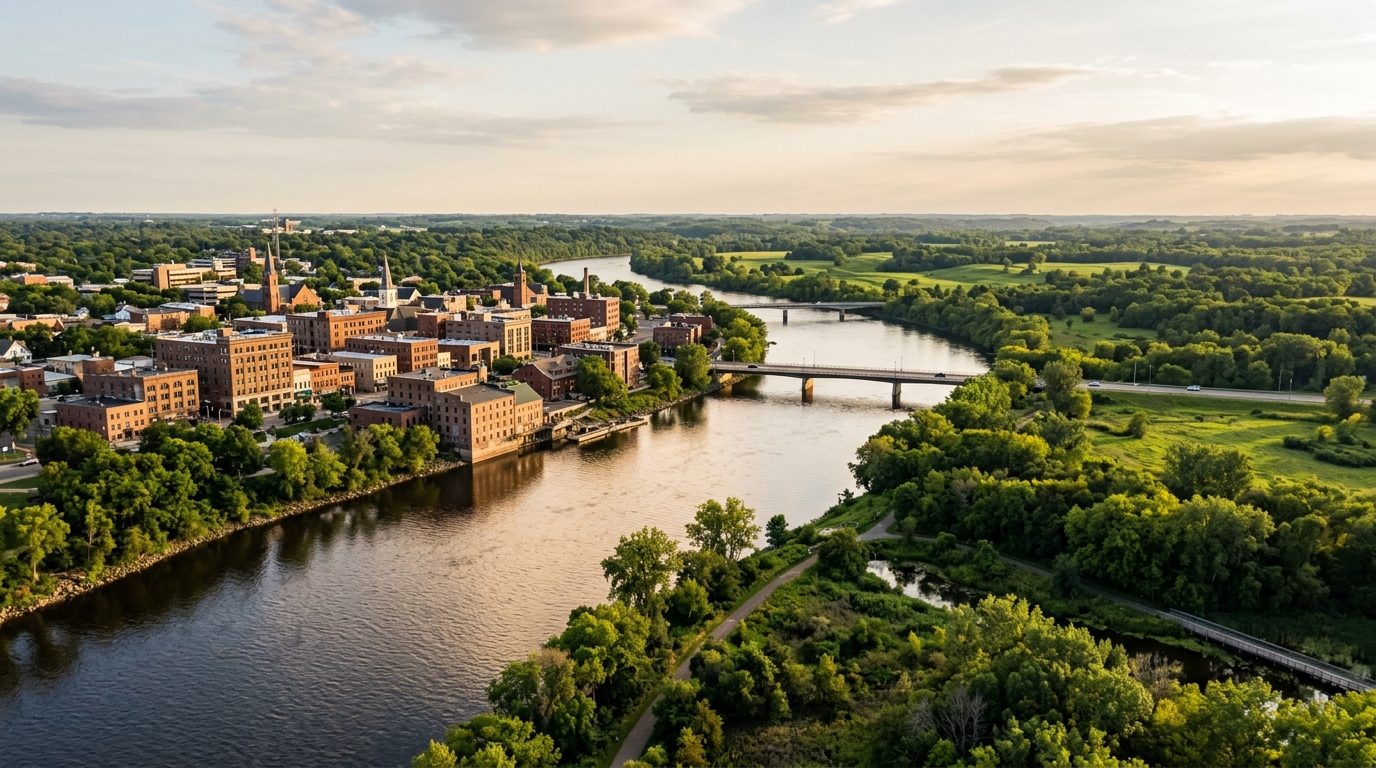
Current real estate market data, news and analysis for the St. Cloud, MN metropolitan area — 205,854 residents across Benton and Stearns counties.
Data as of May 2026. Sources: Redfin Data Center, U.S. Census Bureau.
Latest St. Cloud Real Estate News
Coverage of this market is coming soon. Browse all housing market news.
St. Cloud Real Estate Market Overview
St. Cloud sits along the Mississippi River in central Minnesota, roughly an hour’s drive from Minneapolis-St. Paul, at a point where the river marks the seam between the older city core and its eastern neighbor Sauk Rapids. The surrounding landscape is textbook central Minnesota: gently rolling terrain left behind by retreating glaciers, dotted with small lakes and interrupted by working farmland the further one travels from the urban core. Winters are long and cold and summers warm and humid, with heavy snow a normal part of the housing calendar rather than an exception. St. Cloud grew from a cluster of river townsites in the mid-19th century, and that history shows in a housing stock skewed older than the surrounding suburbs — modest early homes and postwar bungalows fill the blocks nearest downtown and the river, while ranch and split-level construction fills out the neighborhoods beyond. Outside the city limits, the metro shifts quickly into farmland, small lake towns, and low-density rural residential development.
Age and location relative to the river and the university drive most of the variation across the metro. The oldest sections of St. Cloud proper — the East Side and the Southside neighborhoods near St. Cloud State University — carry the character, and the maintenance needs, of housing built well before modern codes, and the Southside’s campus proximity keeps a meaningful share of that stock in rental use rather than owner-occupancy. Newer construction concentrates in the fast-growing suburbs ringing the city, particularly Sartell to the north and, to a lesser extent, Sauk Rapids and Waite Park, where subdivisions have replaced farmland. Lake access adds its own premium: the Horseshoe Chain of Lakes southwest of the city, near Cold Spring and Richmond, is the metro’s most developed year-round lake community within commuting range of St. Cloud.
Healthcare and higher education anchor the local economy. CentraCare, the regional hospital system headquartered in St. Cloud, is the area’s largest employer, and the St. Cloud VA Health Care System adds a second major medical employer. Higher education runs deep: St. Cloud State University and St. Cloud Technical & Community College sit inside the city, while the College of Saint Benedict and Saint John’s University, a well-known Benedictine-affiliated pair, anchor St. Joseph and nearby Collegeville. Coborn’s, a regional grocery and retail company, is headquartered in the area, and Anderson Trucking Service is a major logistics employer tied to the region’s position on Interstate 94. Manufacturing, food processing, and retail round out a regional-hub economy.
Buyers should be aware that the region has a real history of severe weather, including tornadoes, and should check a property’s storm history and insurance requirements. Low-lying land near the Mississippi can see localized flash flooding after heavy rain, even though the river itself is not a major ongoing flood threat to most of the developed core. Property tax rates and assessment practices differ between Benton and Stearns counties, so buyers near the county line should confirm which jurisdiction, and which school district, a specific address falls under. Public transit is limited to St. Cloud Metro Bus service, and most of the metro is car-dependent, though Amtrak’s Empire Builder stops in St. Cloud. Winter readiness, including heating systems, roof snow load, and driveway maintenance, is a practical consideration for any purchase in this climate.
Cities and Towns in the St. Cloud Metro Area
Notable Communities and Neighborhoods
St. Cloud Real Estate Market FAQ
How is the St. Cloud housing market organized across the metro?
The market splits between the older urban core of St. Cloud along the Mississippi River, fast-growing suburbs like Sartell and Sauk Rapids on the fringe, and rural Benton and Stearns county land further out; each has a distinct mix of housing age, lot size, and commute pattern.
Which parts of the St. Cloud metro tend to carry higher prices?
Newer subdivisions in Sartell and other growth suburbs, along with lake-access property near the Horseshoe Chain of Lakes southwest of the city, generally command more than older housing stock in St. Cloud’s historic core neighborhoods.
What should buyers verify before purchasing in the St. Cloud area?
Confirm which county, Benton or Stearns, and school district a property sits in, since tax rates and assessments differ, and check flood history for any parcel near the Mississippi River or its tributaries.
Is severe weather a concern for homeowners in the St. Cloud metro?
Yes — central Minnesota has a documented history of tornadoes and severe thunderstorms, and heavy snow load is a normal seasonal consideration, so buyers should ask about a home’s storm history, roof condition, and heating system before closing.
Nearby Markets