
Current real estate market data, news and analysis for the Cedar Rapids, IA metropolitan area — 279,285 residents across Benton, Jones and Linn counties.
Data as of May 2026. Sources: Redfin Data Center, U.S. Census Bureau.
Latest Cedar Rapids Real Estate News
Coverage of this market is coming soon. Browse all housing market news.
Cedar Rapids Real Estate Market Overview
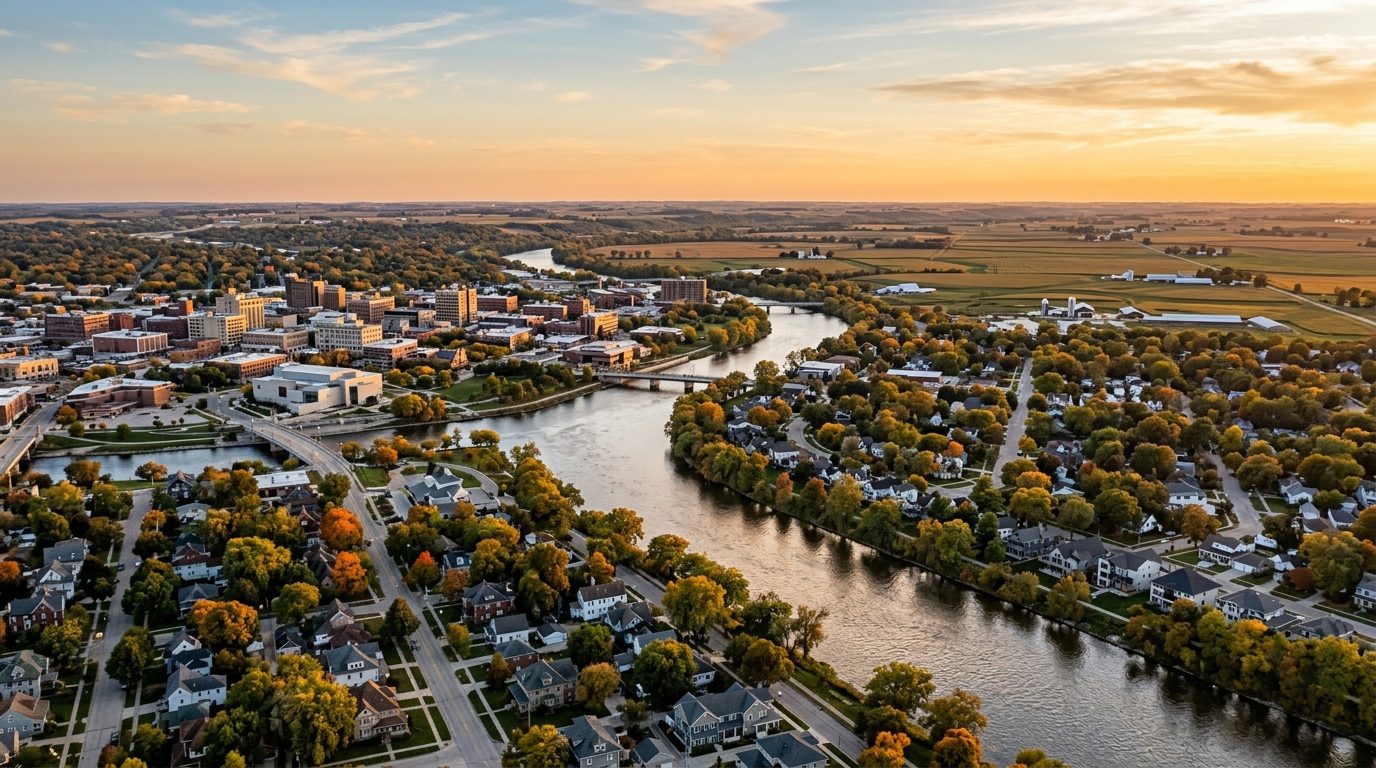
The Cedar Rapids metro sits along the Cedar River in east-central Iowa, spanning Linn, Jones, and Benton counties across farmland and river-valley terrain. Cedar Rapids is split by the river into quadrants, ringed by the suburbs of Marion, Hiawatha, Robins, and Fairfax, while Center Point, Anamosa, and Monticello anchor rural stretches of Linn and Jones counties. Housing in the urban core is largely early-twentieth-century, with bungalows, Foursquares, and Craftsman homes in inner neighborhoods and a few streetcar-era districts of larger, period-revival homes. Beyond these sit postwar ranch homes, then newer suburban subdivisions on larger lots, while small towns further out keep older downtown cores of Victorian and farmhouse-style homes on acreage. The river has shaped the city: a catastrophic flood inundated much of the urban core and prompted redevelopment of low-lying blocks, a second flood struck years later, and a windstorm downed trees and damaged roofs.
Within the metro, newer suburban areas tend toward higher prices, largely due to recent construction, larger lots, and school districts with strong local reputations. Marion, especially its northern reaches, along with Hiawatha and Robins, has drawn steady new-home construction, while southwest Cedar Rapids and neighboring Fairfax benefit from newer subdivisions and nearby schools. A few historic in-town neighborhoods, including Bever Park, Redmond Park-Grande Avenue, and Bever Woods, carry a premium tied to architectural character and established, tree-lined streets. More affordable housing clusters in older, denser neighborhoods on the northwest and southeast sides of Cedar Rapids near downtown and the river, and in industrial-adjacent pockets of the central city. Outlying towns such as Anamosa, Monticello, and Center Point, and rural Benton and Jones counties, run cheaper, reflecting commute distance, not amenities.
The metro economy rests on manufacturing, agribusiness, insurance, and healthcare. Collins Aerospace, an aerospace and defense electronics manufacturer, keeps its principal campus in Cedar Rapids and ranks among the region’s largest employers, alongside manufacturers such as Whirlpool, International Paper, and PMX Industries, and defense contractor BAE Systems. The city is also a longstanding grain- and food-processing center, home to operations run by Cargill, ADM, Ingredion, General Mills, Quaker Oats, and Kraft Heinz. Insurance and financial services form another pillar, anchored by Transamerica’s local operations, a GEICO regional office, and homegrown insurer UFG Insurance. Healthcare employment centers on Mercy Medical Center and UnityPoint Health-St. Luke’s Hospital, both in Cedar Rapids, while higher education adds stability through Kirkwood Community College, Coe College, Mount Mercy University, and Cornell College in Mount Vernon.
Flood risk tied to the Cedar River is the most consequential local factor for buyers to weigh: a catastrophic flood, followed by a second significant flood years later, affected large sections of the urban core, and the city has since built a phased flood-control system along both riverbanks. Buyers near the river should independently verify flood-zone status and elevation. A destructive derecho windstorm swept the metro more recently, a reminder severe summer winds are a recurring hazard too. Property taxes are set separately by the Cedar Rapids city assessor and by county assessors in Linn, Jones, and Benton counties, so practices vary by jurisdiction. Transit remains a modest, car-dependent bus network confined mostly to Cedar Rapids. Growth has concentrated in the newer suburbs while much of Jones and Benton counties remains farmland; rural buyers should independently confirm well and septic systems and subdivision restrictions.
Cities and Towns in the Cedar Rapids Metro Area
Notable Communities and Neighborhoods
Cedar Rapids Real Estate Market FAQ
How is the Cedar Rapids metro area organized geographically?
The metro is centered on Cedar Rapids, which straddles the Cedar River and is divided into quadrants by the river and a central east-west avenue. Around the core city sits a ring of suburbs, including Marion, Hiawatha, Robins, and Fairfax, that make up most of Linn County’s population growth. Beyond the immediate suburbs, Linn County transitions into smaller towns like Center Point and Mount Vernon, while Jones County to the east is anchored by Anamosa and Monticello and Benton County to the west remains largely agricultural with smaller communities spread across it.
Which parts of the metro tend to have higher home prices, and why?
Newer suburban areas with recent construction, larger lots, and highly regarded school districts, such as Marion, Hiawatha, and Robins, along with newer development on the southwest side of Cedar Rapids and in Fairfax, tend to sit at the higher end of the market. A handful of historic in-town neighborhoods known for period architecture and mature, established streets also command a premium despite being closer to the urban core. Prices generally ease with distance from these areas and from the metro’s main employment centers.
What should buyers verify locally before purchasing in this market?
Because the Cedar River has flooded the urban core more than once, buyers considering property near the river or in a previously affected neighborhood should independently confirm current flood-zone designation, ground elevation, and flood-insurance requirements rather than relying on a listing description. In smaller towns and unincorporated parts of Benton and Jones counties, buyers should also confirm whether a property relies on a private well and septic system, and check with the relevant city or county assessor’s office for accurate property tax information, since assessment practices differ by jurisdiction.
What is a distinctive regional risk buyers should understand?
River flooding is the most significant recurring risk in this market: the Cedar River has produced serious flooding in the urban core on more than one occasion, and the city has undertaken flood-control construction along its banks in response. Severe summer thunderstorm winds, including a major derecho-type windstorm, are a related regional hazard capable of causing widespread tree and roof damage across the metro even away from the river itself.
Nearby Markets