
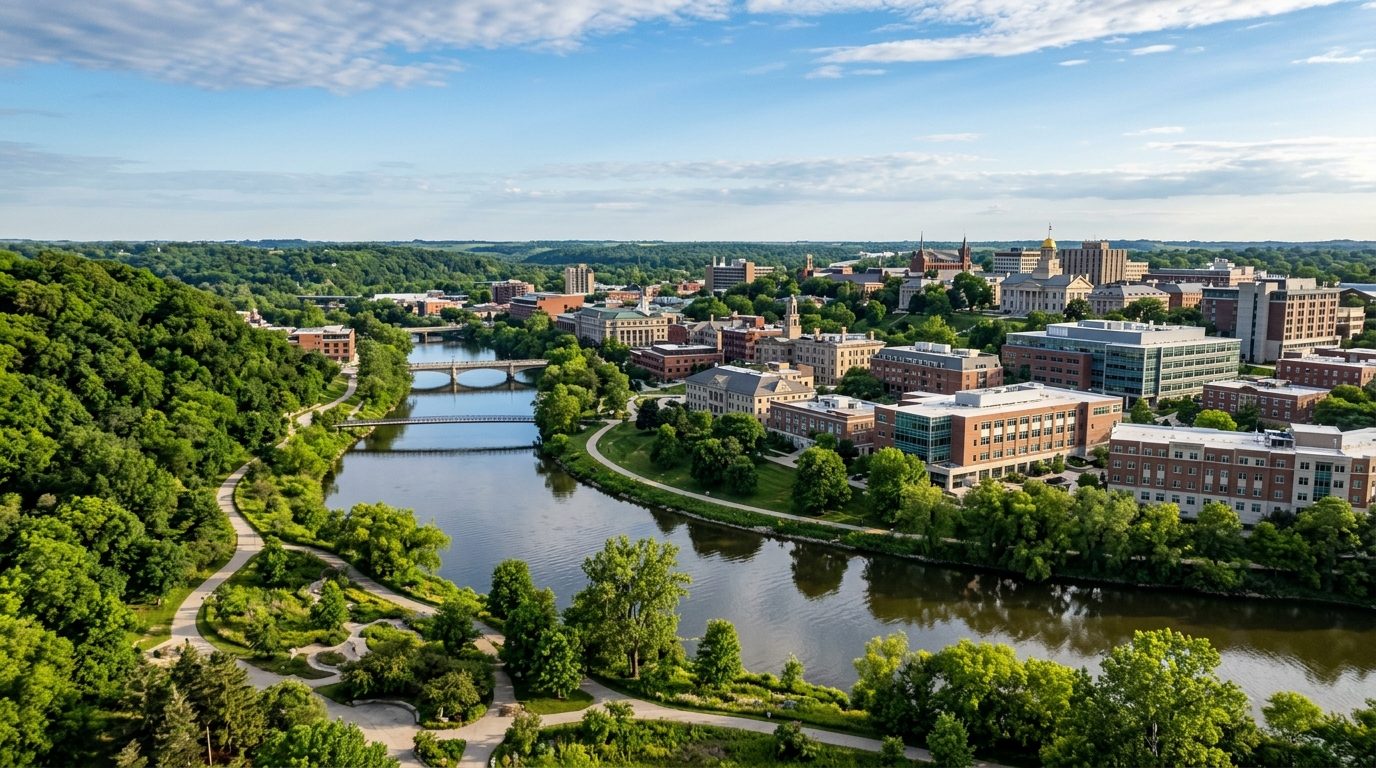
Current real estate market data, news and analysis for the Iowa City, IA metropolitan area — 182,711 residents across Johnson and Washington counties.
Data as of May 2026. Sources: Redfin Data Center, U.S. Census Bureau.
Latest Iowa City Real Estate News
Coverage of this market is coming soon. Browse all housing market news.
Iowa City Real Estate Market Overview
The Iowa City metropolitan area sits in east-central Iowa along the Iowa River, spanning Johnson and Washington counties amid rolling farmland and wooded river bluffs, in the valley where the river passes through the Coralville Reservoir and downtown Iowa City. The core is anchored by Iowa City, the Johnson County seat and home to the University of Iowa, ringed by the suburbs of Coralville, North Liberty, and the small enclave of University Heights, with outlying towns such as Tiffin, Solon, Swisher, and Oxford in the surrounding farmland. Washington County, to the south, keeps a more agricultural, small-town character anchored by the city of Washington. Housing stock reflects this layered growth: brick and frame homes from the early twentieth century cluster near campus and downtown, mid-century ranch and split-level houses fill older neighborhoods further out, and newer subdivisions of single-family homes, townhouses, and apartments have risen on former farmland at the edges of Coralville and North Liberty.
Neighborhoods within walking distance of the University of Iowa campus, downtown, and the hospital complex tend toward the higher end of the local market, both for that proximity and because several are protected historic districts where large lots, mature trees, and architectural character limit teardowns. Established neighborhoods on the city’s west side, closer to the river bluffs and away from through-traffic corridors, carry similar appeal for their quiet, settled feel and larger lots. Newer subdivisions built out from Coralville and North Liberty toward the metro’s edges tend to be more attainable, trading proximity to downtown and campus for larger, more modern floor plans on more abundant land. Smaller towns farther from the core, including those in Washington County, are generally the most affordable, reflecting longer commutes to university and hospital jobs anchoring the regional economy.
The metro’s economy centers heavily on education and health care. The University of Iowa is the region’s largest employer, and University of Iowa Health Care, including University of Iowa Hospitals & Clinics and UI Stead Family Children’s Hospital, is one of the area’s largest health systems and employers. The federal government has a presence too, through the Iowa City VA Health Care System. Private employers include ACT, the testing organization headquartered north of downtown Iowa City, a Procter & Gamble plant in Iowa City, and GreenState Credit Union, headquartered in North Liberty. Washington County leans more toward manufacturing and agriculture, with employers such as CIVCO Medical Solutions in Kalona. School districts and local government round out employment.
Buyers should know that parts of Iowa City sit within the Iowa River floodplain, and Ralston Creek, a smaller waterway through the city, has produced localized flash flooding; flood zone status, elevation certificates, and flood insurance requirements are worth confirming property by property near the river and lower-lying creek corridors. Iowa property tax rates and assessment practices vary by taxing jurisdiction, so buyers should check the specific levies tied to an address. Public transit is workable in the urban core, with fare-free Cambus service plus Iowa City Transit and Coralville Transit, though service thins in outlying towns. The regional economy’s reliance on the university and its health system ties local jobs and housing demand to enrollment, research funding, and hospital employment, a dependency worth weighing alongside routine checks like septic and well systems in rural parts of Washington and Johnson counties.
Cities and Towns in the Iowa City Metro Area
Notable Communities and Neighborhoods
Iowa City Real Estate Market FAQ
How is the Iowa City, IA metro area organized geographically?
The metro is built around Iowa City, the Johnson County seat and home of the University of Iowa, along the Iowa River. Close-in suburbs Coralville and North Liberty, plus the small enclave of University Heights, form a connected urban core, while smaller towns such as Tiffin, Solon, Swisher, and Oxford sit further out amid farmland. Washington County, to the south, is more rural and centers on the city of Washington, giving the metro a layered pattern that shifts from dense university-adjacent neighborhoods to small-town and agricultural areas at its edges.
Which parts of the Iowa City area tend to be pricier or more affordable, and why?
Areas closest to the University of Iowa campus, downtown, and the hospital complex tend to draw the most demand because of walkability to jobs and campus life, and several of these neighborhoods are protected historic districts that limit teardowns and dense redevelopment, reinforcing their appeal. Established neighborhoods on the city’s west side, near the river bluffs, carry similar cachet for their settled character. Newer subdivisions in Coralville and North Liberty tend to be more attainable since they were built more recently on more abundant land, while small towns farther from the core, including those in Washington County, are generally the most affordable given longer commutes to university and hospital jobs.
What should buyers verify locally before purchasing property in the Iowa City metro?
Buyers should confirm flood zone status and elevation information for properties near the Iowa River or Ralston Creek, since parts of Iowa City sit in mapped floodplain areas. In historic districts, it is worth checking design review or preservation requirements that can affect renovations or additions. In more rural parts of Washington County and unincorporated Johnson County, buyers should verify well and septic system condition and any easements or agricultural zoning restrictions, and confirm which city, school district, and county property tax levies apply to a specific address.
What regional risks are specific to the Iowa City housing market?
Localized flooding is the most tangible physical risk, tied to the Iowa River, the Coralville Reservoir and dam upstream, and smaller waterways like Ralston Creek that can flash flood after heavy rain. Economically, the region is closely tied to the University of Iowa and its health care system, so local employment, population growth, and housing demand are sensitive to university enrollment, research funding, and hospital system changes rather than a broadly diversified private economy.
Nearby Markets