
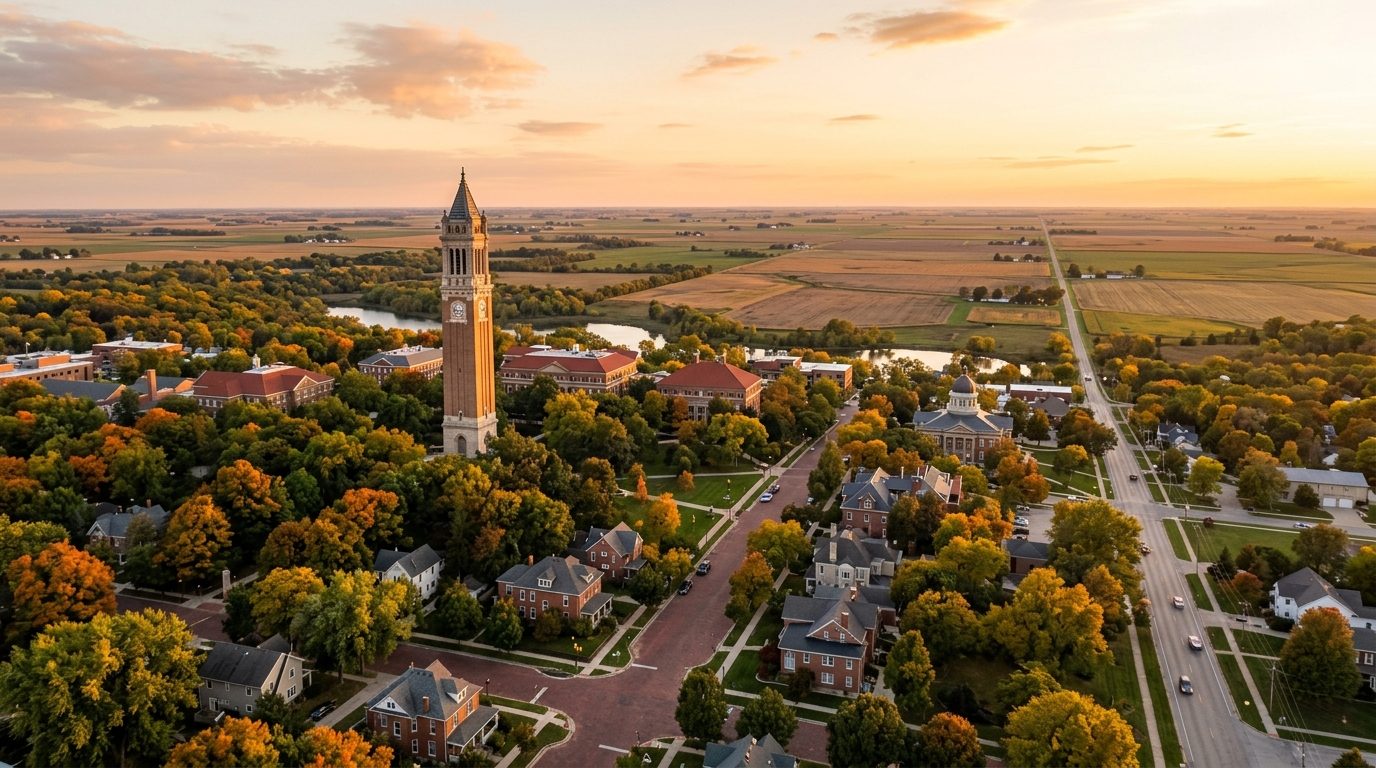
Current real estate market data, news and analysis for the Ames, IA metropolitan area — 128,090 residents across Boone and Story counties.
Data as of May 2026. Sources: Redfin Data Center, U.S. Census Bureau.
Latest Ames Real Estate News
Ames Real Estate Market Overview
Ames sits on the gently rolling till plains of central Iowa, split by the South Skunk River and its tributary, Ioway Creek, which cut shallow valleys through an otherwise flat farm landscape. The climate is humid continental, with warm, humid summers and cold, dry winters typical of the Upper Midwest. The city grew up around a railroad depot and, soon after, around Iowa State University, and its housing stock still reflects that dual origin: a compact grid of early frame and brick homes near the historic core and original campus, ringed by successive waves of postwar ranch houses and split-levels, and, on the north and west edges, newer subdivisions built on former cropland. Surrounding Story and Boone County towns retain smaller, more traditional Main Street cores set among working farmland.
Housing closest to the Iowa State campus and the historic core commands a premium for walkability to campus, downtown, and Campustown, even though many of these blocks are dominated by rental housing serving the student population rather than owner-occupied homes. Established family neighborhoods farther from campus, particularly toward the northwest and near Ada Hayden Heritage Park, tend to combine larger lots and newer construction with strong assigned schools, which also supports higher values. Newer subdivisions on the city’s edges offer the newest construction and larger floor plans at a premium over older infill. Smaller surrounding towns and the city of Boone generally offer lower-cost, lower-density alternatives in exchange for a longer commute into Ames.
The metro’s economy centers on Iowa State University, whose campus, cooperative extension, and affiliated Ames National Laboratory anchor employment in education, research, and public administration. The Iowa State University Research Park, south of campus, houses agricultural-technology, bioscience, and software tenants alongside established companies. Federal and state agricultural research is a further pillar, led by USDA facilities including the National Animal Disease Center and National Centers for Animal Health. Health care is represented by Mary Greeley Medical Center and McFarland Clinic. Manufacturing and corporate employers include Danfoss, Hach Company, and Workiva, alongside Fareway Stores, whose retail and distribution operations remain rooted in Boone. Local government, Story County, the City of Ames, and the Iowa Department of Transportation also employ heavily, and Des Moines Area Community College maintains a presence in the metro.
Because Ioway Creek and the South Skunk River run directly through developed parts of Ames, flood risk is a real and recurring local factor, and buyers near either waterway should check current floodplain mapping before purchasing. The rental market is heavily shaped by the university’s student population, and Ames enforces occupancy rules limiting how many unrelated people can share a single-family home, which affects rental economics and neighborhood character near campus. Land beyond the city’s edge is overwhelmingly farmed, so annexation, drainage-district assessments, and zoning at the urban fringe are worth confirming with local officials. CyRide provides bus transit linking campus and surrounding neighborhoods. School district boundaries vary among Ames, Ballard, Gilbert, Nevada, Boone, and other nearby districts, and should be verified by address.
Cities and Towns in the Ames Metro Area
Notable Communities and Neighborhoods
Ames Real Estate Market FAQ
How is the Ames metro organized geographically?
The metro is anchored by the city of Ames, home to Iowa State University, and radiates outward across Story and Boone counties to smaller communities such as Boone, Nevada, Story City, Huxley, Gilbert, and Slater. Each of these outlying towns has its own small commercial core surrounded by farmland and connects to Ames primarily by state and county highways rather than forming a continuous built-up area.
Which parts of the metro tend to carry higher home prices, and why?
Homes close to the Iowa State campus and the historic core carry a premium for walkability, but many of those blocks are oriented toward student rental housing rather than owner-occupied living. Established family neighborhoods farther out, especially toward the northwest side and near Ada Hayden Heritage Park, and newer subdivisions on the city’s edges, tend to combine larger lots, newer construction, and strong assigned schools, which supports higher values than older, closer-in infill.
What should a buyer verify locally before purchasing in this metro?
Buyers should confirm current floodplain status for any property near Ioway Creek or the South Skunk River, check which school district and attendance zone applies since boundaries differ across Ames, Ballard, Gilbert, Nevada, Boone, and other nearby districts, review the applicable city or county occupancy and rental rules if the property will be leased, and confirm zoning and any agricultural drainage-district obligations for properties near the urban edge.
What is a region-specific risk buyers should understand?
Flooding along Ioway Creek and the South Skunk River is a recurring local hazard, since both waterways run through developed parts of Ames and have produced significant flooding historically. Properties near either waterway, or in low-lying areas that drain toward them, should be checked against current floodplain maps and local stormwater history rather than assumed safe based on distance from the main channel alone.
Nearby Markets