
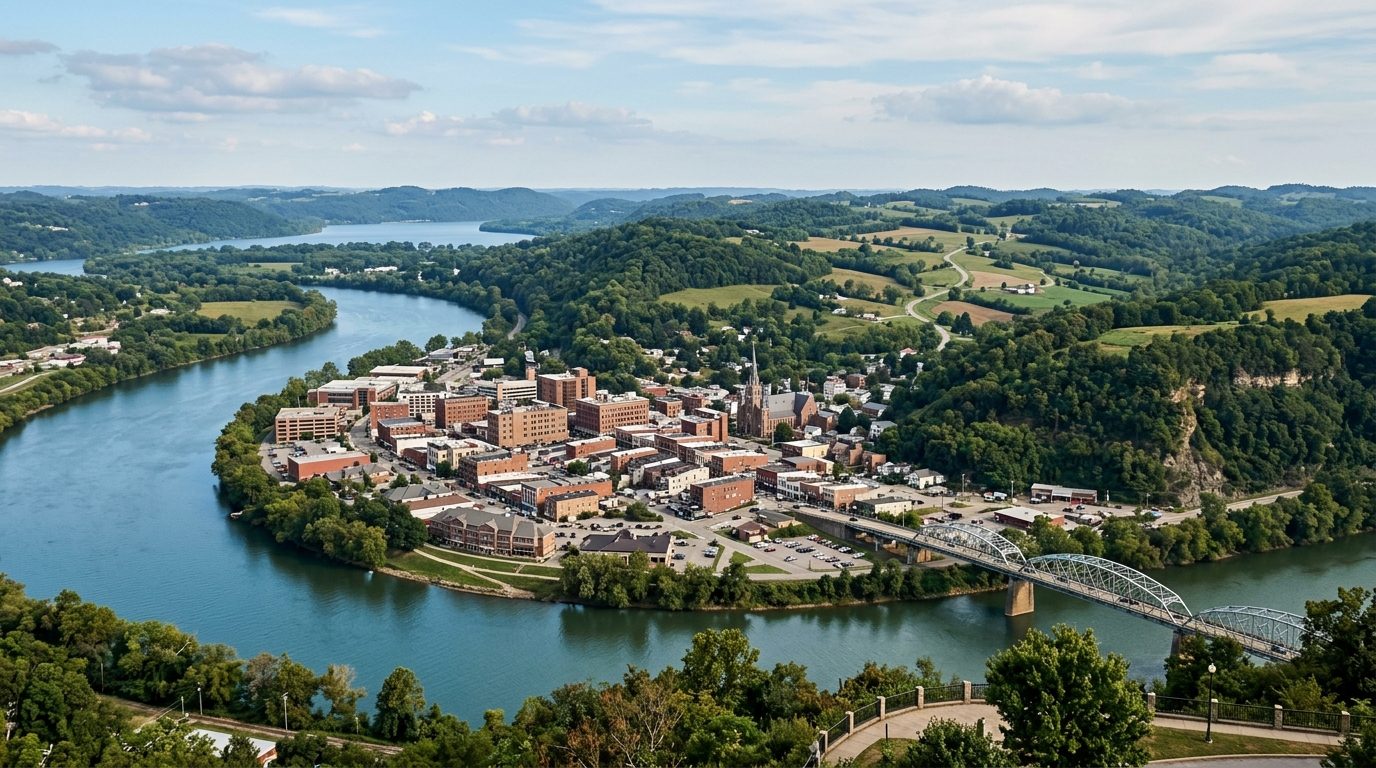
Current real estate market data, news and analysis for the Clarksville, TN-KY metropolitan area — 349,001 residents across Christian, KY, Montgomery, TN, Stewart, TN and Trigg, KY counties.
Data as of May 2026. Sources: Redfin Data Center, U.S. Census Bureau.
Latest Clarksville Real Estate News
Clarksville Real Estate Market Overview
Clarksville sits along the Cumberland River where it meets branches of the Red River, on the northwestern edge of Tennessee’s Highland Rim, the plateau ringing the Nashville Basin. The metro reaches north into the farmland and lake country of southern Kentucky, where terrain gives way to the shorelines of Lake Barkley and Kentucky Lake near Cadiz. Bluffs and wooded ridges frame the river downtown, while land flattens toward Stewart and Trigg counties into pasture, row crops, and the forested public land of Land Between the Lakes. Housing stock layers an old settlement pattern with recent growth: brick ranch homes fill older Clarksville neighborhoods, downtown keeps a compact core of older houses, and Montgomery and Christian counties carry newer subdivisions for a steady flow of military families. Rural Stewart and Trigg counties mix older farmhouses with manufactured homes and lake cabins.
Price tiers track commute distance, age of construction, and proximity to water more than any single center of gravity. Subdivisions in southeastern Montgomery County, positioned toward the Nashville commute along the interstate, sit at the higher end for newer construction and shorter drive times. Downtown Clarksville commands a premium for restored architecture and walkable streets on small lots. Neighborhoods closest to the Fort Campbell gates lean older and more modestly priced, with a larger share of rentals serving arriving and departing service members. Rural acreage in Stewart and Trigg counties generally costs less than in-town lots, except along lakeshores near Cadiz and Dover, where waterfront parcels command more.
Fort Campbell, the Army post straddling the Tennessee-Kentucky line between Clarksville and Hopkinsville, anchors the economy as home station to the 101st Airborne Division and the 160th Special Operations Aviation Regiment; its payroll and family-housing demand shape the local market. Austin Peay State University, based in Clarksville with a teaching site on post, is another major employer. Manufacturing diversifies the base, with Hankook Tire, LG Electronics, Bridgestone, and Trane operating plants around Clarksville’s industrial park, while Amazon and a Google data center add logistics jobs. On the Kentucky side, Hopkinsville’s economy centers on Jennie Stuart Health, automotive suppliers Metalsa and Grupo Antolin, Tyson Foods, and Hopkinsville Community College. Public education and county government round out employment on both sides of the line, alongside Vanderbilt Clarksville Hospital, the largest hospital.
Because the metro straddles a state line, buyers must track more than one set of rules. Tennessee levies no state income tax, while Kentucky does, and property tax and sales tax also differ, a gap shoppers navigate by crossing into Oak Grove or Hopkinsville for lower-taxed retail. School zoning follows the same divide: Tennessee-side children attend Clarksville-Montgomery County or Stewart County schools, while Kentucky-side children fall under Christian County, Hopkinsville Independent, or Trigg County districts, so a short move means a different school system. The humid subtropical climate brings occasional tornadoes that have damaged homes and manufactured housing, so buyers should confirm construction type, flood-zone status, and storm history. Development is shaped heavily by the military presence: on-post housing is privatized, while off-post rental and starter-home demand rises and falls with the Army’s rotation cycle, producing seasonal churn in renters and listings. There is no significant public transit, so daily life depends on driving. Buyers should verify well, septic, and utility service in rural areas, and homeowners association covenants on newer subdivisions.
Cities and Towns in the Clarksville Metro Area
Notable Communities and Neighborhoods
Clarksville Real Estate Market FAQ
How is the Clarksville metro organized across the Tennessee-Kentucky state line?
The metro is anchored by Clarksville in Montgomery County, Tennessee, and extends across the state line to Christian and Trigg counties in Kentucky, with Stewart County, Tennessee, filling out the western edge along the Cumberland River. Fort Campbell, the Army post that drives much of the local economy, sits directly on the state line between Clarksville and Hopkinsville, so the metro effectively functions as one labor market and housing market split between two states, two tax systems, and several separate school districts.
Which parts of the Clarksville metro tend to be pricier, and why?
Newer subdivisions in southeastern Montgomery County that shorten the commute toward Nashville, along with the restored homes of downtown Clarksville, tend to sit at the higher end of the local market. Waterfront and near-waterfront property along Lake Barkley and Kentucky Lake near Cadiz also commands more for water access and recreation. Areas immediately around the Fort Campbell gates and older, rental-heavy neighborhoods generally sit at the more affordable end, while rural acreage away from the lakes tends to be the least expensive.
What should buyers verify locally before purchasing in this metro?
Because the metro spans a state line, buyers should confirm which state and county a property sits in, since that determines income tax exposure, property tax rules, and which school district a home is zoned for. In rural parts of Stewart, Trigg, and outlying Montgomery and Christian counties, buyers should also verify whether a property relies on well and septic systems versus public utilities, check flood-zone status near the Cumberland and Red rivers, and review any homeowners association or planned-unit-development covenants attached to newer subdivisions.
How does Fort Campbell affect housing demand and turnover in this market?
Fort Campbell is the dominant economic force in the metro, and its permanent-change-of-station cycle creates a recurring rhythm of moves, concentrated in summer, as soldiers and their families arrive and depart. This produces seasonal spikes in rental demand and turnover, particularly in neighborhoods near the post gates on both the Tennessee and Kentucky sides, and it supports a large rental and starter-home segment distinct from the privatized housing located on post itself.
Nearby Markets