
Current real estate market data, news and analysis for the Champaign-Urbana, IL metropolitan area — 239,979 residents across Champaign, Ford and Piatt counties.
Data as of May 2026. Sources: Redfin Data Center, U.S. Census Bureau.
Latest Champaign Real Estate News
Coverage of this market is coming soon. Browse all housing market news.
Champaign Real Estate Market Overview
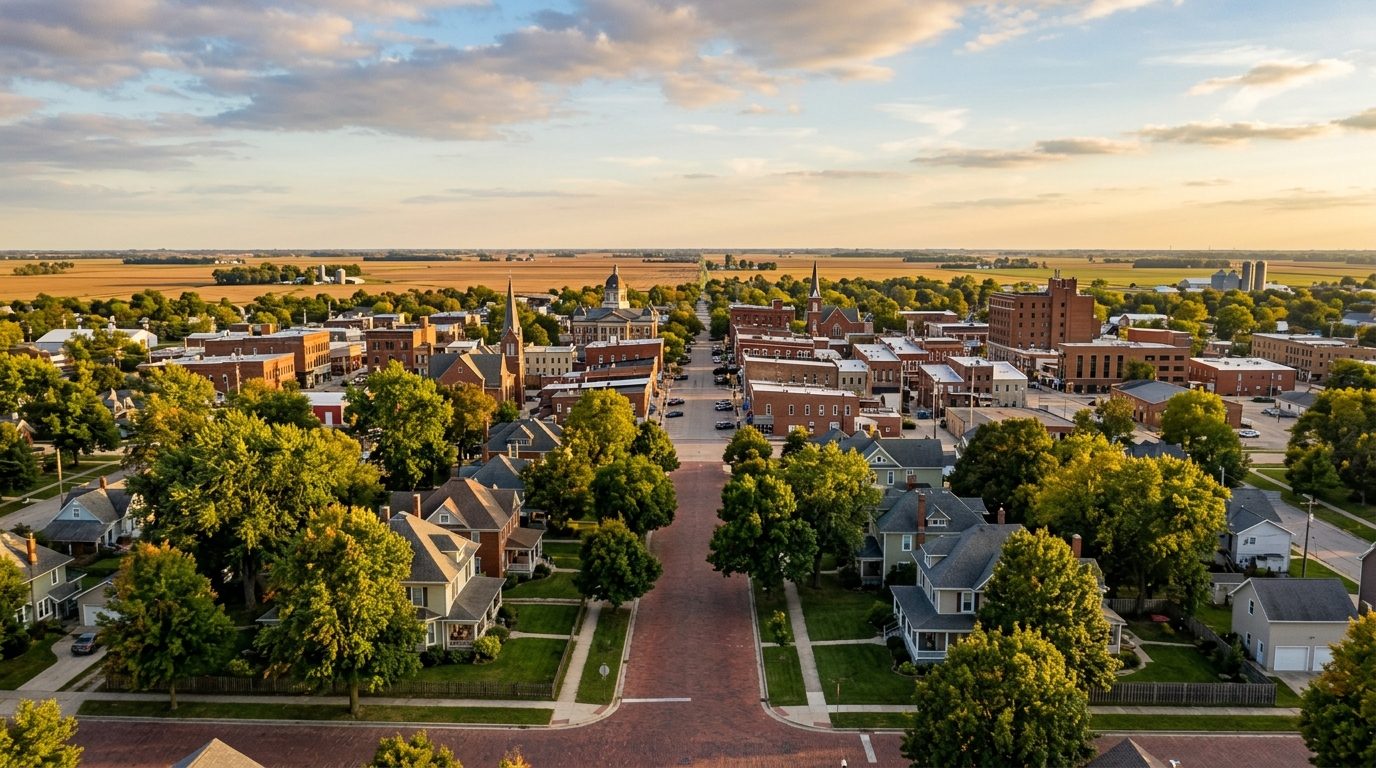
Champaign and Urbana sit side by side on the flat prairie of east-central Illinois, their built-up areas merging into a single urban footprint with no clear dividing line between the two cities. The terrain is level cropland punctuated by shallow drainage ditches and detention basins, since the region was originally tallgrass prairie converted to row-crop agriculture. Housing stock mixes older frame and brick homes near the university campus and the two historic downtowns with a wide band of mid-century ranch and split-level houses radiating outward, and newer subdivisions on the southern and northern edges of both cities. Rental construction concentrates close to campus for the large student population, while owner-occupied housing dominates farther out. The satellite towns of Savoy and Mahomet form the outer ring of the metro, adding newer subdivisions amid otherwise continuous farmland.
Within Champaign-Urbana, the most sought-after and typically higher-priced pockets sit near the edges of the University of Illinois campus but outside the dense rental core, in neighborhoods with mature trees, brick streets, and walkable access to parks or to the two downtowns. Newer subdivisions on the south side of Champaign, along with growth areas in far north Champaign and southeast Urbana, tend to carry premium pricing tied to larger lots and proximity to newer retail and golf-course amenities. Lower-priced housing clusters closer to the rental districts nearest campus, in older neighborhoods with smaller, aging homes, and in pockets farther from the university and from newer retail development on the west side of Champaign. Savoy and Mahomet offer newer construction appealing to buyers wanting more space in exchange for a longer commute.
The University of Illinois at Urbana-Champaign anchors the metro’s economy by a wide margin, providing employment directly and through the research and technology activity around it, including a university research park housing agricultural-technology and life-sciences firms. Carle Health, the region’s dominant hospital and insurance system, is another major employer, alongside Christie Clinic and the local public school districts. Outside the university and health care, the metro has a notable industrial base: Kraft Heinz operates a large food-manufacturing plant in Champaign, FedEx Ground runs a regional distribution hub, and Horizon Hobby, a hobby-products company, is headquartered locally. Agriculture and agribusiness remain important to the surrounding county, with companies such as John Deere, ADM, and Cargill maintaining a presence tied to the region’s farmland and to agricultural research at the university.
Illinois carries some of the highest property tax burdens in the country, and Champaign County’s rates run above the state and national averages, so buyers should budget for a larger annual tax bill than the purchase price alone would suggest. The flat, prairie terrain limits large-scale flooding across most of the urbanized area, but low-lying spots along local creeks can see localized stormwater flooding, and the city funds a dedicated stormwater utility fee to manage it, so a flood-zone check is worthwhile. Central Illinois sits within an active severe-weather corridor and sees occasional tornadoes and damaging thunderstorm winds, making wind coverage worth reviewing with an insurer. A local mass-transit district serves the core cities and one nearby suburb, with university affiliates riding free, a factor for buyers weighing car-dependence. Zoning and permitting are handled separately by each city and by the county, so buyers near municipal boundaries should verify which jurisdiction governs a given parcel.
Cities and Towns in the Champaign Metro Area
Notable Communities and Neighborhoods
Champaign Real Estate Market FAQ
How is the Champaign-Urbana housing market organized geographically?
The metro is really two adjoining cities, Champaign and Urbana, that share a continuous built-up area with the University of Illinois campus straddling the boundary between them. Beyond the core cities, the smaller towns of Savoy and Mahomet form an outer ring of newer subdivisions surrounded by farmland, so location within the metro often comes down to proximity to campus, to one of the two downtowns, or to the newer retail corridors on the edges of Champaign.
Which parts of Champaign-Urbana tend to be pricier, and why?
Homes close to the University of Illinois campus but outside the dense rental blocks tend to command a premium, particularly in older neighborhoods with mature trees and brick streets that offer walkable access to campus or to one of the downtowns. Newer subdivisions on the south side of Champaign and in growth areas of southeast Urbana also carry higher prices, reflecting larger lots and more recent construction, while housing closest to the rental core nearest campus and in older, smaller-home neighborhoods farther from the university tends to be more affordable.
What should buyers verify locally before purchasing in Champaign-Urbana?
Because Champaign, Urbana, Savoy, and unincorporated Champaign County each administer their own zoning and permitting, buyers should confirm which jurisdiction governs a specific parcel, especially near city boundaries. It is also worth checking current property tax rates and any pending assessment appeals, since Illinois property taxes run well above the national average, and confirming whether a property falls within a local stormwater or drainage district given the region’s flat terrain.
What is the main region-specific risk buyers should understand in Champaign-Urbana?
The dominant risks are severe weather and stormwater related rather than coastal or wildfire related: central Illinois sits in an active severe-thunderstorm and tornado corridor, and the flat prairie terrain means that while large-river flooding is uncommon in the urbanized core, low-lying areas along local creeks and drainage ways can experience localized flooding during heavy rain. Buyers should review wind and storm coverage with an insurer and check flood-zone status even for properties well away from any major waterway.
Nearby Markets