
Current real estate market data, news and analysis for the Decatur, IL metropolitan area — 99,300 residents across Macon county.
Data as of May 2026. Sources: Redfin Data Center, U.S. Census Bureau.
Latest Decatur Real Estate News
Coverage of this market is coming soon. Browse all housing market news.
Decatur Real Estate Market Overview
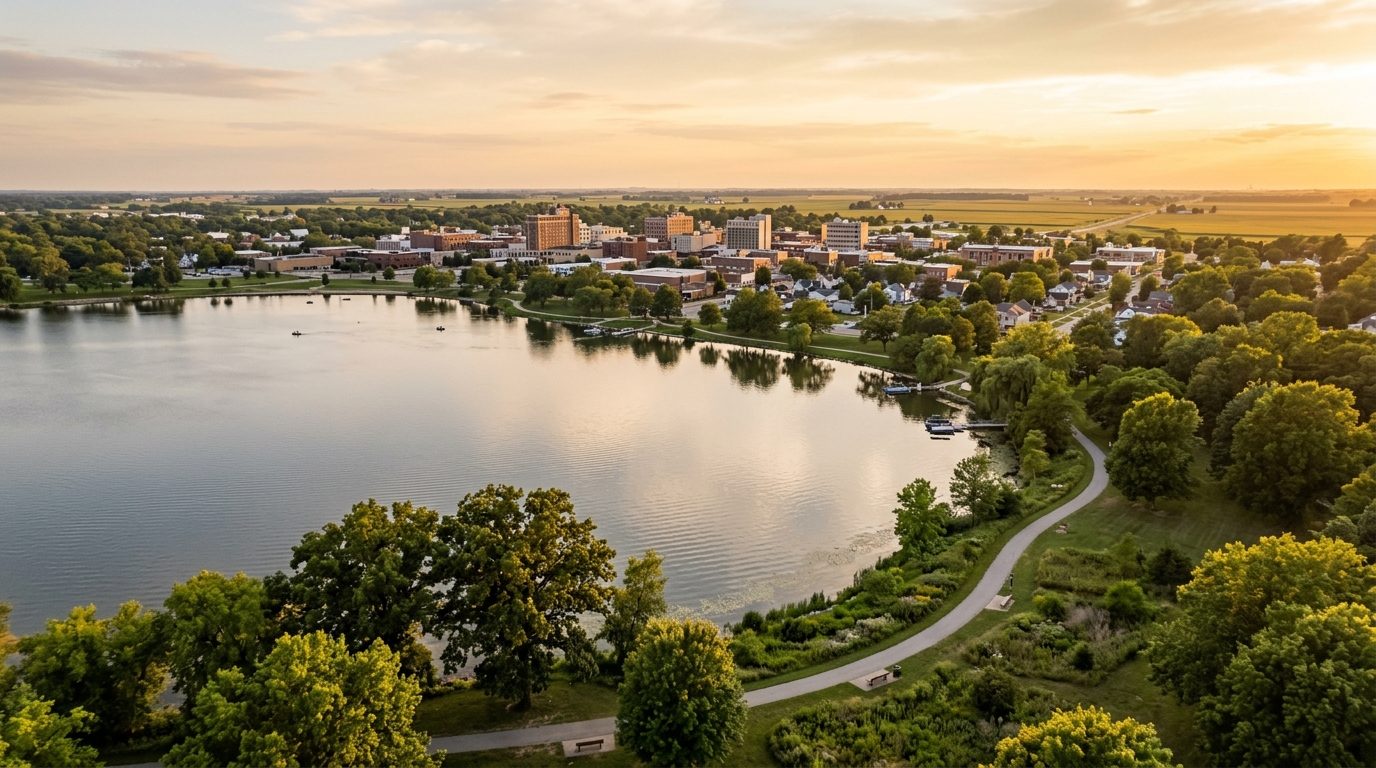
Decatur sits on the central Illinois prairie along the Sangamon River and Lake Decatur, a reservoir that anchors the city’s parks and shoreline neighborhoods amid flat, fertile farmland stretching to the edge of nearly every town in the metro. The built environment is compact rather than sprawling, with older neighborhoods holding early twentieth-century bungalows, foursquares, and Colonial and Craftsman-style homes, and postwar ranch houses filling out the city’s outer edges. Recognized historic districts cluster near Millikin University and the city’s west side, featuring varied architectural styles on mature, tree-lined streets. Surrounding towns such as Forsyth, Mount Zion, and Maroa favor newer single-family subdivisions on larger lots, while rural Macon County retains farmhouses and acreage properties amid working farmland. Detached single-family homes dominate; condominiums and higher-density housing are limited mostly to downtown and infill projects.
Within the metro, Forsyth and Mount Zion, situated just east and southeast of Decatur, generally sit toward the higher end of the local price spectrum, reflecting newer construction, distinct school districts, and less deferred maintenance than much of the older city core. Decatur’s west side, including neighborhoods near Millikin University and the historic districts, and areas along the Lake Decatur shoreline also trend upward locally, aided by architectural character and mature landscaping. Older sections of central and northeast Decatur, along with pockets near the city’s industrial corridors, tend toward the lower end of the price range, shaped by smaller, older housing stock. Small outlying communities such as Argenta, Blue Mound, Niantic, Oreana, and Macon sit at a modest, rural small-town tier defined by limited turnover and distance from Decatur’s job centers.
The metro’s economy centers on agribusiness and manufacturing, reflecting its position amid some of the country’s most productive farmland. Archer Daniels Midland (ADM) maintains its North American headquarters and one of its largest processing complexes in Decatur, a presence dating to the 1930s, making it one of the area’s largest and most visible employers. Caterpillar Inc. operates a major manufacturing plant in the city producing off-highway trucks and related heavy equipment. Decatur Memorial Hospital and area school districts round out the region’s larger employers. Higher education contributes as well: Millikin University, a private university near downtown, and Richland Community College, a public two-year institution, both feed the local workforce. Grain processing and agricultural logistics remain persistent threads throughout the local job base.
Buyers should weigh the metro’s exposure to spring and early-summer severe weather; central Illinois lies within a zone of elevated tornado and thunderstorm activity, with past decades bringing damaging tornado outbreaks to the area, a history worth factoring into insurance costs and, in some homes, the presence of a storm shelter or safe room. Illinois carries a comparatively heavy property tax burden, and Macon County rates run above the national norm, so buyers should confirm the specific tax rate, taxing bodies, and school district tied to any parcel. Public transit is limited to a city bus system, with Amtrak reached only via a connecting Thruway bus, so most residents drive. Zoning and building requirements vary between Decatur and its surrounding villages, and buyers on the urban or rural fringe should verify floodplain status, well and septic systems, and any farmland lease arrangements before purchasing.
Cities and Towns in the Decatur Metro Area
Notable Communities and Neighborhoods
Decatur Real Estate Market FAQ
How is the Decatur metro area organized geographically?
The metro centers on the city of Decatur, built around Lake Decatur and the Sangamon River, and radiates outward through a ring of smaller incorporated towns, including Forsyth, Mount Zion, Harristown, Long Creek, Maroa, Argenta, Blue Mound, Macon, Niantic, Oreana, and Warrensburg, all set within the farmland of Macon County.
Which areas in the Decatur metro trend toward higher prices, and why?
Forsyth and Mount Zion, along with Decatur’s west side near Millikin University and the historic districts and the Lake Decatur shoreline, tend to sit toward the higher end locally, largely because of newer or well-maintained housing stock, distinct school districts, and setting. Older central and northeast Decatur neighborhoods and the outlying small towns generally sit lower on the local spectrum.
What should buyers verify before purchasing property in this market?
Buyers should confirm the property tax rate and taxing bodies attached to a specific parcel, floodplain status near the Sangamon River or Lake Decatur, any historic-district design review requirements, and, for rural or fringe properties, well and septic systems and farmland lease arrangements.
How significant is tornado risk in the Decatur area?
Central Illinois sits within a zone of elevated severe weather activity, and the Decatur area has experienced notable tornado outbreaks in past decades, particularly during spring and early summer. Buyers should weigh this history when considering insurance coverage and features such as storm shelters or safe rooms.
Nearby Markets