
Current real estate market data, news and analysis for the Bloomington, IL metropolitan area — 171,419 residents across McLean county.
Data as of May 2026. Sources: Redfin Data Center, U.S. Census Bureau.
Latest Bloomington Real Estate News
Coverage of this market is coming soon. Browse all housing market news.
Bloomington Real Estate Market Overview
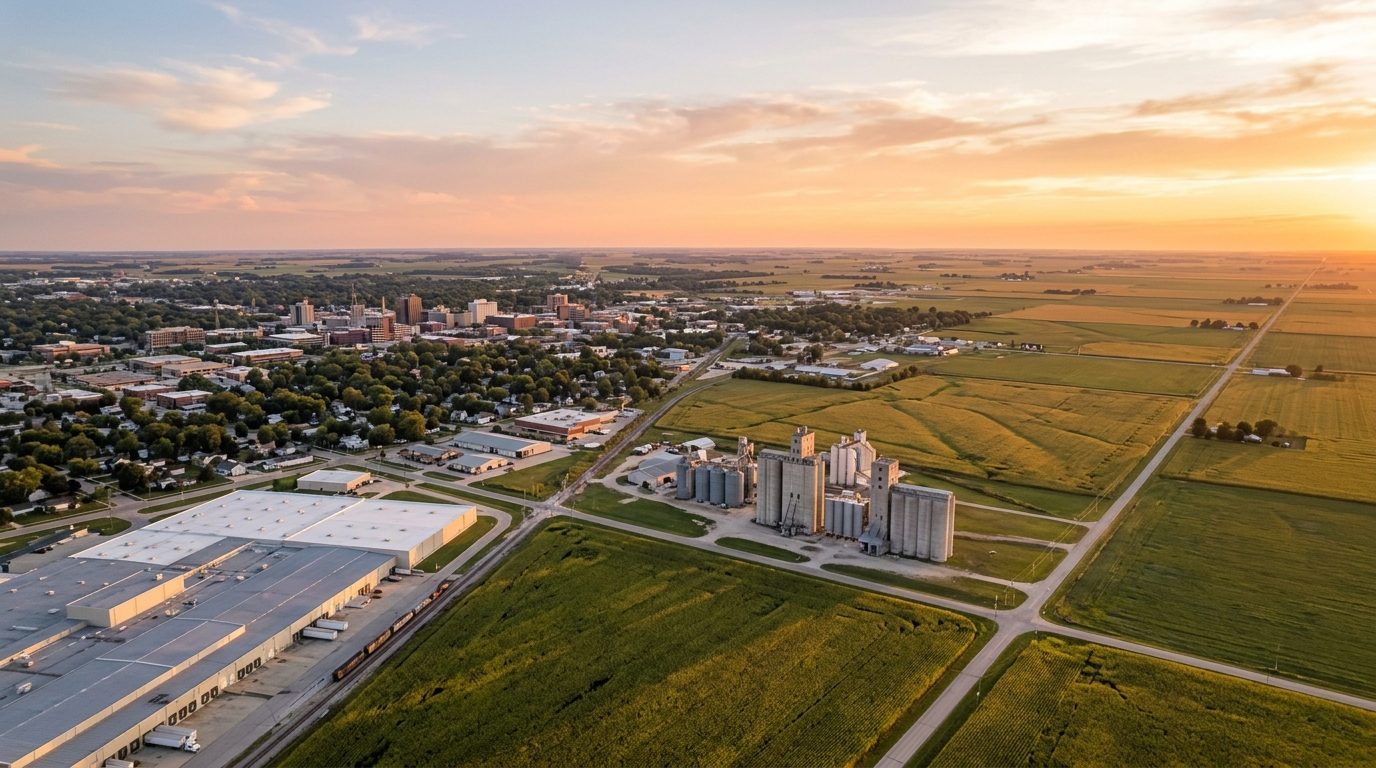
Bloomington and Normal form a contiguous twin-city core on the flat-to-gently-rolling prairie of central Illinois’s Corn Belt, surrounded by small agricultural towns — Le Roy, Chenoa, Heyworth, Colfax, Danvers and others — that remain distinctly rural and farm-oriented. Housing stock in Bloomington’s historic core includes 19th-century Victorian, Queen Anne and Italianate homes, layered with early-to-mid-20th-century bungalow and craftsman neighborhoods and large tracts of late-20th-century and 2000s-era subdivisions in north Normal and east Bloomington. A more recent wave of new construction has followed rapid population growth tied to the metro’s largest new employer. Uptown Normal stands apart as a deliberately redeveloped, dense, mixed-use district built around a circular public plaza since the early 2000s, a walkable New Urbanist contrast to the metro’s otherwise low-density, car-oriented pattern.
Newer construction and amenity access shape the top of the local market. North Normal, near Illinois State University and the Ironwood golf course, favors larger lots and newer homes and tends to command a premium, and Uptown Normal carries a premium of its own for walkability, mixed-use retail and rail access. Bloomington’s historic districts offer architectural character and mature streetscapes close to downtown, generally on smaller and older lots than the newer suburban product. The metro’s outlying agricultural towns are structurally more affordable, reflecting longer commutes to the Bloomington-Normal job core and smaller, older housing stock with fewer local amenities. Rapid recent hiring at the area’s newest major employer has tightened inventory broadly across the metro, compressing what was once a clearer gap between starter and move-up areas as buyers compete for a limited number of listings.
State Farm, the insurance company, has been headquartered in Bloomington for generations and remains the metro’s largest single employer, though it is consolidating its Bloomington campuses onto one site by the end of 2027, a change worth knowing about for anyone tracking local commercial real estate. Rivian operates its flagship electric-vehicle manufacturing plant in Normal, in a former auto-manufacturing facility, and has been expanding both the plant and a nearby supplier park as it ramps up production — the company’s rapid hiring has been a primary driver of the metro’s recent population and housing growth. Illinois State University and Illinois Wesleyan University anchor higher education in Normal and Bloomington respectively, and Carle BroMenn Medical Center in Normal and OSF St. Joseph Medical Center in Bloomington are the metro’s two hospital systems.
Illinois carries property tax rates well above the national average, and McLean County is no exception; because rates depend on the specific overlapping school, park, library and other taxing districts a parcel falls within, buyers should verify the exact taxing bodies for any address rather than assume a countywide rate. McLean County has recorded more confirmed tornadoes than any other county in Illinois, reflecting its position in the state’s severe-storm corridor, so buyers should ask about basements or storm shelters and confirm wind and hail coverage on any homeowners policy. Flood risk here is localized to isolated floodplain parcels near small creeks rather than a metro-wide concern, unlike river-adjacent markets. Given how much of the metro’s recent growth traces to a single large employer’s rapid expansion, buyers should also weigh that concentration when thinking about long-term demand.
Cities and Towns in the Bloomington Metro Area
Notable Communities and Neighborhoods
Bloomington Real Estate Market FAQ
How is the Bloomington-Normal market organized?
The metro centers on the twin cities of Bloomington and Normal, which form one contiguous urban core, surrounded by small agricultural towns such as Le Roy, Chenoa, Heyworth and Colfax that remain distinctly rural and function as their own smaller, separate housing markets.
Which parts of the Bloomington-Normal area tend to be pricier?
North Normal, near Illinois State University and the Ironwood golf course, and the Uptown Normal district, with its walkable mixed-use redevelopment, both tend to command a premium. The metro’s outlying agricultural towns are generally the most affordable part of the market.
What should buyers verify locally in Bloomington-Normal?
Because Illinois property tax rates depend on which overlapping school, park, library and other taxing districts a parcel falls within, buyers should verify the exact taxing bodies for any address rather than assume one countywide rate. It’s also worth asking whether a home has a basement or storm shelter, given the area’s tornado history.
What’s a region-specific risk to know about in Bloomington-Normal?
McLean County has recorded more confirmed tornadoes than any other county in Illinois, so severe spring and summer storms are a real, recurring consideration here. Much of the metro’s recent housing demand also traces to rapid hiring at one large employer, which is worth factoring into any long-term view of local market conditions.
Nearby Markets