
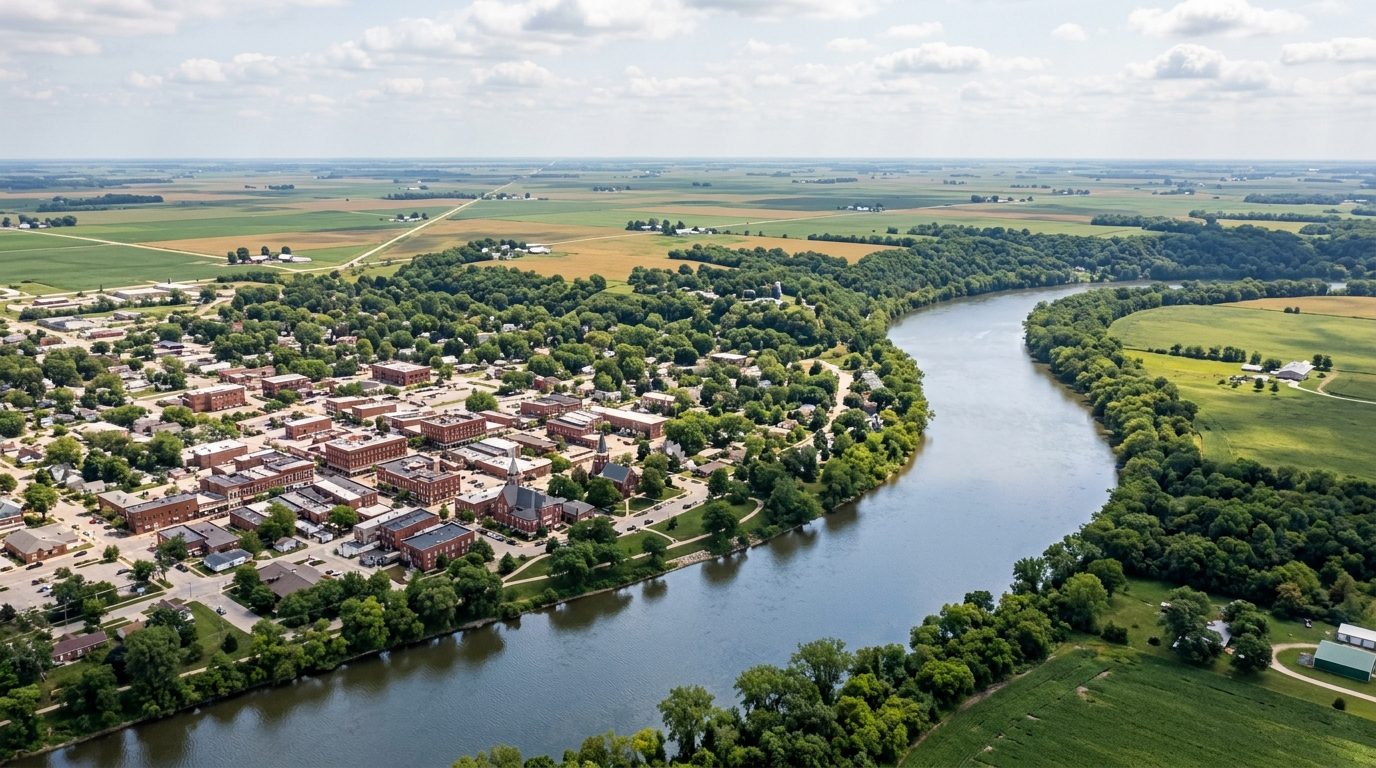
Current real estate market data, news and analysis for the Kankakee, IL metropolitan area — 105,525 residents across Kankakee county.
Data as of May 2026. Sources: Redfin Data Center, U.S. Census Bureau.
Latest Kankakee Real Estate News
Coverage of this market is coming soon. Browse all housing market news.
Kankakee Real Estate Market Overview
Kankakee County sits on the Illinois prairie along the Kankakee River, about an hour south of downtown Chicago via Interstate 57. Flat farmland dominates the county, giving way to a wooded river valley near the county seat of Kankakee, where the river bends past forest preserves and the city’s historic core. Housing stock mirrors this layered history: Kankakee itself retains blocks of early twentieth-century Prairie-style and Craftsman homes in its riverside historic district alongside postwar bungalows and ranches. Bradley, Bourbonnais, and Manteno carry newer subdivisions built out over recent decades, while smaller towns such as Herscher, Momence, St. Anne, and Grant Park mix in-town housing with farmsteads and acreage on the agricultural fringe.
Bourbonnais and Manteno tend to sit toward the higher end of the local price range. Both lie along the Interstate 57 corridor that carries commuters toward Chicago, and both have newer housing stock and schools that rank favorably against neighboring districts; Bourbonnais also benefits from Olivet Nazarene University, which anchors steady nearby housing demand. The city of Kankakee spans a wider range: its riverside historic district, home to a pair of Frank Lloyd Wright houses and large architect-built homes along the river, holds value on distinctive older housing and mature streets, while other parts of the core city carry softer values tied to older housing stock. Smaller river and farm towns such as Momence, St. Anne, and Grant Park price more modestly, reflecting rural character and longer commutes, though river frontage carries its own premium.
The local economy rests on manufacturing, food processing, health care, and higher education rather than one dominant industry. Riverside Healthcare and St. Mary’s Hospital anchor health care, while CSL Behring operates a major biotechnology and plasma manufacturing plant in the county. Steelmaker Nucor Steel and machine-tool maker Peddinghaus Corporation represent a long-standing metals and machining base, and food processors including Van Drunen Farms and Silva International draw on surrounding farmland. Olivet Nazarene University and Kankakee Community College are significant employers and steady sources of housing demand in Bourbonnais and Kankakee. An electric-vehicle battery manufacturer, Gotion, has more recently begun operations in the county, part of a push by county and state economic development agencies to expand advanced manufacturing along the Interstate 57 corridor.
Buyers should weigh several local factors. Property along the Kankakee River and its tributaries can sit within mapped floodplain, and the river is prone to periodic ice-jam flooding in winter and early spring, so flood zone status and insurance requirements are worth confirming with the county before closing. Illinois carries a comparatively heavy property tax burden statewide, and rates vary by taxing district and municipality within the county, so buyers should check the specific tax bill for a parcel rather than assume a countywide rate. Public transit is limited: Amtrak trains call at the historic Kankakee depot, and River Valley Metro runs local buses through Kankakee, Bradley, Bourbonnais, and Manteno, but most residents rely on cars and Interstate 57 to reach Chicago. County zoning protects farmland from scattered development, so rural buyers should verify well and septic systems, drainage tile, and road maintenance responsibility before purchasing acreage.
Cities and Towns in the Kankakee Metro Area
Notable Communities and Neighborhoods
Kankakee Real Estate Market FAQ
How is the Kankakee, Illinois metro area organized geographically?
The metro centers on the city of Kankakee, the county seat, situated where the Kankakee River curves through the county roughly an hour south of Chicago. Immediately north and east of the city sit the villages of Bradley and Bourbonnais, which have grown together with Kankakee into a connected urban core along the river and Interstate 57. Manteno lies further north along the interstate as a separate commuter-oriented village, while the rest of the county spreads into farm townships and small agricultural towns like Momence, St. Anne, Herscher, Grant Park, and Bonfield, each built around a historic downtown and a rail or highway crossing.
Which parts of the Kankakee area tend to be more expensive, and why?
Bourbonnais and Manteno generally command higher prices because of newer housing stock, direct access to Interstate 57 for a Chicago commute, and schools that are generally well regarded relative to the rest of the county. Kankakee’s riverside historic district also holds a premium for its distinctive older architecture, including homes designed by Frank Lloyd Wright, and its setting along the river. Older sections of the core city and the smaller outlying farm towns tend to price lower, reflecting aging housing stock, longer commute times, and smaller local buyer pools.
What should a buyer verify locally before purchasing in Kankakee County?
Because tax rates, school district boundaries, and municipal services vary from one town to the next in this area, buyers should confirm the specific property tax bill, taxing district, and school assignment for any address rather than relying on countywide assumptions. In unincorporated areas and smaller towns, it is also worth confirming whether a property relies on a private well and septic system, its floodplain status if it is near the Kankakee River or a tributary, and who is responsible for maintaining the access road or drainage tile on rural parcels.
Is flooding a concern in the Kankakee, Illinois area?
Yes, in specific locations. The Kankakee River and its tributaries flood periodically, including ice-jam flooding in winter and early spring that can raise river levels quickly in low-lying areas near the water. Properties directly along the river or within its floodplain should be checked against official flood maps and may require flood insurance, while land set back from the river is generally not affected. Much of the surrounding county is also active farmland, so buyers on the rural fringe should ask about drainage tile, tiling easements, and any agricultural use restrictions that could affect a parcel.
Nearby Markets