
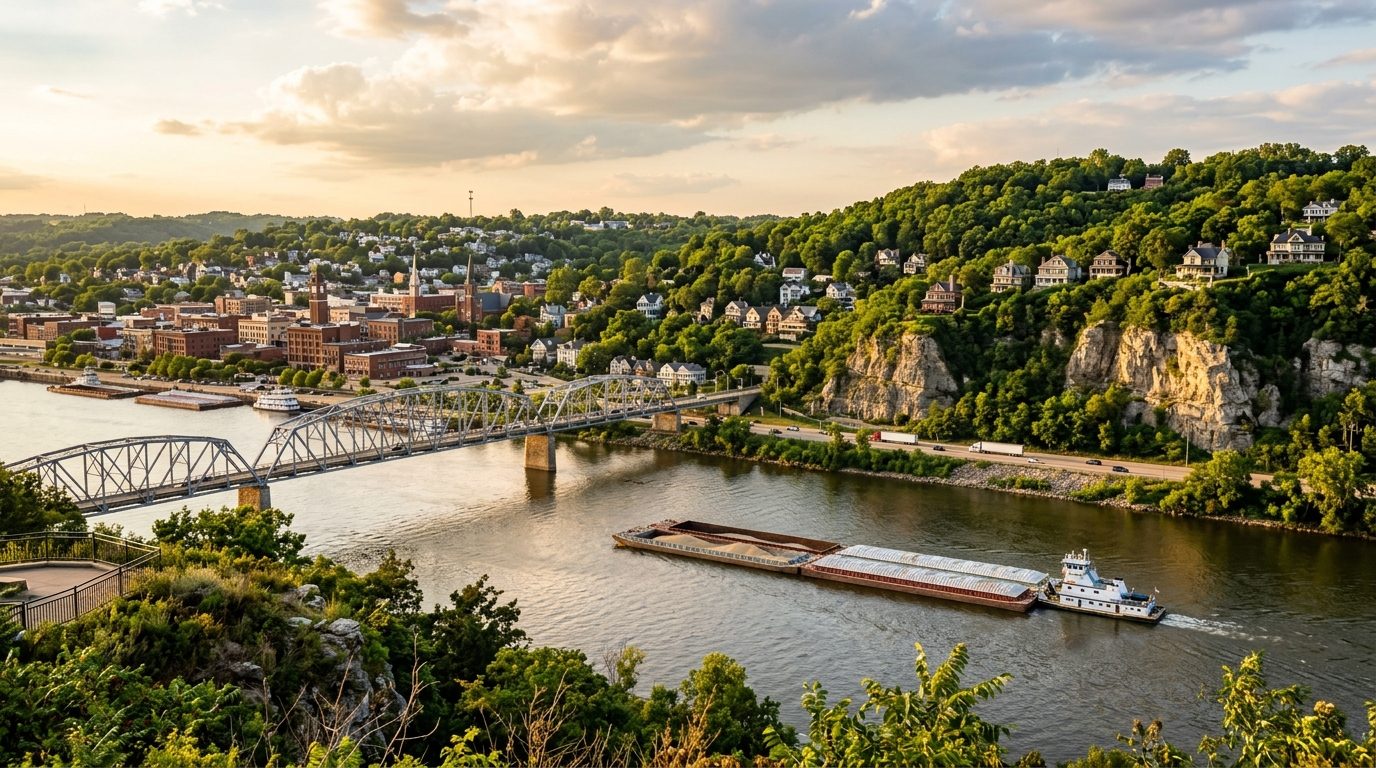
Current real estate market data, news and analysis for the Dubuque, IA metropolitan area — 99,381 residents across Dubuque county.
Data as of May 2026. Sources: Redfin Data Center, U.S. Census Bureau.
Latest Dubuque Real Estate News
Coverage of this market is coming soon. Browse all housing market news.
Dubuque Real Estate Market Overview
Dubuque sits where Iowa, Illinois, and Wisconsin meet along a bend of the Mississippi River, with limestone bluffs rising steeply behind downtown while flatter ground hugs the riverfront and the old rail and industrial corridors. The terrain shapes the street pattern: narrow roads climb the bluffs, and neighborhoods step down the hillsides toward the water. Housing stock reflects this layered history — Victorian-era frame houses with wraparound porches, Italianate brick rowhouses, and limestone cottages built directly into hillsides sit alongside converted warehouse lofts in the old Millwork District near downtown. Outside the city, the surrounding county is dotted with small agricultural towns such as Cascade, Farley, Epworth, and New Vienna, where housing leans toward farmhouses, ranch homes, and modest mid-century construction rather than the ornate bluff-front styles found in Dubuque proper.
Within the metro, the bluff-top historic districts closest to downtown — areas such as the Cathedral Historic District, Jackson Park, and Fenelon Place — carry a premium tied to river views, walkability, and architectural character, though many homes there require ongoing upkeep given their age and hillside foundations. The fast-growing suburbs of Asbury and Peosta, west of the city, also trend toward the higher end, but for different reasons: newer construction, larger lots, and newer schools rather than historic pedigree. Older, flatter residential blocks nearer downtown and the industrial riverfront, along with smaller outlying farm towns farther from Dubuque’s job centers, tend to sit toward the lower end, reflecting smaller lots, older mechanical systems, or longer commutes to main employers.
The area’s economy centers on manufacturing, insurance, healthcare, and education. John Deere Dubuque Works, a long-established plant producing construction and forestry equipment, is among the region’s largest employers. Cottingham & Butler, an insurance and risk-management firm headquartered in Dubuque, anchors a sizable financial-services presence. Healthcare runs through MercyOne Dubuque Medical Center and UnityPoint Health–Finley Hospital, both major local employers. Higher education plays an outsized role for a metro this size: Loras College, the University of Dubuque, and Clarke University are all based in the city and cooperate through a long-standing tri-college arrangement. Tourism tied to the riverfront, including the National Mississippi River Museum & Aquarium and the Port of Dubuque’s casino and event venues, supports hospitality jobs, and Dyersville, in the county’s eastern part, draws visitors to the Field of Dreams movie site.
Because Dubuque sits directly on the Mississippi River, flood risk is a real and recurring local factor; a permanent floodwall and levee system protects downtown and the Port of Dubuque, and buyers near the riverfront or in low-lying blocks should check flood-zone status and any history of high water before purchasing. Property tax rates and assessment practices vary between the City of Dubuque and the smaller incorporated towns in the county, so buyers should confirm current assessments with the county assessor rather than assume consistency. The city runs its own public transit system, the Jule, though a personal vehicle is effectively necessary outside the urban core. Development patterns also differ: the historic bluff neighborhoods operate under preservation guidelines governing exterior changes, while the growing western suburbs are shaped by ongoing annexation and infrastructure extension. Buyers looking at the county’s smaller towns should also verify well and septic status, since municipal water and sewer service is not universal outside the larger incorporated cities.
Cities and Towns in the Dubuque Metro Area
Notable Communities and Neighborhoods
Dubuque Real Estate Market FAQ
How is the Dubuque, Iowa metro area organized geographically?
The metro centers on the city of Dubuque, which sits along a bend of the Mississippi River at the point where Iowa, Illinois, and Wisconsin meet. Limestone bluffs rise behind the downtown core, and older neighborhoods step down the hillsides toward the riverfront. Beyond the city, Dubuque County spreads west and south into rolling farmland dotted with small incorporated towns, including fast-growing suburbs just outside city limits and older agricultural communities farther out.
Which parts of the Dubuque metro tend to be pricier, and why?
Historic bluff-top neighborhoods close to downtown, known for river views, walkable streets, and older architecture, tend toward the higher end because of their location and character, even though many homes there need ongoing upkeep. The growing western suburbs also trend higher, but for a different reason: newer construction, larger lots, and newer infrastructure. Older residential blocks nearer the industrial riverfront and smaller farm towns farther from the city’s job centers tend to sit lower, largely due to age of construction and commute distance.
What should buyers verify before purchasing property in the Dubuque area?
Buyers should confirm flood-zone status and any history of high water for property near the riverfront or in low-lying areas, check current property tax assessments with the county assessor since rates and practices vary between the city and smaller incorporated towns, and verify well and septic status for homes in outlying towns where municipal water and sewer service is not universal. In the historic bluff districts, it is also worth checking whether a property falls under preservation guidelines that govern exterior changes.
Is river flooding a concern for property in Dubuque?
Yes. Dubuque sits directly on the Mississippi River, and periods of high water are a recurring regional reality. The city maintains a permanent floodwall and levee system that protects downtown and the Port of Dubuque, but property outside that protected area, or in low-lying sections near the river, can carry flood exposure. Buyers should check flood-zone designations and ask about flood insurance requirements before purchasing in or near the riverfront.
Nearby Markets