
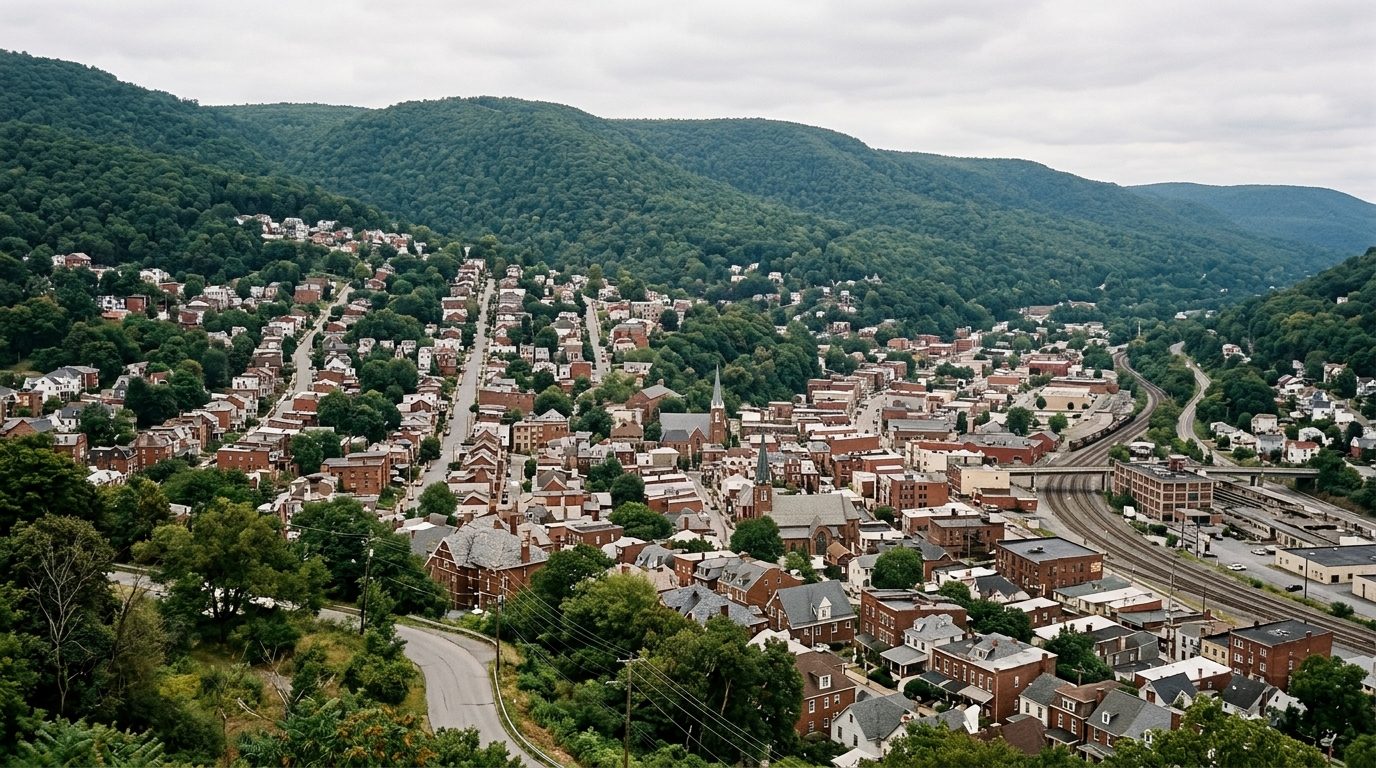
Current real estate market data, news and analysis for the Altoona, PA metropolitan area — 119,541 residents across Blair county.
Data as of May 2026. Sources: Redfin Data Center, U.S. Census Bureau.
Latest Altoona Real Estate News
Coverage of this market is coming soon. Browse all housing market news.
Altoona Real Estate Market Overview
Altoona sits in a mountain valley of the Allegheny Front in central Pennsylvania, where the terrain folds into steep ridgelines and narrow hollows that shaped the city’s grid-and-hillside street pattern. The city grew up around the Pennsylvania Railroad’s repair shops, and its core neighborhoods still read as a working rail town: dense blocks of rowhouses, foursquares, and modest single-family frame homes built close to the street, many dating to the late nineteenth and early twentieth centuries. Surrounding boroughs and townships spread up the valley floors and onto the lower slopes, where lot sizes open up and postwar and newer construction becomes more common. The overall housing stock skews older than in much of the state, with brick and frame construction predominating in the city itself.
Within the metro, price tiers generally track distance from the historic industrial core and proximity to open, buildable land. Neighborhoods closest to the old rail yards and downtown, where lots are small and homes were built for shop workers a century ago, tend to sit at the lower end of the market. Higher-priced housing is more common in boroughs and townships south and east of the city, such as Hollidaysburg and the surrounding township land, where wider lots, newer subdivisions, and stronger school district reputations draw a premium. Areas with mountain or valley views, or those set back from the flood-prone streams that cut through the city, also tend to command more.
Health care anchors the local economy, led by the region’s dominant hospital system based in Altoona, which draws patients and staff from well beyond Blair County. Education is another pillar, with Penn State’s Altoona campus and the Altoona Area School District among the area’s larger employers. The railroad that built the city never fully left: Norfolk Southern still operates a major locomotive repair shop on the old Pennsylvania Railroad Juniata Shops site, preserving a direct link between the region’s rail past and its present-day job base. Convenience-store chain Sheetz, founded in the area and still headquartered nearby, maintains substantial operations and corporate functions in the region. Manufacturing, retail distribution, and food processing round out an economy still rooted in blue-collar tradition.
Terrain shapes daily life here in ways that go beyond geography lessons. Several streams running through the city sit within mapped flood hazard areas, a legacy of a valley floor built up tightly around waterways long before modern floodplain rules existed, and buyers in low-lying sections should factor that into their due diligence. The area’s older housing stock brings the usual considerations of century-old construction: dated wiring and plumbing, aging roofs, and a need for updated systems in homes that have not been renovated. On the upside, property tax burdens in the region tend to run below the statewide median. Winters bring meaningful snow given the elevation and mountain exposure, and the steep streets common in older neighborhoods can complicate access during bad weather.
Cities and Towns in the Altoona Metro Area
Notable Communities and Neighborhoods
Altoona Real Estate Market FAQ
What is the Altoona, PA metro area known for?
Altoona grew up as a company town for the Pennsylvania Railroad, which built major locomotive and railcar repair shops there in the 1800s, including the famous Horseshoe Curve that let trains climb the Allegheny Mountains. That railroading heritage still shapes the city’s identity, layout, and job base today.
What towns and areas make up the Altoona metro area?
The metro is anchored by the city of Altoona in Blair County and includes surrounding boroughs and townships such as Hollidaysburg, Duncansville, Bellwood, Tyrone, Roaring Spring, Martinsburg, Newry, and Williamsburg, along with the townships between them.
What is the housing stock like in the Altoona area?
Housing in the city core tends to be older, with rowhouses, foursquares, and early twentieth-century frame homes built on narrow lots close to the street. Outlying boroughs and townships have a wider mix of ages, including more recent construction on larger lots.
Is the Altoona area urban, suburban, or rural?
It’s a mix. The city of Altoona has a dense, historic urban core built around its former rail yards, while the surrounding boroughs and townships range from small-town main streets to rural, mountainous countryside typical of central Pennsylvania.
Nearby Markets