
Current real estate market data, news and analysis for the State College, PA metropolitan area — 157,393 residents across Centre county.
Data as of May 2026. Sources: Redfin Data Center, U.S. Census Bureau.
Latest State College Real Estate News
Coverage of this market is coming soon. Browse all housing market news.
State College Real Estate Market Overview
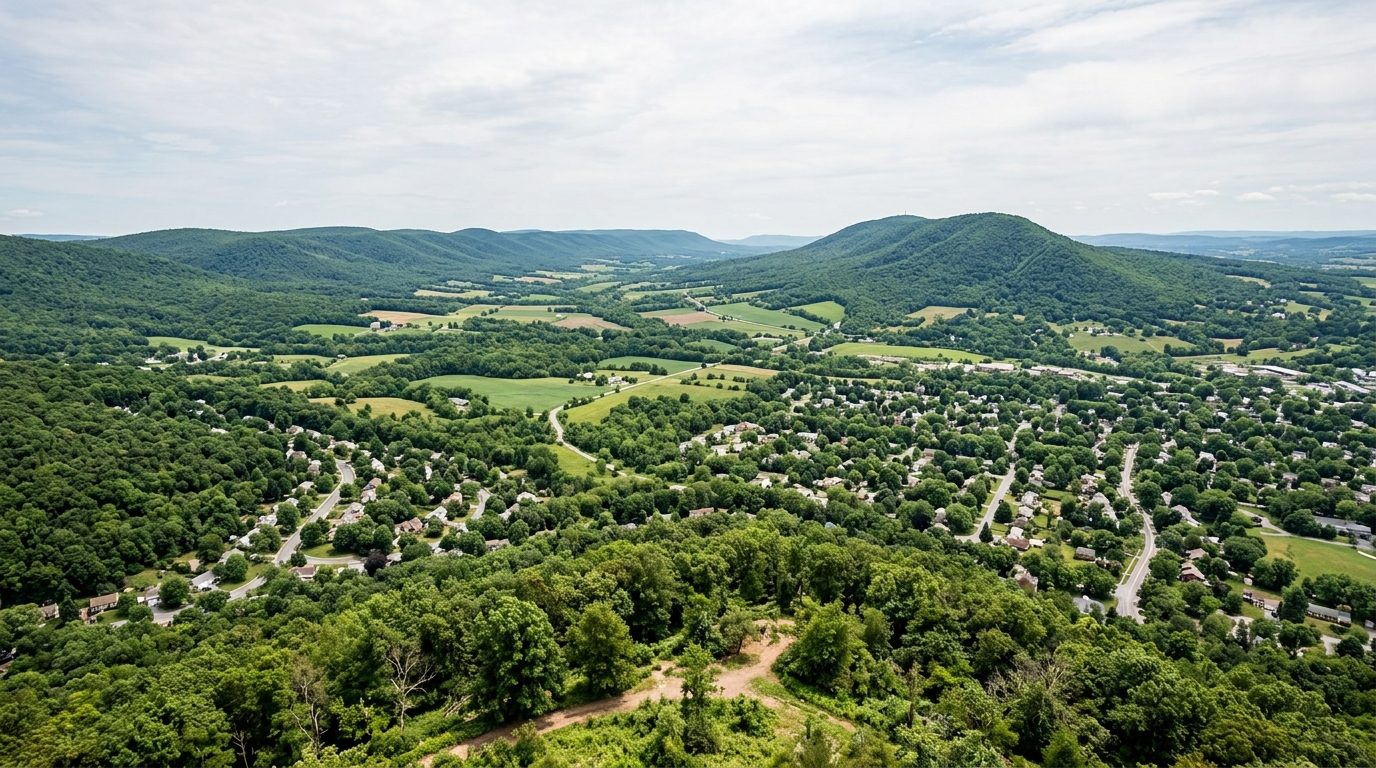
State College sits in the Nittany Valley, a trough within Pennsylvania’s ridge-and-valley Appalachian province, bounded by Bald Eagle Mountain to the northwest and Tussey Mountain to the southeast, with the freestanding rise of Mount Nittany anchoring the valley’s northern end. The terrain drives settlement patterns: State College borough occupies flat valley floor around Penn State’s University Park campus, while surrounding townships climb gradually toward wooded ridgelines before opening into farmland in the valley’s outer folds. Housing stock layers accordingly — streets nearest campus carry early-twentieth-century Colonial Revival, Tudor, and bungalow houses on compact lots; the first ring of suburbs holds mid-century ranches and split-levels; and outlying townships and boroughs mix newer colonials, planned-community duplexes, and larger-lot construction.
Price tiers track proximity to campus and to Mount Nittany’s slopes more than any single factor. Walkable neighborhoods near downtown and the university, tree-canopied, sidewalked, with older porch-front houses, carry a premium for convenience even on small lots. Golf-course and amenity-based planned communities on the borough’s edges add a premium for recreation access and curated streetscapes. Land grows cheaper and homes larger farther into the surrounding townships and outlying boroughs, where acreage, mountain views, and distance from campus trade against a longer commute. The historic county-seat borough northeast of State College forms its own tier: Victorian-era houses on tree-lined streets, generally priced below comparable homes nearer campus but requiring more restoration awareness.
The regional economy centers on Pennsylvania State University’s University Park campus, which drives employment directly through instruction, research, and administration, and indirectly through the restaurants, retail, hotels, and services supporting students, visiting families, and athletics and conference traffic. The largest employer outside higher education is the not-for-profit hospital system headquartered in State College, which operates the area’s main acute-care hospital and a network of physician practices. State government offices, Centre County government, the local public school district, and a major heavy-construction and materials company round out the area’s largest workforces, alongside a regional clinic affiliated with a larger central-Pennsylvania health network. Because so much economic activity ties back to the university, hiring and housing demand both follow the academic calendar.
Buyers should expect a valley climate, persistent fog, heavier snowfall than nearby lowland cities, and icy hillside roads in winter, though the area is well inland with no coastal storm or hurricane exposure. Property taxes are set locally through county, municipal, and school district millage, and rates vary between the borough, surrounding townships, and outlying boroughs, so confirming the applicable school district before comparing homes across town lines matters. Public transit centers on a campus-focused bus network serving the borough and inner townships well, but thins quickly in rural areas where a vehicle becomes necessary. The rental market is shaped heavily by the student population, with demand and short-term rates spiking around the academic calendar and home football weekends, and many near-campus properties operating as long-term student rentals rather than owner-occupied homes. Outlying townships and villages more often rely on private wells and on-lot septic systems rather than municipal service, so buyers there should verify well yield and septic history before purchase.
Cities and Towns in the State College Metro Area
Notable Communities and Neighborhoods
State College Real Estate Market FAQ
How is the State College housing market organized geographically?
The metro centers on State College borough, home to Penn State’s University Park campus, and is ringed by suburban townships including Ferguson, Patton, College, and Harris. Beyond that inner ring sit smaller boroughs and villages such as Bellefonte (the Centre County seat), Philipsburg, Milesburg, Port Matilda, Howard, Snow Shoe, Centre Hall, Millheim, and Unionville, along with the rural farmland and mountain terrain that separates them. Each municipality sets its own zoning and tax rates, so location within this borough-township-village structure matters as much as square footage.
Which parts of the State College area tend to be pricier, and why?
Walkable neighborhoods close to downtown and campus carry a premium for convenience despite smaller lots, and golf-course or amenity-based planned communities on the borough’s edges add a premium for recreation access. Prices generally ease with distance from campus, as outlying townships and villages trade walkability for acreage, mountain views, and quieter surroundings. The Victorian-era housing stock in the historic county seat northeast of State College forms a distinct, generally lower-priced tier shaped by the home’s age rather than distance alone.
What should buyers verify locally before purchasing in the State College area?
Confirm which municipality and school district a property sits in, since tax millage and zoning differ borough by borough and township by township. In the university-adjacent boroughs, check whether a property is used as a long-term rental and what that means for condition and turnover. In the surrounding rural townships and villages, verify whether the home relies on a private well and on-lot septic system, and review any available well-yield or septic inspection history, since municipal water and sewer do not reach many outlying areas.
How does Penn State’s student population and football schedule affect the local rental market?
A large share of housing near campus operates as long-term student rental stock rather than owner-occupied homes, which shapes turnover, maintenance patterns, and noise levels on those blocks. Demand for short-term lodging spikes sharply around home football weekends and major campus events, straining parking and traffic near the university even though it does not typically affect long-term rental leases, which run on the academic calendar rather than a month-to-month cycle.
Nearby Markets