
Current real estate market data, news and analysis for the Chambersburg, PA metropolitan area — 160,652 residents across Franklin county.
Data as of May 2026. Sources: Redfin Data Center, U.S. Census Bureau.
Latest Chambersburg Real Estate News
Coverage of this market is coming soon. Browse all housing market news.
Chambersburg Real Estate Market Overview
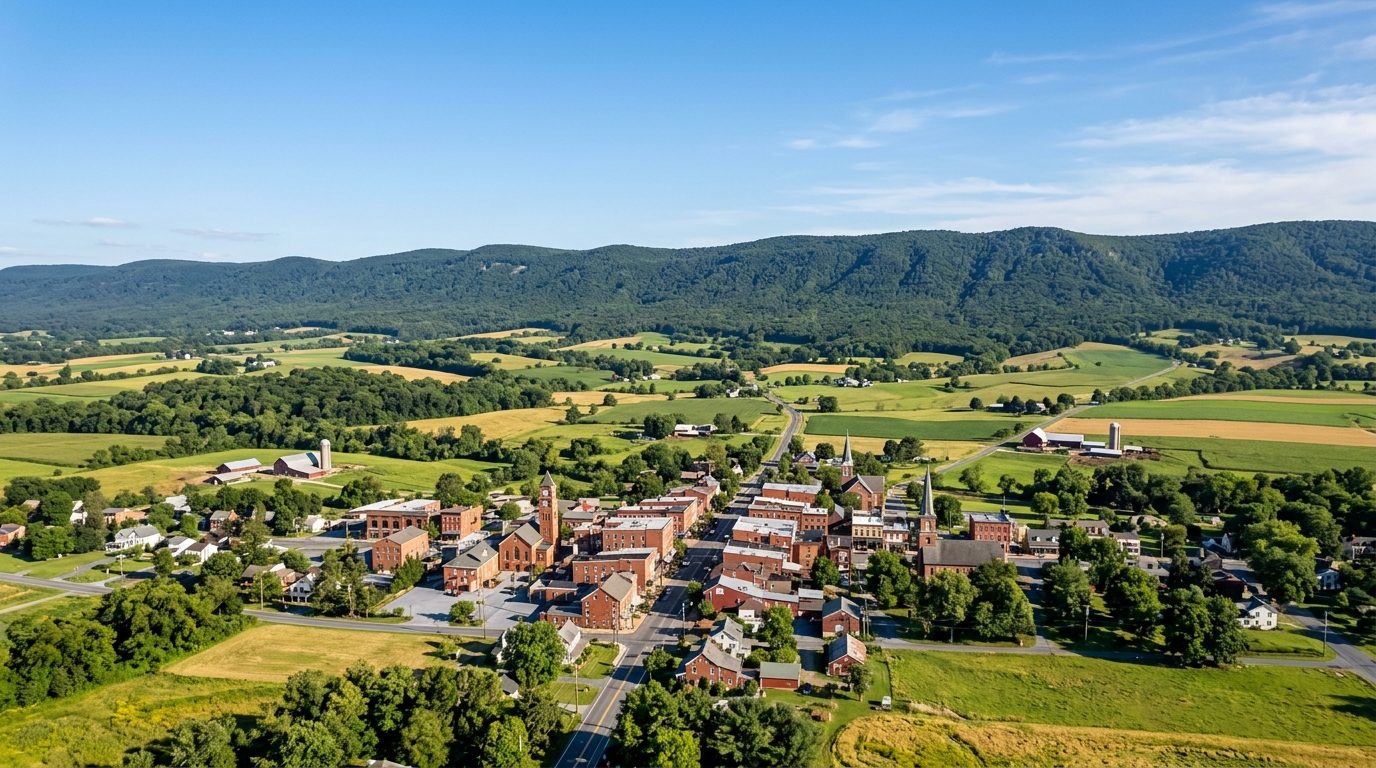
The Chambersburg metro sits in the Cumberland Valley, a broad limestone lowland within the Great Appalachian Valley, bounded by the forested ridge of South Mountain to the east and lower foothills toward the Tuscarora range to the west. Franklin County’s terrain is gently rolling to flat across the valley floor, drained by Conococheague Creek through Chambersburg and Antietam Creek through Waynesboro, with elevation rising near Caledonia State Park and Michaux State Forest. Chambersburg’s core retains a dense grid of brick rowhouses and Italianate and Georgian-style homes rebuilt after the town’s Civil War-era burning, radiating from its central square. Waynesboro carries a parallel legacy of modest worker housing tied to its machine-tool history. Outside the boroughs, farmhouses, ranch homes, and newer subdivisions built on former cropland dominate a landscape still shaped by active agriculture.
Price tiers track proximity to downtown cores, school reputation, and terrain. Homes within the Chambersburg and Waynesboro historic districts, walkable to shops and civic buildings, command a premium for architectural character despite smaller lots. The area around Mercersburg, home to a well-regarded private boarding school, and the higher-elevation cottage neighborhoods near Blue Ridge Summit and South Mountain, originally built as summer retreats for their cooler air and views, also sit toward the upper end given their seclusion and larger parcels. Newer subdivisions along the Interstate 81 corridor near Chambersburg draw a premium tied to commuter convenience. Rural crossroads villages and older sections of Waynesboro and Greencastle, farther from interstate access, tend to sit at the more affordable end.
The regional economy blends agriculture, manufacturing, logistics, and public-sector employment. Franklin County’s position along Interstate 81 has drawn distribution and manufacturing operations to industrial parks around Chambersburg, building on a long-standing base of metal fabrication and food processing. Summit Health, which operates Chambersburg Hospital, is among the area’s largest private employers, alongside the Chambersburg Area School District. Letterkenny Army Depot, a U.S. Army maintenance and logistics installation north of Chambersburg, is a major federal employer and a significant driver of the local labor market. Ventura Foods maintains manufacturing operations in the county, and Menno Haven operates a large continuing-care retirement community. Franklin County government, Wilson College, and Penn State’s Mont Alto campus add further institutional employment, while agriculture remains active across the valley.
Buyers should account for several local factors. Pennsylvania property taxes are set through overlapping county, municipal, and school district levies, so bills vary by township and school district even for comparable homes. Older sections of Chambersburg and Waynesboro along Conococheague and Antietam creeks carry flood exposure worth checking against current flood-zone mapping. Winters bring routine snow accumulation, so roof condition is worth confirming on older homes. Outside the boroughs, public water and sewer service is limited, and many rural properties rely on private wells and on-lot septic systems that require inspection and maintenance before closing. Homeowners associations are uncommon outside newer planned subdivisions. Public transit is minimal, and most residents rely on personal vehicles, with Interstate 81 serving as the primary commuting corridor. Much of the surrounding countryside remains under agricultural zoning or preservation easements, limiting new development in some townships.
Cities and Towns in the Chambersburg Metro Area
Notable Communities and Neighborhoods
Chambersburg Real Estate Market FAQ
How is the Chambersburg, PA metro area organized?
The metro corresponds to Franklin County, anchored by the county seat of Chambersburg, with secondary town centers in Waynesboro, Greencastle, and Mercersburg and smaller boroughs like Mont Alto and Orrstown. Each borough has its own local government and school district, and much of the county outside these town centers is unincorporated township land, so the market is really a set of small-town cores linked by farmland and Interstate 81 rather than one continuous suburban footprint.
Which parts of the Chambersburg area tend to be pricier, and why?
Homes inside the historic districts of Chambersburg and Waynesboro carry a premium for walkability and architectural character. The Mercersburg area draws buyers partly for its well-regarded private boarding school, and the higher-elevation neighborhoods near Blue Ridge Summit and South Mountain, originally built as summer retreat communities, command a premium for scenery, cooler summer air, and larger, more secluded lots. Newer subdivisions along the Interstate 81 corridor near Chambersburg also price higher for commuter access.
What should buyers verify locally before purchasing in this area?
Confirm which school district and township a property sits in, since boundaries do not always align with borough limits and affect both schools and tax bills. Check whether the home is served by public water and sewer or relies on a private well and on-lot septic system, and if so, request well yield and septic inspection records. Also check current flood-zone mapping for properties near Conococheague or Antietam Creek, and review local zoning or agricultural preservation easements on any parcel bordering farmland.
What is the main region-specific risk to be aware of in the Chambersburg area?
The most relevant local risk is flooding along the region’s creek corridors, particularly Conococheague Creek through Chambersburg and Antietam Creek through Waynesboro, which have a history of overtopping during heavy remnant tropical storms. Older homes built close to these waterways, especially in low-lying sections of the historic downtowns, should be checked against current FEMA flood-zone designations and any history of local flood insurance claims before purchase.
Nearby Markets